What the DHS Memo Means for Immigration Policy in 2026
Understand the latest DHS memo policies impacting immigration in 2026. Get critical insights and protect your rights. Contact Vasquez Law for a free consultation.
Published on February 19, 2026
Talk to an immigration attorney
Free call. A clear plan for your case.
Free & confidential · Se habla espanol · 24/7

Have questions? Talk to an attorney - free evaluation.
Call 1-844-967-3536Worried how the latest immigration news affects you?
Schedule a confidential case review with an immigration attorney - know exactly where you stand.
What the DHS Memo Means for Immigration Policy in 2026
Understanding the latest directives from the Department of Homeland Security (DHS) is crucial for anyone navigating the complex landscape of U.S. immigration law. A new DHS memo can significantly alter policies related to enforcement, detention, and processing, directly impacting individuals and families across North Carolina, Florida, and nationwide. Staying informed about these changes, especially in 2026, is the first step toward protecting your legal rights and securing your future. This guide provides a comprehensive overview of recent DHS memorandums and their implications for immigrants.
Need help understanding a recent DHS memo or navigating its impact on your immigration case? Our experienced attorneys are ready to fight for you. Se Habla Español.
Schedule Your Free Case Evaluation
Or call us now: 1-844-967-3536
Quick Answer: What is a DHS Memo?
A DHS memo is a directive issued by the Department of Homeland Security that provides guidance or sets policy for its component agencies, including USCIS, ICE, and CBP. These memorandums clarify how existing laws should be enforced or interpreted, often impacting immigration procedures, enforcement priorities, and eligibility criteria. Staying informed about the latest DHS memo is vital for immigrants and their legal representatives.
- DHS memos guide agencies like USCIS, ICE, and CBP.
- They define or clarify immigration enforcement and processing policies.
- A new memo can affect detention, asylum, and removal proceedings.
- Recent memorandums often reflect current administration priorities.
- Legal counsel is essential to interpret and respond to these changes.
Understanding the Impact of a DHS Memo on Immigration in 2026
Department of Homeland Security (DHS) memos serve as critical guidance documents that shape the day-to-day operations of various immigration agencies. These directives are not new laws, but rather interpretations or policy instructions on how to implement existing immigration statutes. For instance, a DHS memo might outline new priorities for immigration enforcement, affecting who is targeted for detention or deportation. This can have profound implications for individuals and communities, particularly in areas with significant immigrant populations like Charlotte, North Carolina, and throughout Florida.
In 2026, the landscape of immigration policy remains dynamic. Recent memorandums have focused on a range of issues, from border security measures to internal enforcement guidelines and the processing of asylum claims. For example, a DHS memo today might address the use of discretion in certain removal cases, or provide updated guidance on expedited removal procedures. Understanding the nuances of these documents is paramount, as they directly influence the strategies immigrants and their attorneys must adopt. Vasquez Law Firm closely monitors these developments to provide timely and effective advice.
Key Agencies and Their Roles
The DHS encompasses several key agencies, each playing a distinct role in immigration. U.S. Citizenship and Immigration Services (USCIS) handles benefit applications, such as visas, green cards, and naturalization. U.S. Immigration and Customs Enforcement (ICE) is responsible for enforcing immigration laws within the U.S. interior, including arrests and deportations. U.S. Customs and Border Protection (CBP) manages border security and inspections at ports of entry. A single DHS memo can influence all these agencies, creating a ripple effect throughout the immigration system.
Recent DHS Memo Highlights and Their Implications
The year 2026 has seen several significant DHS memos that have reshaped immigration practices. One notable DHS memo outlines a plan to detain refugees for further vetting, a policy that can impact asylum seekers arriving at the border. This type of directive underscores the heightened scrutiny individuals may face and the importance of having robust legal representation from the outset. Another significant directive, often referred to as a "DHS ICE memo," might detail new enforcement actions in or near protected areas, such as schools or hospitals, which are typically considered sensitive locations.
Furthermore, some memos have addressed the criteria for expedited removal, allowing certain non-citizens to be removed from the U.S. without a formal hearing before an immigration judge. The implications of such a DHS memo can be severe, as it limits due process protections. Immigrants facing these situations need immediate legal counsel to explore all available avenues for relief. Understanding these complex policy shifts is a core part of the services Vasquez Law Firm provides, helping clients in North Carolina and Florida navigate these challenging circumstances.
DHS Memo on Enforcement Priorities
A recent DHS memo has clarified enforcement priorities, directing ICE and CBP to focus resources on individuals who pose a threat to national security, public safety, or border security. While this may seem straightforward, the definitions of these categories can be broad and subject to interpretation. For instance, a minor criminal offense might be deemed a public safety threat under certain interpretations, leading to detention and removal proceedings. It is crucial to understand how these priorities apply to individual cases, especially for those with past legal issues or who have received a notice of intent to deport.
Navigating DHS Memo Changes: A Step-by-Step Approach
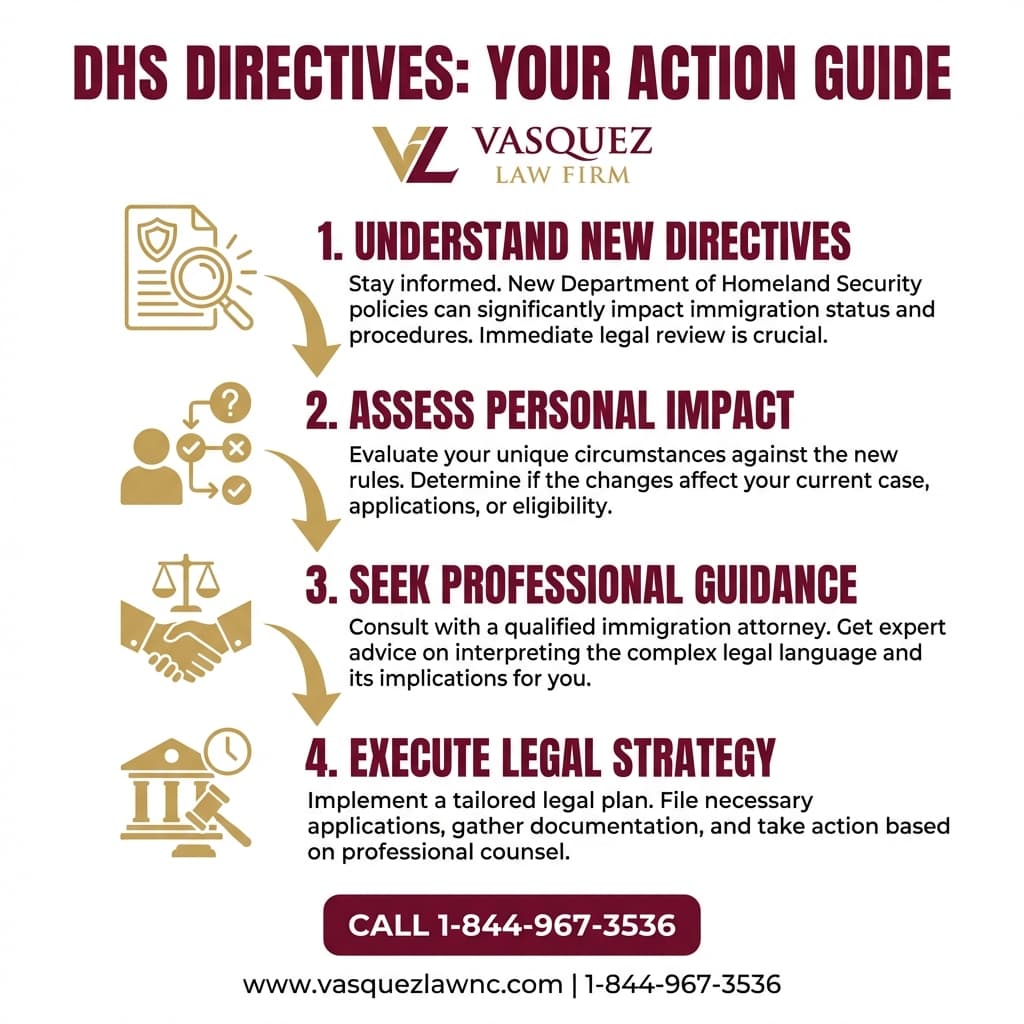
When a new DHS memo is announced, it can cause significant uncertainty and anxiety. Taking a proactive and informed approach is essential. The first step involves staying updated through reliable legal news sources and consulting with an experienced immigration attorney. Do not rely on rumors or unofficial information. An attorney can help you understand how a specific DHS memo might affect your current immigration status, pending application, or future plans.
Next, gather all relevant personal and immigration documents. This includes your identification, visa, green card, any notices from USCIS or ICE, and records of any past interactions with immigration authorities. Being prepared with accurate documentation allows your attorney to quickly assess your situation and formulate an effective strategy. Remember, the goal is to anticipate potential challenges and address them before they escalate.
- Stay Informed: Regularly check official government sources like USCIS (www.uscis.gov) and consult with immigration legal experts.
- Consult an Attorney: Seek immediate legal advice from an immigration lawyer who is knowledgeable about the latest DHS memo updates.
- Gather Documents: Compile all immigration-related documents, including applications, receipts, and correspondence with DHS agencies.
- Assess Your Status: Understand how the new memo specifically impacts your visa, green card, or asylum claim.
- Adjust Strategy: Work with your attorney to modify your immigration strategy or application process as needed.
- Prepare for Interviews/Hearings: If applicable, prepare thoroughly for any interviews or court appearances, understanding the new guidelines.
- Know Your Rights: Be aware of your rights during any interaction with ICE or CBP, especially concerning search, seizure, and detention.
Common Mistakes to Avoid with DHS Memo Updates
Mistakes when dealing with immigration policy changes can have severe consequences, including delays, denials, or even deportation. One of the most common errors is assuming that a new DHS memo does not apply to your case. Policies often have broad impacts, and what seems minor could be significant. Another frequent mistake is providing incomplete or inaccurate information on applications or during interviews, which can lead to accusations of fraud or misrepresentation. Always be truthful and thorough in all communications with immigration officials.
Ignoring deadlines is also a critical error. Immigration processes are notoriously strict with submission dates, and missing a deadline, especially for appeals or responses to Requests for Evidence (RFEs), can result in the automatic denial of your case. Furthermore, attempting to navigate complex legal changes without professional help is a significant risk. Immigration law is highly specialized, and the intricacies of a DHS memo require expert interpretation. Our team at Vasquez Law Firm helps clients in Charlotte and across North Carolina avoid these pitfalls, providing sound legal guidance.
- Ignoring New Memos: Do not assume a new DHS memo won't affect you. Policies can have far-reaching implications.
- Delaying Legal Counsel: Waiting to consult an attorney after a new policy is announced can lead to missed opportunities or irreversible errors.
- Providing Inaccurate Information: Always be truthful and complete in all immigration forms and interviews.
- Missing Deadlines: Strict deadlines apply to all immigration processes. Missing them can lead to automatic denials.
- Relying on Unofficial Sources: Only trust information from official government websites or verified legal professionals.
- Failing to Prepare for Interviews: Understand the current policies and be prepared to address them during any immigration interview.
- Not Knowing Your Rights: Be informed about your rights when interacting with immigration enforcement officers.
- Underestimating Complexity: Immigration law is complex; attempting to self-represent, especially with new policies, is risky.
If you only remember one thing: Always consult with an experienced immigration attorney immediately after a new DHS memo is announced to understand its specific impact on your case and to ensure compliance with the latest regulations. This proactive step can safeguard your immigration journey.
North Carolina, Florida, and Nationwide Immigration Notes
Immigration law in the United States is primarily federal, meaning that a DHS memo generally applies nationwide. However, the practical impact and enforcement of these policies can vary significantly from state to state and even locality to locality. In North Carolina, for instance, local law enforcement agencies may have agreements with ICE, such as 287(g) programs, which can influence how a DHS memo on enforcement priorities is implemented. This can lead to different experiences for immigrants in Charlotte compared to other cities.
Similarly, in Florida, specific state laws or local ordinances might interact with federal immigration policies in unique ways. The sheer volume of immigration cases in Florida also means that processing times and enforcement actions can be particularly sensitive to changes outlined in a DHS memo. Nationwide, these memos establish a baseline, but local conditions, resources, and judicial interpretations can create variations. Therefore, understanding both the federal directive and its regional application is key. Vasquez Law Firm serves clients across North Carolina and Florida, offering localized expertise within the federal framework.
Federal Immigration Framework
The U.S. immigration system operates under federal law, primarily governed by the Immigration and Nationality Act (INA). The Department of Homeland Security (DHS) is the lead agency responsible for enforcing and administering these laws. A DHS memo provides a standardized interpretation and implementation strategy across the country, aiming for consistency. However, the discretion given to individual officers and the varying resources of local ICE field offices can still lead to different outcomes based on geographic location.
When to Call an Immigration Lawyer Now
The moment you suspect a new DHS memo might affect your immigration status or if you receive any communication from an immigration agency, it is critical to contact an attorney immediately. Delays can be detrimental to your case. If you are facing deportation proceedings, have been detained by ICE, or are concerned about an upcoming interview, legal representation is not just advisable, it is essential. An attorney can intervene on your behalf, clarify your rights, and ensure you are not making any missteps that could jeopardize your future.
Furthermore, if you are considering applying for any immigration benefit, such as a visa, green card, or asylum, understanding the latest policies is paramount. A knowledgeable immigration lawyer can guide you through the application process, ensuring all documentation is correct and submitted on time, especially in light of any new DHS memo. Don't wait until it's too late; proactive legal counsel can make all the difference in achieving a positive outcome for your immigration journey.
- You receive a Notice to Appear (NTA) in immigration court.
- You or a family member is detained by ICE or CBP.
- You are seeking asylum or refugee status and a new DHS memo impacts vetting.
- Your visa or green card application is pending, and a new policy is announced.
- You have an upcoming interview with USCIS or other DHS agencies.
- You have a past criminal record and are concerned about enforcement priorities.
- You need to understand the implications of a specific DHS memo on your case.
- You are unsure if you qualify for an immigration benefit due to recent changes.
- You are considering appealing an adverse decision from an immigration agency.
- You believe your rights have been violated by immigration enforcement.
About Vasquez Law Firm
At Vasquez Law Firm, we combine compassion with aggressive representation. Our motto "Yo Peleo" (I Fight) reflects our commitment to standing up for your rights. We understand the profound impact that immigration issues have on individuals and families, and we are dedicated to providing personalized, effective legal solutions. Our Charlotte-based team, serving clients across North Carolina, Florida, and nationwide for immigration matters, is deeply committed to achieving the best possible outcomes.
- Bilingual Support: Se Habla Español - our team is fully bilingual, ensuring clear communication and understanding.
- Service Areas: We proudly serve clients in North Carolina, Florida, and provide nationwide immigration services.
- Experience: With over 15 years of dedicated experience, we have a proven track record in complex immigration, personal injury, and criminal defense cases.
- Results: Our firm has successfully handled thousands of cases, always prioritizing our clients' needs and fighting tirelessly for their justice.
Attorney Trust and Experience
Attorney Vasquez holds a Juris Doctor degree and is admitted to practice in both the North Carolina State Bar and Florida Bar. With over 15 years of dedicated legal experience, he has built a reputation for providing personalized attention and achieving favorable outcomes for his clients. He leads a team that is passionate about immigration law and committed to making a tangible difference in people's lives. You can learn more about our team and approach at our attorneys page.
Don't face your legal challenges alone. Our team is here to help you every step of the way, especially when navigating a new DHS memo.
Call today: 1-844-967-3536 | Se Habla Español
Frequently Asked Questions About DHS Memos
What is the purpose of a DHS memo?
A DHS memo provides internal guidance to Department of Homeland Security agencies like USCIS, ICE, and CBP. Its purpose is to clarify how existing immigration laws should be interpreted and enforced, ensuring consistency across operations. These memos help streamline processes, establish enforcement priorities, and adapt to evolving legal or operational needs. They are crucial for implementing the current administration's immigration policy objectives.
How does a DHS memo affect my pending immigration application?
A DHS memo can significantly impact your pending application by changing processing priorities, eligibility criteria, or the level of scrutiny applied to certain cases. For example, a memo might introduce new vetting procedures for asylum seekers or alter the discretion exercised by officers in waiver applications. It's essential to consult with an immigration attorney to understand how a specific memo could affect your individual application's status and outcome.
Are DHS memos legally binding?
DHS memos are generally legally binding on the agencies they instruct, but they are not laws themselves. They are policy directives that interpret and implement existing statutes and regulations. While they carry significant weight within the DHS, their legal authority can be challenged in court if they are deemed to exceed statutory authority or violate due process. They guide enforcement, but individuals still retain their legal rights under the INA.
How can I stay updated on new DHS memos in 2026?
To stay updated on new DHS memos in 2026, regularly check the official websites of the Department of Homeland Security (DHS), U.S. Citizenship and Immigration Services (USCIS), and Immigration and Customs Enforcement (ICE). Legal news outlets and reputable immigration law firms, like Vasquez Law Firm, also provide timely analysis and updates. Subscribing to government alerts or legal newsletters can ensure you receive critical information as it becomes available.
What is the difference between a DHS memo and an Executive Order?
An Executive Order is issued by the President and has the force of law, directing federal agencies on how to implement or enforce existing laws. A DHS memo, on the other hand, is issued by the Secretary of Homeland Security and provides internal guidance to agencies within the DHS. While both can influence immigration policy, Executive Orders are broader and higher-level directives, whereas memos are more specific operational instructions.
Can a DHS memo be challenged in court?
Yes, a DHS memo can be challenged in court, particularly if it is argued that the memo exceeds the statutory authority granted to the DHS, violates constitutional rights, or contradicts established legal precedents. Such challenges are often brought by civil rights organizations or immigrant advocacy groups. However, individual immigrants typically challenge the application of the memo to their specific case, rather than the memo itself, through an attorney.
Does a DHS memo on enforcement priorities mean I won't be deported?
A DHS memo on enforcement priorities provides guidance on which individuals ICE should prioritize for arrest and deportation. While it may indicate that certain low-priority individuals are less likely to be targeted, it does not guarantee immunity from deportation. Any non-citizen found to be removable under the Immigration and Nationality Act (INA) can still be subject to enforcement action. It is crucial to consult an attorney to assess your specific risk.
What should I do if a DHS memo changes asylum policy?
If a DHS memo changes asylum policy, it is imperative to seek immediate legal counsel from an experienced immigration attorney. Asylum laws are highly complex and sensitive to policy shifts. An attorney can explain how the new policy affects your eligibility, the evidence required, and the procedural steps for your asylum claim. They can help you adapt your application or strategy to comply with the latest requirements and protect your right to seek refuge.
How does a DHS memo impact DACA recipients?
A DHS memo can significantly impact DACA (Deferred Action for Childhood Arrivals) recipients, especially concerning renewal policies, eligibility requirements, or the program's overall future. While federal court decisions often dictate DACA's status, DHS directives provide operational guidance to USCIS regarding processing DACA applications. Recipients should remain vigilant about any new announcements and consult with an immigration attorney to understand how these changes might affect their deferred action status and work authorization.
Can a DHS memo affect border security operations?
Absolutely. A DHS memo frequently provides specific instructions to Customs and Border Protection (CBP) regarding border security operations. This can include directives on how to process individuals at ports of entry, implement new screening technologies, manage asylum claims at the border, or conduct enforcement actions in border regions. These memos are critical in shaping the operational strategies and priorities that CBP officers follow daily.
Sources and References
- U.S. Citizenship and Immigration Services (USCIS): Official government agency responsible for immigration benefits.
- Executive Office for Immigration Review (EOIR): Administers immigration courts and appellate review.
- U.S. Department of State: Provides information on U.S. visas and foreign policy.
Need immigration help? Our immigration attorneys can review your case.
Ready to take the next step? Contact Vasquez Law Firm today for a free, confidential consultation. We're committed to fighting for your rights and achieving the best possible outcome for your case, especially in light of the latest DHS memo updates.
Start Your Free Case Evaluation Now
Call us: 1-844-967-3536
Se Habla Español - Estamos aquí para ayudarle.

William Vasquez
Founder & CEO, Vasquez Law Firm, PLLC
William Vasquez is the founder and CEO of Vasquez Law Firm, PLLC, a results-driven firm specializing in immigration, criminal defense, personal injury, and workers' compensation. A U.S. Air Force veteran and recipient of the Joint Service Achievement Medal, William is dedicated to fiercely fighting for his clients' rights.
Related Legal Services
Need legal help? Learn more about how our immigration attorneys can help, or contact us for a free evaluation.
You can also visit immigration lawyers serving all of North Carolina for more information.


