What Happens When Workers' Comp Claims Are Denied in NC?
If your workers' comp claims are denied in North Carolina, you still have rights. Learn how to appeal a denial and protect your benefits in 2026. Contact Vasquez Law Firm for a free consultation.
Published on March 10, 2026
Hurt on the job?
Free review of your workers' comp claim.
Free & confidential · Se habla espanol · 24/7
Have questions? Talk to an attorney - free evaluation.
Call 1-844-967-3536Hurt on the Job? Claim What You Are Owed
A review of your workers' comp claim - we handle the fight.
What Happens When Workers' Comp Claims Are Denied in NC?
Receiving a denial for your workers' comp claims can be a devastating blow, especially when you're already dealing with a workplace injury and lost wages. In North Carolina, the process for filing a workers' compensation claim and appealing a denial can be complex and intimidating for injured workers. Many individuals in Smithfield and across the state find themselves unsure of their next steps after an initial rejection. Understanding your rights and the specific procedures involved is crucial to securing the benefits you need to recover and support your family in 2026. Vasquez Law Firm is here to help you navigate this challenging situation.
Need help with your denied workers' comp claims? Our experienced attorneys are ready to fight for you. Se Habla Español.
Schedule Your Free Case Evaluation
Or call us now: 1-844-967-3536
Quick Answer
When workers' comp claims are denied in North Carolina, you have the right to appeal the decision through the NC Industrial Commission. This typically involves filing specific forms, gathering medical evidence, and possibly attending hearings. Acting quickly and seeking legal guidance from an attorney can significantly improve your chances of overturning the denial and securing your entitled benefits.
- File Form 33 or 33.5 to initiate the appeal.
- Gather all medical records and evidence supporting your injury.
- Attend mediations or hearings as required by the Commission.
- Consult with an experienced workers' compensation attorney promptly.
- Understand the strict deadlines for filing appeals.
Understanding Denied Workers' Comp Claims in North Carolina
Many injured workers in North Carolina face the disheartening reality of having their workers' comp claims initially denied. Data from the NC Industrial Commission indicates that a significant percentage of claims receive an initial rejection for various reasons. This denial does not mean your case is over; instead, it marks the beginning of the appeals process. Employers or their insurance carriers often deny claims to minimize their financial liability, even if your injury is legitimate.
Common reasons for denial include disputes over whether the injury occurred in the scope of employment, lack of sufficient medical evidence, failure to report the injury within the required timeframe, or pre-existing conditions. For example, if you slipped and fell at work but your employer claims you were on a personal errand, your claim might be denied. It is essential to remember that these denials are frequently challenged and overturned with proper legal support. Understanding why your claim was denied is the first step toward building a strong appeal.
Common Reasons for Workers' Comp Claim Denials
Understanding why your workers' comp claims might be denied is crucial for preparing a strong appeal. Insurance companies and employers often cite specific grounds to reject claims, and knowing these can help you proactively address potential issues. For instance, if you didn't seek medical attention immediately after your injury, the insurer might argue that your injury wasn't severe or wasn't work-related.
One primary reason for denial is the employer disputing that the injury arose out of and in the course of employment. This means they argue your injury wasn't caused by your job duties or didn't happen while you were working. Another frequent reason is insufficient medical evidence; if your medical records don't clearly link your injury to a workplace accident, the claim can be rejected. Furthermore, missing deadlines for reporting your injury or filing your claim can lead to an automatic denial. Pre-existing conditions are also often used to deny benefits, with the insurer claiming your current injury is merely an exacerbation of an old problem rather than a new workplace injury.
Steps to Appeal Denied Workers' Comp Claims in NC
If your workers' comp claims have been denied, taking swift and strategic action is paramount. The appeals process in North Carolina is structured and has strict deadlines that must be met. The first critical step is to obtain a copy of the denial letter, which should outline the specific reasons for the rejection. This letter is your roadmap for addressing the insurance company's arguments.
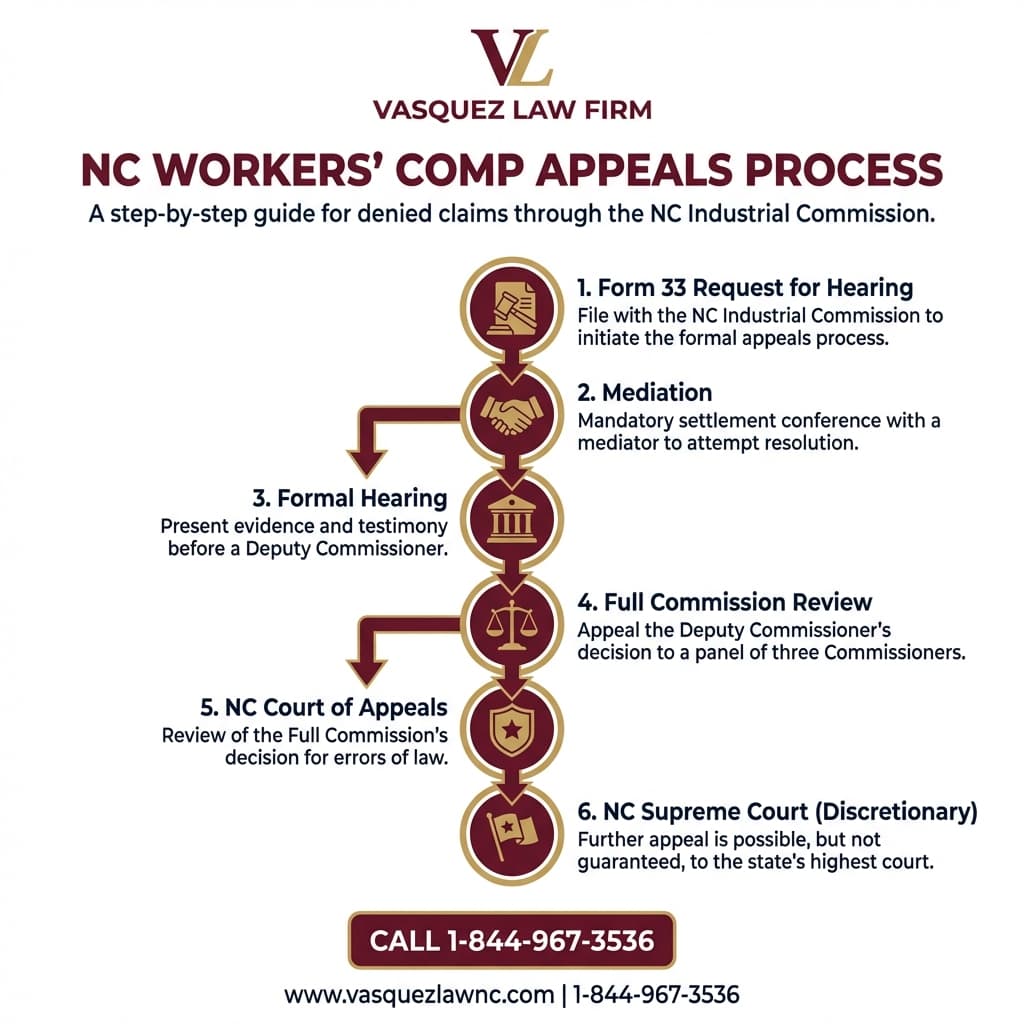
- File Form 33 or 33.5: To officially dispute the denial, you must file a Form 33, Request for Hearing, with the NC Industrial Commission. If your claim was accepted but then denied for specific treatments, you might file a Form 33.5, Discovery Request. This formal request initiates the appeals process, signaling your intent to challenge the insurer's decision.
- Gather Comprehensive Evidence: Collect all relevant medical records, doctor's notes, diagnostic test results, and any evidence linking your injury to your work. This includes witness statements, accident reports, and photos of the accident scene or your injuries. The more evidence you have to support your claim, the stronger your appeal will be.
- Participate in Mediation: The NC Industrial Commission often requires parties to attend mediation to attempt a settlement before a formal hearing. This is an opportunity to negotiate with the insurance company, potentially resolving the dispute without a lengthy court process. An attorney can represent you and advocate for your best interests during this crucial stage.
- Attend Hearings: If mediation is unsuccessful, your case will proceed to a formal hearing before a Deputy Commissioner of the NC Industrial Commission. This is similar to a trial, where both sides present evidence, call witnesses, and make legal arguments.
- Further Appeals: If you are unsatisfied with the Deputy Commissioner's decision, you can appeal to the Full Commission, and then potentially to the North Carolina Court of Appeals or even the NC Supreme Court. Each level of appeal has its own procedures and deadlines, making legal representation increasingly vital.
For more details on the appeals process, refer to the official North Carolina Industrial Commission website.
The NC Industrial Commission's Role
The North Carolina Industrial Commission (NCIC) plays a central role in resolving disputes related to workers' comp claims. This state agency oversees the administration of the North Carolina Workers' Compensation Act, ensuring fair treatment for injured workers and employers. When a claim is denied, the NCIC provides the forum for injured workers to appeal those decisions, offering a structured legal process for resolution. They administer mediations, hearings, and subsequent appeals, serving as an impartial body to interpret and apply the law.
Essential Documents and Evidence for Your Appeal
Successfully appealing denied workers' comp claims hinges on presenting a compelling case supported by robust evidence. Organizing and submitting the correct documentation is critical to proving your injury and its connection to your employment. Without these key pieces of evidence, even a legitimate claim can struggle to gain approval.
- Medical Records: All doctor's notes, diagnostic test results (X-rays, MRIs, CT scans), specialist reports, physical therapy records, and medication lists related to your injury. These documents establish the nature and extent of your injury.
- Accident Report: A copy of the official accident report filed with your employer. This report is crucial for documenting the incident and its immediate aftermath.
- Witness Statements: Written statements from co-workers or other individuals who witnessed the accident or can attest to your working conditions or injury.
- Wage Statements: Proof of your average weekly wages before and after the injury to calculate lost income and potential disability benefits.
- Correspondence: All written communications with your employer, the insurance company, and the NC Industrial Commission. Keep detailed records of dates, times, and content of all interactions.
- Photos/Videos: Any visual evidence of the accident scene, faulty equipment, or your injuries. These can provide powerful corroboration for your testimony.
- Employer Information: Details about your employer, including their insurance carrier, policy number, and contact information.
- Legal Filings: Copies of all forms filed with the NC Industrial Commission, such as your original Form 18 (Notice of Accident) and Form 33 (Request for Hearing).
Timeline: What to Expect in a NC Workers' Comp Appeal
The timeline for appealing denied workers' comp claims in North Carolina can vary significantly depending on the complexity of your case and the caseload of the NC Industrial Commission. While there's no exact universal schedule, understanding the typical stages can help you manage expectations.
- Initial Denial: This usually occurs within a few weeks to a few months after filing your original claim. The insurer will send a Form 61 (Denial of Claim) or similar notice.
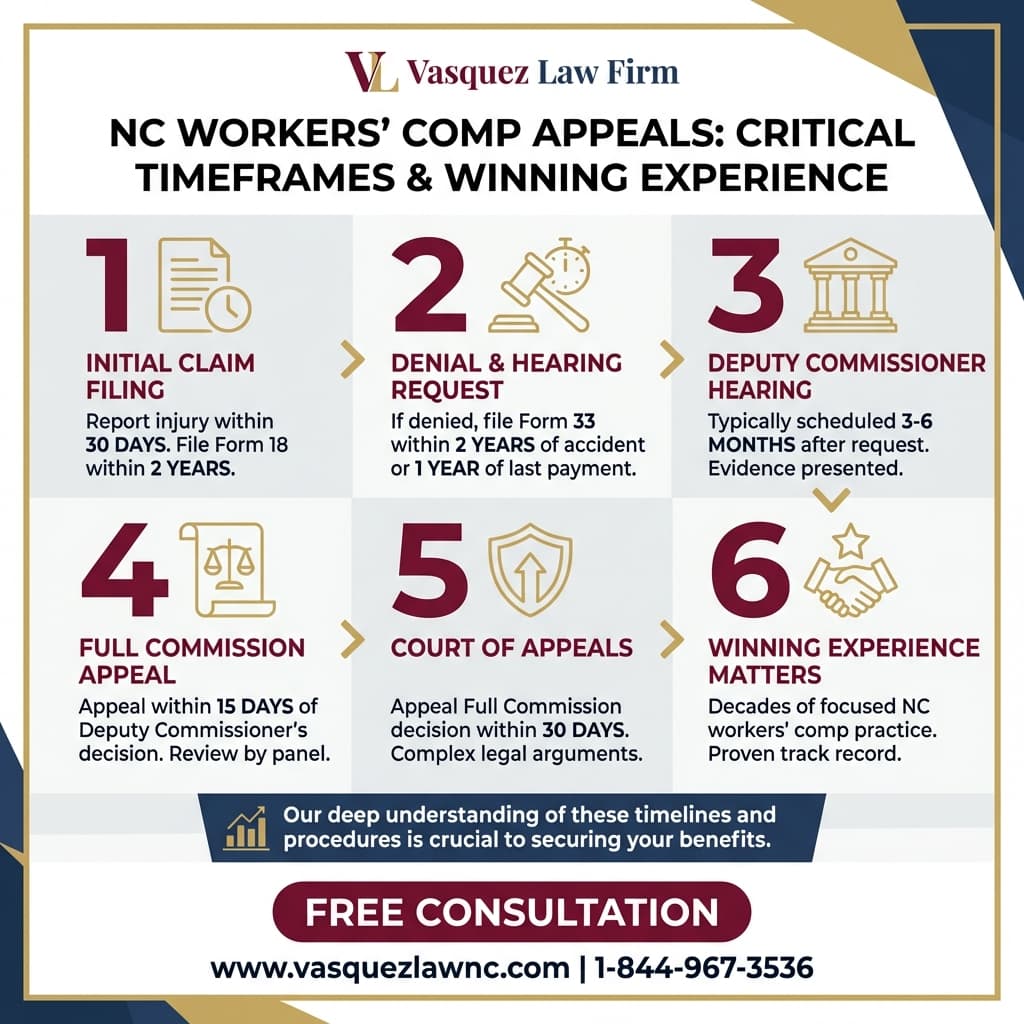
- Filing Form 33 (Request for Hearing): You generally have two years from the date of injury or the last payment of medical compensation to file this form, but it's best to act immediately after denial.
- Discovery Period: After filing Form 33, both sides exchange information, including medical records, witness lists, and other evidence. This can take several months.
- Mediation: Often scheduled within 3-6 months after Form 33 is filed. Many cases settle at this stage.
- Hearing Before a Deputy Commissioner: If mediation fails, a hearing is typically scheduled 6-12 months after Form 33 is filed. The hearing itself may last a few hours to a few days.
- Deputy Commissioner's Decision: A written decision is usually issued within 30-90 days after the hearing.
- Appeal to the Full Commission: If either party appeals, this must be done within 15 days of the Deputy Commissioner's decision. This process can add another 6-12 months.
- Appeals to Higher Courts: Further appeals to the NC Court of Appeals or Supreme Court can extend the process by another year or more.
Due to these varying timelines, persistent legal guidance is crucial. For more information on workers' compensation settlements, read our blog post on workers' compensation settlements.
Common Mistakes When Appealing Denied Workers' Comp Claims and How to Avoid Them
Navigating the appeals process for denied workers' comp claims is fraught with potential pitfalls that can jeopardize your ability to secure benefits. Many injured workers, especially those without legal representation, make critical errors that weaken their case. Avoiding these common mistakes can significantly improve your chances of a successful appeal in North Carolina.
- Missing Deadlines: Failing to file Form 33 or other required documents within the strict statutory deadlines is one of the most common and damaging mistakes. If you miss a deadline, your claim could be permanently barred. Always mark deadlines and file promptly.
- Inadequate Medical Treatment or Documentation: Not seeing a doctor immediately after your injury, failing to follow prescribed treatment, or not getting a clear diagnosis can weaken your claim. Ensure all medical visits and treatments are documented and linked to your work injury.
- Speaking to the Insurer Without Counsel: Insurance adjusters are trained to minimize payouts. Any statements you make can be used against you. Avoid discussing the details of your injury or case with the insurer without your attorney present.
- Returning to Work Too Soon: If you return to work against medical advice or before you've fully recovered, the insurer might argue your injury wasn't as severe as claimed, or that you've recovered sufficiently. Follow your doctor's restrictions strictly.
- Not Reporting All Symptoms: Fully disclose all symptoms and pain to your medical providers. Downplaying your discomfort can lead to an incomplete medical record that doesn't fully reflect your injury's impact.
- Failing to Disclose Pre-Existing Conditions: While a pre-existing condition doesn't automatically disqualify you, failing to disclose it can damage your credibility. Be honest about your medical history, as the work injury may have aggravated it.
- Neglecting to Gather Evidence: Relying solely on your word is often not enough. Collect all available evidence: witness statements, photos, accident reports, and a log of lost wages.
- Posting About Your Injury on Social Media: Anything you post online, even if it seems innocuous, can be used by the insurance company to discredit your claim. Avoid discussing your injury or activities on social media.
If you only remember one thing: Never underestimate the complexity of a workers' comp appeal; legal representation is often the deciding factor in securing your benefits.
Don't face your legal challenges alone. Our team is here to help you every step of the way.
Call today: 1-844-967-3536 | Se Habla Español
When to Call a Lawyer About Denied Workers' Comp Claims
The moment you receive a denial for your workers' comp claims, it's time to consider contacting an attorney. While you have the right to represent yourself, the legal intricacies and aggressive tactics of insurance companies often make professional guidance essential. An attorney can help you understand the specific reasons for denial and strategize the most effective appeal.
- Your Claim Was Denied: This is the most immediate trigger. A lawyer can review the denial letter and explain your options.
- The Insurance Company Is Delaying or Not Responding: Unnecessary delays can hinder your recovery and financial stability. An attorney can push for timely action.
- You Disagree with Your Doctor or Treatment: If the company doctor isn't providing adequate care or you're being forced back to work too soon, a lawyer can advocate for your right to proper treatment.
- Your Employer Retaliates: If you face demotion, harassment, or termination after filing a claim, a lawyer can address potential retaliation issues.
- You Have a Pre-Existing Condition: Insurers often use pre-existing conditions to deny claims, even if your work injury aggravated it. An attorney can argue how the work injury worsened your condition.
- Your Injury Is Severe or Permanent: Cases involving severe injuries, permanent disability, or significant lost wages require experienced legal representation to ensure you receive maximum compensation.
- You Are Offered a Settlement: Never accept a settlement offer without having an attorney review it. They can determine if the offer is fair and covers all your present and future needs.
- You Feel Overwhelmed or Confused: The legal process can be daunting. A lawyer provides clarity, handles paperwork, and represents your interests at all stages.
If you're in Smithfield or anywhere in North Carolina facing a denied workers' compensation claim, Attorney Vasquez and his team are ready to help. Our firm has extensive experience fighting for the rights of injured workers.
About Vasquez Law Firm
At Vasquez Law Firm, we combine compassion with aggressive representation for injured workers and their families across North Carolina. Our motto "Yo Peleo" (I Fight) reflects our unwavering commitment to standing up for your rights and securing the justice you deserve. We understand the physical, emotional, and financial toll a workplace injury can take, and we are dedicated to providing personalized, effective legal solutions.
- Bilingual Support: Se Habla Español - our team is fully bilingual, ensuring clear communication and understanding for all our clients.
- Service Areas: We proudly serve clients throughout North Carolina, including Smithfield, and handle workers' compensation cases statewide.
- Experience: With over 15 years of dedicated legal experience, Attorney Vasquez has a proven track record of helping clients navigate complex legal matters.
- Results: We have achieved thousands of successful outcomes across multiple practice areas, including workers' compensation, personal injury, and criminal defense.
Attorney Trust and Experience
Attorney Vasquez holds a Juris Doctor degree and is admitted to practice in the North Carolina State Bar. With over 15 years of dedicated legal experience, he has built a reputation for providing personalized attention and achieving favorable outcomes for his clients facing workers' comp claims. His commitment to the community and his clients is evident in every case he handles, ensuring that injured workers receive the diligent and aggressive representation they need.
Frequently Asked Questions
What is the most common workers' comp claim?
The most common workers' comp claims often involve strains, sprains, and tears, particularly affecting the back, neck, and shoulders. These injuries can result from heavy lifting, repetitive motions, slips, or falls. Additionally, cuts, lacerations, and contusions are frequent, especially in manual labor or industrial settings. Understanding these common injuries can help workers recognize potential claims and seek prompt medical attention after a workplace incident in North Carolina.
How long do most workers' comp settlements take in NC?
The duration of workers' comp settlements in North Carolina varies significantly, ranging from a few months to several years. Simple cases with clear liability and minor injuries might settle relatively quickly, perhaps within 6-12 months. More complex cases involving severe injuries, disputed liability, or extensive medical treatment can easily take 1-3 years or even longer to reach a final settlement. Legal representation can often help expedite the process by efficiently managing negotiations and paperwork.
Can I appeal a denied workers' comp claim in North Carolina?
Yes, absolutely. If your workers' comp claims are denied in North Carolina, you have the legal right to appeal the decision. This process involves filing specific forms with the NC Industrial Commission, typically a Form 33, Request for Hearing. It is crucial to act quickly, as there are strict deadlines for filing appeals. Consulting with an attorney immediately after a denial can significantly strengthen your appeal efforts.
What is the deadline to appeal a workers' comp denial in NC?
In North Carolina, you generally have two years from the date of your injury or the last payment of medical compensation to file a Form 33 (Request for Hearing) to appeal a denied workers' comp claim. However, it's always best to initiate the appeal process as soon as possible after receiving a denial letter. Delays can complicate your case and potentially impact your ability to collect benefits. An attorney can help ensure all deadlines are met.
Do I need a lawyer for a denied workers' comp claim?
While not legally required, hiring a lawyer for denied workers' comp claims in North Carolina is highly advisable. Insurance companies have legal teams dedicated to minimizing payouts, making the appeals process challenging for unrepresented individuals. An attorney can navigate the complex legal procedures, gather crucial evidence, negotiate with the insurer, and represent you at hearings, significantly increasing your chances of a successful outcome and fair compensation.
What kind of evidence do I need to appeal a denial?
To appeal a denied workers' comp claim, you will need comprehensive evidence. This includes all medical records, doctor's notes, diagnostic test results, and treatment plans directly linking your injury to the workplace incident. Additionally, gather accident reports, witness statements, photos of the accident scene or your injuries, and records of lost wages. Thorough documentation is key to proving your case and overturning the denial.
What if my employer retaliates after I file a claim?
If your employer retaliates against you for filing workers' comp claims, such as through demotion, harassment, or termination, it is illegal under North Carolina law. You should document all instances of retaliation and contact an attorney immediately. Your lawyer can help you file a complaint with the appropriate state agencies and pursue legal action to protect your rights and seek remedies for the retaliation you've experienced.
Will a pre-existing condition affect my workers' comp appeal?
A pre-existing condition can complicate workers' comp claims, but it does not automatically bar you from receiving benefits in North Carolina. If your workplace injury aggravated or accelerated a pre-existing condition, you might still be entitled to compensation. The key is to demonstrate that the work incident significantly contributed to your current disability or need for treatment. An experienced attorney can help argue this crucial aspect of your case.
What happens after a workers' comp hearing in NC?
After a workers' comp hearing before a Deputy Commissioner in North Carolina, the Commissioner will issue a written decision, typically within 30 to 90 days. This decision will either affirm the denial, award benefits, or make other determinations. If either party disagrees with the decision, they have 15 days to appeal to the Full Commission. Further appeals can then be made to the North Carolina Court of Appeals and the NC Supreme Court.
How does workers' comp pay for lost wages in NC?
In North Carolina, workers' comp generally pays for lost wages at a rate of two-thirds (66 2/3%) of your average weekly wage, up to a maximum amount set annually by the NC Industrial Commission. These payments, known as temporary total disability (TTD) benefits, begin after a 7-day waiting period. If your disability lasts longer than 21 days, you can receive payment for the first 7 days. These benefits continue as long as you are out of work due to your injury.
Sources and References
Hurt at work? Our workers' compensation attorneys can review your claim.
Ready to take the next step? Contact Vasquez Law Firm today for a free, confidential consultation. We're committed to fighting for your rights and achieving the best possible outcome for your case.
Start Your Free Case Evaluation Now
Call us: 1-844-967-3536
Se Habla Español - Estamos aquí para ayudarle.

William Vasquez
Founder & CEO, Vasquez Law Firm, PLLC
William Vasquez is the founder and CEO of Vasquez Law Firm, PLLC, a results-driven firm specializing in immigration, criminal defense, personal injury, and workers' compensation. A U.S. Air Force veteran and recipient of the Joint Service Achievement Medal, William is dedicated to fiercely fighting for his clients' rights.
Related Legal Services
Need legal help? Learn more about speak with a workers comp lawyer, or contact us for a free evaluation.
You can also visit workers comp lawyers across North Carolina for more information.