Who Is Affected by Trump Suspending Immigrant Visas for 75 Countries
Trump suspends immigrant visas for 75 countries: Who’s affected? Learn who may be blocked and next steps—call 1-844-967-3536 for help.
Published on January 30, 2026
Talk to an immigration attorney
Free call. A clear plan for your case.
Free & confidential · Se habla espanol · 24/7
Have questions? Talk to an attorney - free evaluation.
Call 1-844-967-3536Worried how the latest immigration news affects you?
Schedule a confidential case review with an immigration attorney - know exactly where you stand.
USCIS Case Status
Check your USCIS case status
Enter your receipt number and get the official status. Free, no registration.
Who Is Affected by Trump Suspending Immigrant Visas for 75 Countries
If you’ve seen headlines claiming “Trump suspends immigrant visas for 75 countries: Who’s affected?” you may be worried about family petitions, consular interviews, and green card processing. Even when news stories are still developing, visa suspensions and travel restrictions can move fast—often through presidential proclamations and agency guidance. This article explains what a large-scale visa suspension could mean in practice, who is most at risk of delays or denials, what exceptions sometimes exist, and what to do next if you or your loved ones are stuck abroad.
Need a Work Visa or Permit?
H-1B, TN, L-1, and more. We help workers and employers navigate the visa process.
Need a quick, clear plan for your case? Talk with our immigration team serving smithfield residents. Se Habla Español. Call 1-844-967-3536 or request a free case evaluation.
1) What the headline means—and what to verify first
When people search “Trump suspends immigrant visas for 75 countries: Who’s affected?” they usually want one thing: whether an interview, visa, or entry to the U.S. will be stopped. The hard truth is that “visa suspension” can mean different things depending on the legal tool used and the agencies involved.
A. How visa suspensions usually happen
Large visa restrictions are often implemented through a Presidential Proclamation (for entry restrictions) plus policy changes at the Department of State (for visa issuance at U.S. consulates). In past administrations, restrictions have been tied to security screening, document integrity, overstay rates, or diplomatic issues.
Two key legal concepts often show up:
- Entry restrictions (who may be admitted at the border)
- Visa issuance restrictions (whether a consulate may issue a visa at all)
B. Why “75 countries” lists can change quickly
Country lists can expand or shrink based on negotiations, compliance benchmarks, litigation, or new guidance. That’s why it’s important to confirm the current rule in official sources—not just social media.
C. Where to check official updates (reliable sources)
Start with the Department of State’s visa page at U.S. visa information from travel.state.gov and official USCIS announcements at USCIS.gov. If your case is already in immigration court, follow updates through EOIR (Executive Office for Immigration Review).
News coverage that raised public attention to these concerns can be found here: analysis discussing policy impacts on immigrant families.
2) Who may be affected if immigrant visas are suspended
If the government restricts immigrant visas broadly, the biggest impact is usually on people processing through U.S. consulates abroad (consular processing). For many families in smithfield, that means a spouse, parent, or child waiting overseas may face long delays.
A. Family-based immigrant visa applicants
Family categories are often the most visible because they involve U.S. citizens and lawful permanent residents sponsoring close relatives. If a suspension applies to immigrant visas, these applicants may be affected:
- IR-1/CR-1 spouses of U.S. citizens
- IR-2/CR-2 children of U.S. citizens
- F2A spouses/children of lawful permanent residents
- Parents of U.S. citizens (IR-5)
- Adult children and siblings in family preference categories
Even when petitions are approved by USCIS, consulates can pause interviews or refuse issuance if a proclamation or State Department guidance blocks the category.
B. Employment-based immigrant visas
Employment-based immigrant visas can also be disrupted—especially if the policy targets broader “immigrant visas” rather than just family categories. That can affect professionals, investors, and sponsored workers waiting abroad for final visa issuance.
Common examples include:
- EB-1, EB-2, EB-3 consular immigrant visas
- EB-5 immigrant investor visas
C. Diversity Visa (DV) lottery winners
Diversity visas are time-sensitive because they are tied to a fiscal year deadline. If a suspension hits DV processing, selectees may lose the chance to immigrate even if they did everything right—simply due to timing.
3) Does this affect tourist, student, or work visas too?
People searching “Trump suspends immigrant visas for 75 countries: Who’s affected?” often ask whether nonimmigrant visas (temporary visas) are also impacted. The answer depends on how the policy is written.
A. Immigrant vs. nonimmigrant: the key difference
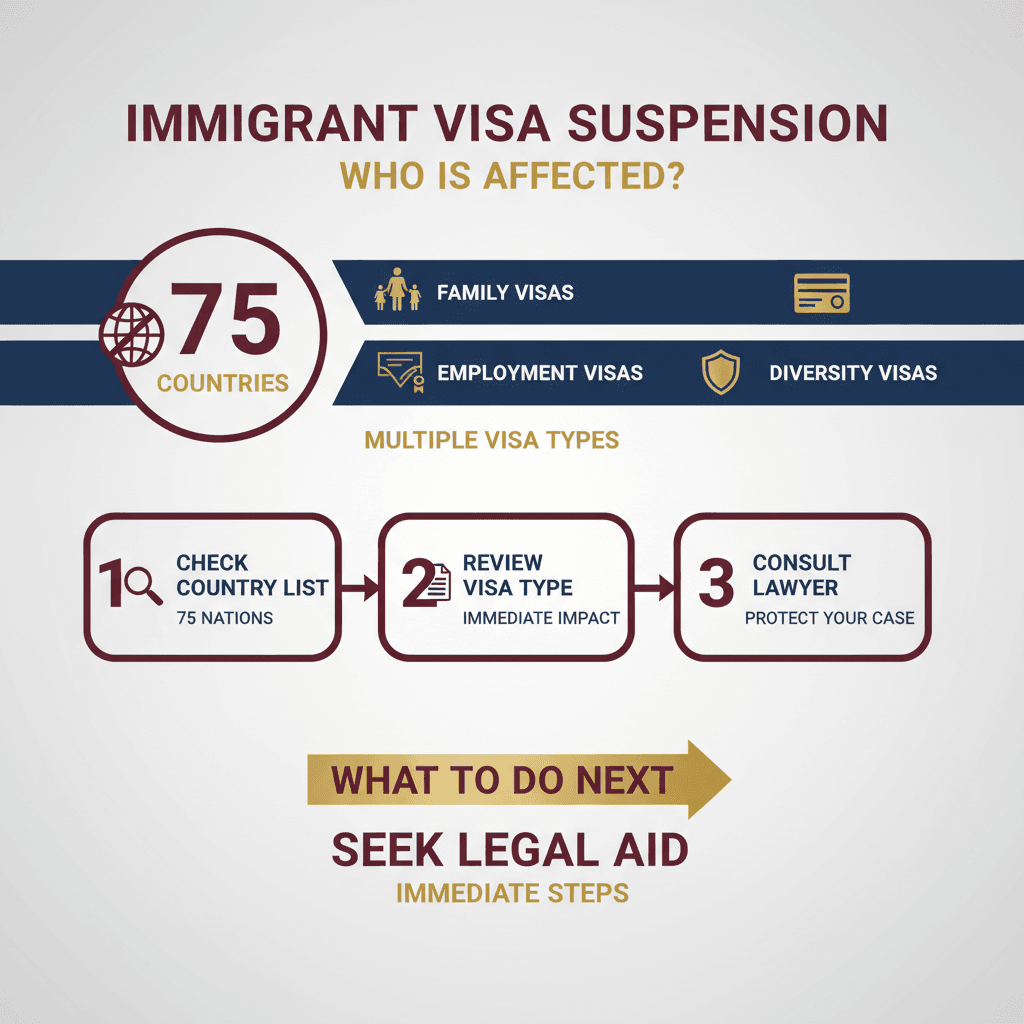
Immigrant visas are for people who plan to live permanently in the U.S. (green card entry). Nonimmigrant visas are for temporary stays (like B-2 tourism, F-1 students, H-1B workers, or J-1 exchange visitors).
B. Possible spillover effects: interviews, security checks, and administrative processing
Even if a suspension targets only immigrant visas, some applicants see delays because consulates shift staffing, add screening, or place cases into “administrative processing.” That can slow:
- K-1 fiancé(e) visas (technically nonimmigrant, but family-based in practice)
- Student visas when security screening expands
- Work visas if posts reduce appointment capacity
C. How “public charge” policy debates can intersect
Visa policy debates sometimes overlap with public charge issues (whether the government believes a person is likely to rely on certain public benefits). Public charge is rooted in the Immigration and Nationality Act at INA § 212(a)(4). Changes in how public charge is applied can affect both consular cases and certain USCIS applications.
Important: The rules around public charge have changed over time through regulation and litigation. If your case raises public charge questions, get advice based on the current rule and your exact facts.
4) Legal authority, common exceptions, and waivers
To understand “Trump suspends immigrant visas for 75 countries: Who’s affected?” it helps to know where the legal power comes from and what exceptions may apply. These policies often turn on statutory authority and the precise wording of the proclamation or guidance.
A. The president’s authority under INA § 212(f)
One of the most cited legal tools for entry restrictions is INA § 212(f) (codified at 8 U.S.C. § 1182(f)), which allows the president to suspend entry of certain noncitizens if deemed detrimental to U.S. interests. This authority has been litigated heavily, including in the travel ban era.
B. Typical exceptions seen in past restrictions
Many broad restrictions include carve-outs. Depending on the policy, exceptions may exist for:
- Lawful permanent residents (green card holders)
- Immediate relatives of U.S. citizens (sometimes included, sometimes not)
- People with valid visas issued before a certain date
- People whose entry is in the national interest
- Asylees, refugees, or people under CAT protections (varies by rule)
C. Waivers and “national interest” requests
Some proclamations allow case-by-case waivers. These are hard, but not impossible. Strong waiver packets often include proof of:
- Undue hardship to a U.S. citizen or LPR family member
- Low security or public-safety risk
- Clear U.S. interest (medical, economic, humanitarian, or family unity)
5) What to do now if your visa process may be paused
If you or a loved one is caught in uncertainty, you can still take steps to protect your case. For many families we serve in smithfield, the goal is to avoid mistakes that create new delays—like missing document deadlines or letting medical exams expire.
A. A step-by-step checklist (practical and fast)
- Confirm the exact visa type (IR-1, F2A, EB-2, DV, K-1, etc.).
- Confirm where the case is: USCIS, NVC, consulate, or CBP entry.
- Save proof of status and deadlines: NVC messages, interview letters, fee receipts.
- Check appointment availability and local consulate alerts.
- Do not rely on “shortcuts” or unverified agents; mistakes can trigger fraud findings.
B. If your consular interview is canceled or refused
Ask for written confirmation of the reason. Often, the case is placed in a temporary refusal status under INA § 221(g) while the consulate waits for documents, background checks, or policy instructions.
Even when a policy blocks issuance, careful follow-up matters. You may need to:
- Submit missing documents through NVC or the consulate portal
- Request reconsideration if the wrong rule was applied
- Prepare a waiver or exception request (if allowed)
C. If you are inside the U.S.: adjustment of status may be different
Some visa suspensions target consular processing but do not directly stop eligible people already in the U.S. from applying for a green card through adjustment of status under 8 U.S.C. § 1255 (INA § 245). Eligibility is fact-specific, so get legal guidance before filing.
Don’t guess with your family’s future. If you’re trying to reunite with a spouse, child, or parent and you’re hearing “Trump suspends immigrant visas for 75 countries: Who’s affected?” contact Vasquez Law Firm, PLLC. Se Habla Español. Call 1-844-967-3536 or message us here.
6) How Vasquez Law Firm, PLLC helps families and employers respond
What's Your Immigration Situation?
Answer 3 questions - we'll tell you your options
Question 1 / 3
What best describes your situation?
Keep Reading

Policy shifts are stressful, but a well-documented case is harder to derail. At Vasquez Law Firm, PLLC, Attorney Vasquez (JD) brings 15 years of immigration law experience and is admitted to the North Carolina State Bar. We help clients plan around uncertainty while staying compliant with federal law.
A. Strategy tailored to your process stage
We build a plan based on where your case sits:
- USCIS stage: petition strength, evidence, and timing
- NVC stage: document completeness, affidavits of support, and interview readiness
- Consulate stage: refusal analysis, 221(g) follow-up, waiver strategy
Learn more about our Immigration Law services and how we support families and workers.
B. Serving smithfield residents and nearby communities
We regularly assist clients serving smithfield and surrounding areas like Clayton, Selma, Garner, and Raleigh. If you need in-person document support or prefer bilingual help, our team is ready.
For many Johnston County families, immigration issues connect to real life—work schedules, school calendars, and hearings at local institutions like the Johnston County Courthouse in Smithfield.
C. Clear communication and bilingual support (Se Habla Español)
When headlines say “Trump suspends immigrant visas for 75 countries: Who’s affected?” you deserve straight answers. We explain:
- What is confirmed vs. rumor
- What the law allows and what agencies must follow
- What you can do this week to protect your place in line
Meet our team and credentials through Attorney Vasquez and our attorneys page.
Frequently Asked Questions
Below are common questions we hear from families and employers reacting to visa suspension headlines.
1) Does a visa suspension mean my approved petition is canceled?
Usually, no. An approved petition (like an I-130 or I-140) is not automatically “canceled” just because a consulate can’t issue visas for a period of time. But delays can cause problems like expired documents or changing family situations. You should keep your case current with the National Visa Center (NVC) and respond to any requests quickly.
2) What if my spouse is overseas and we live in smithfield?
If you live in smithfield and your spouse is waiting abroad, the key questions are the visa category, the consulate, and whether an exception or waiver could apply. You should also gather proof of hardship and family ties in the U.S. (housing, children, medical needs, job letters). This evidence can matter if waivers or discretionary exceptions are available.
3) Are green card holders affected by country-based bans?
Many entry restrictions historically exempt lawful permanent residents, but not always in every detail. Some rules affect travel and re-entry logistics, especially if someone has been outside the U.S. for extended periods. If you are an LPR, do not assume you are safe—verify the current text of the policy and consult counsel before international travel.
4) Can I switch to adjustment of status in the U.S. if consular processing is blocked?
Sometimes, but only if you are eligible. Adjustment of status is governed by INA § 245 (8 U.S.C. § 1255) and depends on lawful entry, current status, and other bars. A consultation can help determine whether a strategy shift is lawful and realistic for your timeline.
5) What is INA 221(g), and is it a denial?
INA 221(g) is commonly used when a consulate cannot issue a visa at the interview because something is missing or additional review is required. It is often a “temporary refusal” rather than a final denial. Some 221(g) cases resolve quickly with documents; others last months due to security checks or policy constraints.
6) How can I track official updates without misinformation?
Use official sources first: travel.state.gov for consular processing and USCIS.gov for petitions and benefits inside the U.S. If your case is in immigration court, check EOIR. News summaries can help, but always confirm details in official announcements or with counsel.
Ready to protect your case and your family? If you’re trying to understand “Trump suspends immigrant visas for 75 countries: Who’s affected?” get advice tailored to your facts. Contact Vasquez Law Firm, PLLC today—Se Habla Español. Call 1-844-967-3536 or schedule your consultation.
Attorney advertising / legal information disclaimer: This article is for general information only and is not legal advice. Immigration rules can change quickly. For advice about your specific situation, speak with a qualified immigration attorney.

William Vasquez
Founder & CEO, Vasquez Law Firm, PLLC
William Vasquez is the founder and CEO of Vasquez Law Firm, PLLC, a results-driven firm specializing in immigration, criminal defense, personal injury, and workers' compensation. A U.S. Air Force veteran and recipient of the Joint Service Achievement Medal, William is dedicated to fiercely fighting for his clients' rights.
Related Legal Services
Need legal help? Learn more about learn about our immigration practice, or contact us for a free evaluation.
You can also visit immigration legal services throughout NC for more information.