How Tesla Autopilot Can Cost You a Traffic Ticket in NC
Need a traffic ticket lawyer NC? Don’t trust “self-driving” claims—tickets still hit your license. Get help today: 1-844-967-3536.
Published on December 23, 2025
Fight your ticket
Free review to keep points off your record.
Free & confidential · Se habla espanol · 24/7

Have questions? Talk to an attorney - free evaluation.
Call 1-844-967-3536Fight Your Ticket, Protect Your License
A review that can keep points off your record.
How Tesla Autopilot Can Cost You a Traffic Ticket in NC
If you’re searching for a traffic ticket lawyer NC, here’s the uncomfortable truth: “self-driving” headlines don’t protect you in court. After reports that California may suspend Tesla’s sales license over alleged deceptive self-driving claims, many drivers are asking the same question—if my car “drove itself,” can I beat my ticket? In North Carolina, the driver is still the one who pays—often with points, insurance hikes, and sometimes a license suspension.
Need legal help?
Immigration in NC and FL. Personal injury and workers compensation across NC. Criminal defense in Johnston and Harnett counties, and traffic tickets in 10 NC counties. Tell us your county and we will tell you exactly what we can do.
Quick Summary (Read This First)
What happened: News reports say California may suspend Tesla’s sales license over alleged deceptive claims about self-driving capability.
Why it matters to you: Driver-assist tech can create a false sense of safety—yet North Carolina officers still cite the human driver, and courts still assign points and consequences to you.
What to do now: Preserve evidence (dashcam/vehicle logs), check your court date, and understand what outcomes are realistic (reduction, dismissal, or a no-points result).
What This News Means for North Carolina Residents
Recent reporting raises questions about how certain “self-driving” features are marketed and understood by drivers. According to this report on California’s potential action involving Tesla and self-driving claims, regulators may challenge statements that could mislead consumers about what the vehicle can truly do.
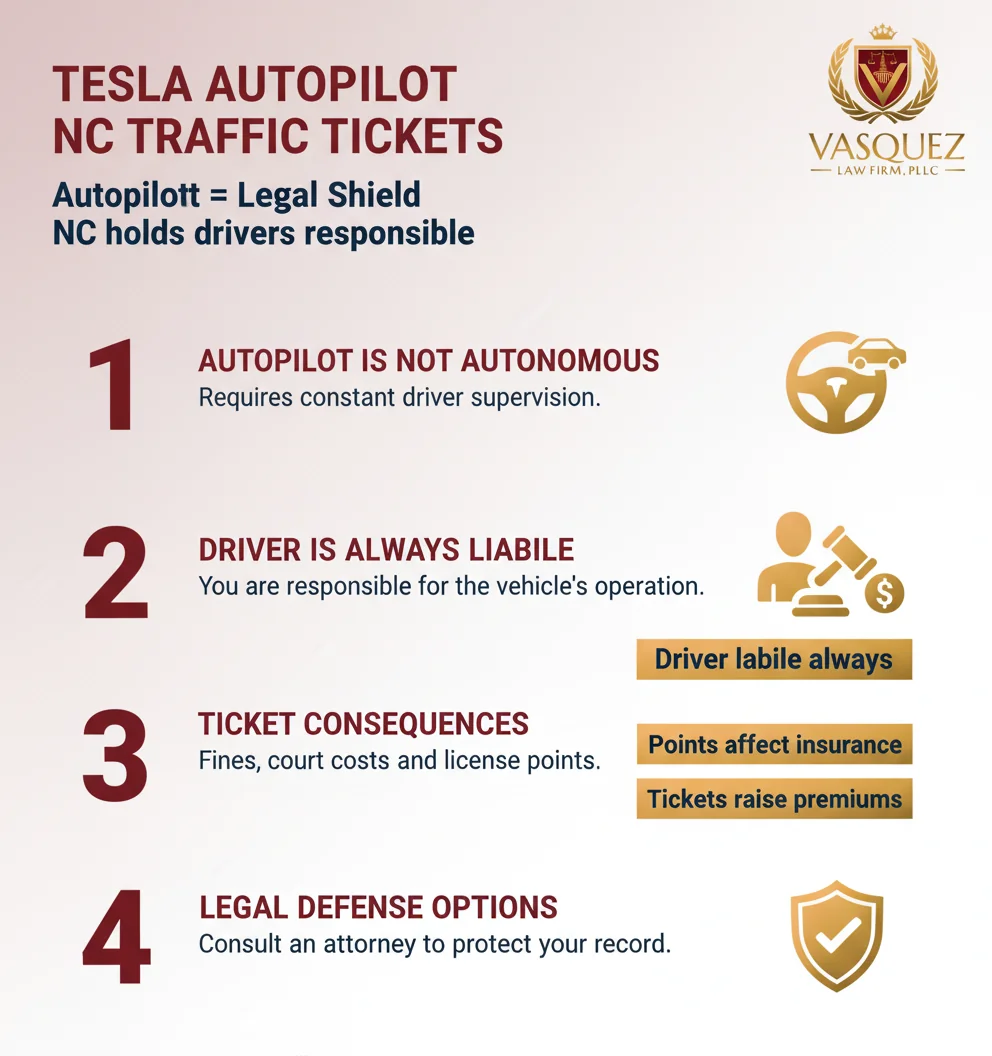
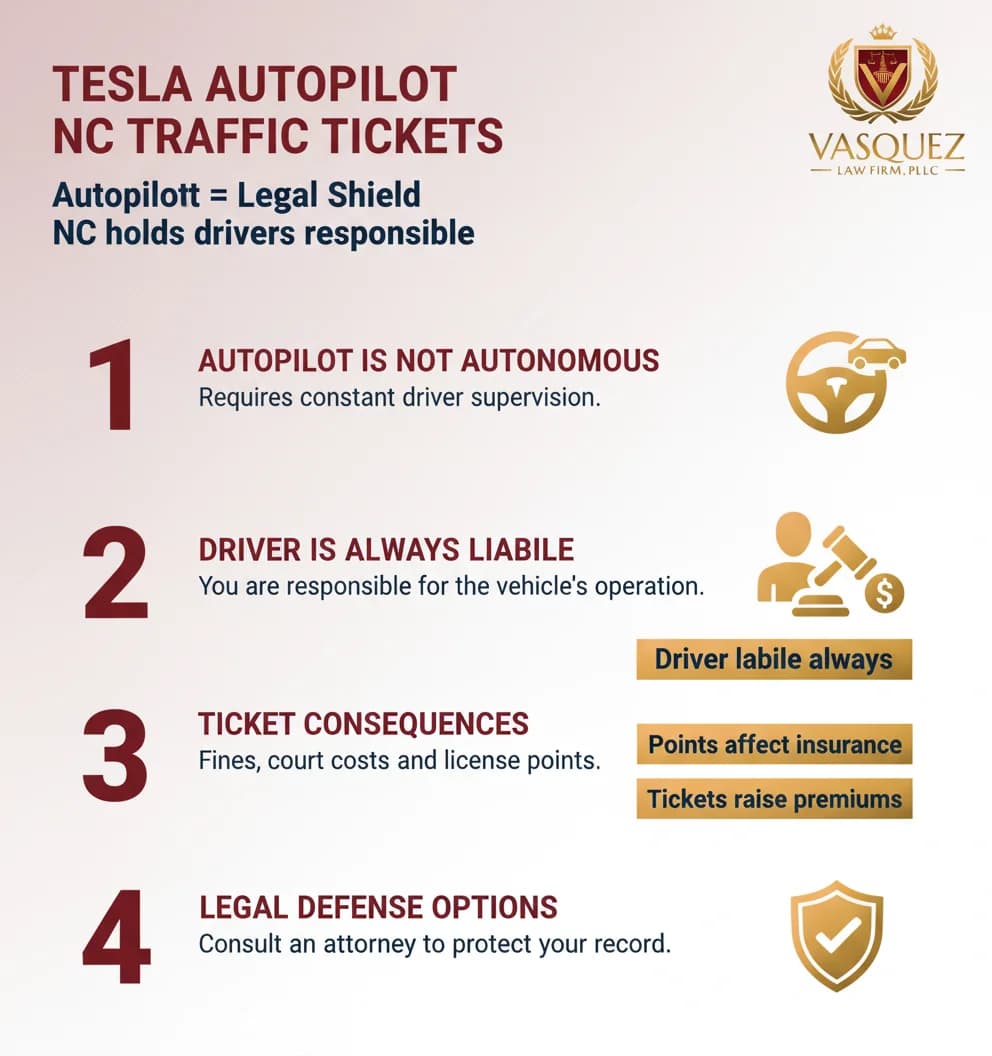
For drivers in North Carolina, the key takeaway is simple: even if your car has advanced driver-assist technology, you can still be cited for speeding, reckless driving, lane violations, texting, or following too closely. Courts typically focus on what happened on the road—and whether the driver met their legal duty of care.
Why “driver-assist” doesn’t erase a traffic ticket
Terms like “Autopilot” and “Full Self-Driving” can be confusing. But in real-world traffic enforcement, officers don’t need to prove what the software did. They usually only need to testify about what they observed: speed, lane movement, unsafe passing, or a collision pattern.
If you told an officer “the car did it,” that rarely ends the stop. In many cases, it creates a second problem: the officer may think you weren’t paying attention, which can make a charge sound more serious.
What’s really at stake: license points, insurance points, and suspension
A single conviction can trigger DMV points and insurance points. The exact impact depends on the charge (and your record), but the risk is real—especially for higher speeds, aggressive driving, or repeat offenses. For a lot of people, the hidden cost isn’t the fine; it’s what happens afterward.
For official background on licensing and record consequences, the North Carolina DMV is a good place to start—but it won’t tell you the best strategy for your court.
Why this issue is showing up more in NC district courts
As more people drive vehicles with lane-centering and adaptive cruise control, more drivers assume “the system has it.” But citations in places like Mecklenburg County, Wake County, Guilford County, and surrounding districts still treat the driver as responsible. That’s why drivers increasingly look for a traffic ticket lawyer NC who understands both the courtroom and the tech facts that matter.
What to Do in the Next 24-48 Hours
If this situation applies to you, take these steps NOW:
- Step 1: Document everything: photograph your ticket, note weather/traffic, and write down what the officer said (and what you said) while it’s fresh.
- Step 2: Preserve video and data: save dashcam clips, pull any available trip history, and do not overwrite memory cards. If your vehicle stores event data, note the date/time and location.
- Step 3: Check your court date and charge level: confirm whether it’s an infraction, misdemeanor traffic offense, or a charge that could threaten your license.
- Step 4: Consult with a legal expert to understand your rights and options
Don’t make these 3 fast mistakes after a “self-driving” ticket
- Don’t assume paying online is “cheaper.” It can be a conviction that follows you for years.
- Don’t post details on social media (or in a forum) about what happened. Those statements can come back in court.
- Don’t rely on a “the car did it” defense without understanding how evidence is actually admitted and used.
What evidence actually helps in NC traffic court
Useful evidence often includes:
- Dashcam footage showing traffic flow, signage, and lane markings
- Photos of the area (speed limit signs, construction zones, sight lines)
- Witness information (passengers, nearby drivers, first responders)
- Maintenance records if you claim equipment failure (tires, brakes, calibration)
Warning Signs & Red Flags to Watch For
These are signs your case may be in jeopardy:
- You’re charged with a high-speed offense (often where reductions are harder and points risk is higher).
- The officer wrote notes suggesting distraction, “hands off wheel,” or failure to maintain lane.
- You have prior tickets, a provisional license, a CDL, or you drive for work (higher stakes).
Seeing these signs? Vasquez Law Firm, PLLC has handled hundreds of denied claims in North Carolina. Attorney Vasquez knows the tactics insurers use. Get a free case evaluation.
Why the “Autopilot did it” argument can backfire
In many cases, saying you weren’t controlling the vehicle can sound like an admission that you weren’t driving attentively. That may increase the chance the State views the incident as careless or reckless.
Extra red flags for CDL and professional drivers
If you hold a CDL, drive a company vehicle, or have safety-sensitive work, even a “minor” conviction can create employment issues. A traffic ticket lawyer NC can help you focus on outcomes that reduce record impact—not just the fine.
Your Rights: What You CAN and CANNOT Do
YOU HAVE THE RIGHT TO:
- Review the exact charge(s) and the statute cited on your citation before deciding how to respond.
- Ask the court about proper procedures (date, time, courtroom, failure-to-appear consequences).
- Challenge the State’s evidence and negotiate for a reduction when legally appropriate.
YOU CANNOT:
- Assume the vehicle manufacturer will “take responsibility” for your citation—traffic court focuses on the driver’s conduct.
- Miss deadlines or ignore a court date—failure to appear can lead to additional penalties and license problems.
Vasquez Law Firm, PLLC helps North Carolina clients understand and protect their rights every day.
What to say (and not say) during a traffic stop
Be polite, provide required documents, and avoid arguing on the roadside. If you believe the car’s features contributed, it’s usually better to discuss that later with counsel rather than improvising explanations under stress.
Pleading options: guilty, not guilty, responsible, or reduction
North Carolina traffic cases often come down to record impact. Many people want a result that avoids points, reduces the speed on record, or prevents a suspension. The best option depends on the charge, county practices, and your prior record.
Documents You'll Need (Save This Checklist)
Gather these documents NOW (before they disappear):
- A clear photo/scan of the citation (front and back)
- Your driving record snapshot (if available) and any prior disposition paperwork
- Dashcam footage or phone video (original files, not just clips)
- Photos of signage, roadway markings, construction notices, and lighting conditions
- Vehicle service/repair records if you believe a malfunction contributed
Tip: Keep all documents organized in one folder - it makes the process much easier.
KEY TAKEAWAY:
If you simply “pay the ticket,” you may be accepting a conviction that triggers DMV/insurance points. In many cases, the real goal is protecting your record—not fighting about tech marketing terms.
Legal Background and Context
Traffic cases in North Carolina are governed by the state’s motor vehicle laws and are typically handled in District Court. Common charges in “driver-assist confusion” situations include speeding, reckless driving, failure to maintain lane, and following too closely.
For speeding, one commonly cited statute is N.C. Gen. Stat. § 20-141 (Speed restrictions). Depending on the alleged facts, other statutes may apply, such as N.C. Gen. Stat. § 20-140 (Reckless driving).
The basic rule courts apply: driver responsibility
Even as vehicles add automation, the law generally expects a human driver to supervise the vehicle and operate safely. That means “the car accelerated” usually doesn’t end the case. Instead, the legal question becomes whether the State can prove the elements of the offense beyond a reasonable doubt (or by the applicable standard for the specific proceeding).
Should I Fight My Traffic Ticket?
Find out if it's worth fighting
Question 1 / 3
What were you cited for?
Keep Reading

Court outcome vs. DMV consequences: two separate problems
Your court disposition may affect your DMV record, and your DMV record may affect your ability to drive. The DMV also publishes educational material about licensing and records at the NC DMV website. This is why many people look for a traffic ticket lawyer NC to coordinate a strategy that considers both the courtroom and the downstream record impact.
Can vehicle data help in NC traffic court?
Sometimes. Dashcam video is often the cleanest and easiest evidence to understand. Vehicle-generated logs can be harder: you may need proper authentication, technical explanation, and relevance to the exact alleged violation. Also, even if the data shows driver-assist was engaged, the State may argue that confirms you were responsible for supervising.
If you want to understand how traffic cases generally work and where they’re heard, the North Carolina Judicial Branch provides official court information.
How Vasquez Law Firm, PLLC Helps North Carolina Clients Win These Cases
Our experienced team, led by Attorney Vasquez, has helped hundreds of North Carolina clients. Here's exactly how we help:
- Step 1: We analyze the citation, county, and your record to identify realistic best outcomes (dismissal, reduction, or no-points results when available).
- Step 2: We gather and organize evidence that matters—dashcam footage, photos of signage, and documentation that supports mitigation.
- Step 3: We assess whether “driver-assist” facts help or hurt, and we plan how to address them without creating new admissions.
- Step 4: We negotiate and litigate strategically, focusing on protecting your license and insurance exposure—not just the fine.
Many readers who search for a traffic ticket lawyer NC are dealing with more than one worry: “Will I lose my license?” “Will my insurance jump?” “Will my employer find out?” We build the plan around those real-life stakes.
For drivers seeking more background on the kinds of matters we handle, see our Traffic Violations services page.
Real example: “A client was cited for speeding and unsafe movement after telling the officer the vehicle’s driver-assist was on. We preserved dashcam footage, documented unclear signage near a work zone, and negotiated a reduction that protected the client’s record.” - Attorney Vasquez (15 years’ experience; North Carolina State Bar; Se Habla Español)

Frequently Asked Questions (Specific to This Situation)
1) If I was using Tesla Autopilot/driver-assist when I got a ticket in North Carolina, can I blame the car?
Usually, no. North Carolina enforcement and courts generally treat you as the responsible driver. Saying “the car did it” may be viewed as admitting you weren’t fully attentive.
2) Can I subpoena Tesla or vehicle data to fight a speeding ticket in NC?
It depends. Data can be difficult to obtain and harder to authenticate in court. Even if you get it, it must be relevant to the specific allegation (speed, lane movement, following distance) and presented in a legally usable way.
3) Does this Tesla self-driving controversy change North Carolina traffic law right now?
Not directly. The California regulatory story highlights marketing and consumer expectations, but North Carolina traffic statutes still apply the same way in District Court. It may, however, change how judges and prosecutors view “self-driving” claims as a practical matter.
4) Could an officer charge reckless driving because I said I wasn’t controlling the vehicle?
Potentially. Reckless driving focuses on willful or wanton disregard for safety. If an officer believes you were knowingly not supervising the vehicle, it can affect charging decisions and negotiation posture.
5) If my ticket happened near Charlotte or Raleigh in heavy traffic, does that matter?
Yes. Traffic conditions, signage, road design, and work zones can be critical. Photos and video showing congestion, lane shifts, or unclear speed-limit transitions can matter in negotiation and court.
6) What if I already told the officer “Autopilot was on” and it’s written on the citation?
That note can shape how the State views your case. The focus often becomes damage control: clarifying supervision, challenging the proof of the underlying offense, and pursuing a resolution that protects your record.
7) Will my insurance go up if I just pay the ticket online?
It can. Paying typically results in a conviction. Insurance consequences vary by carrier and record, but many drivers see the biggest cost after the case is “over,” not on the day they pay.
Don't Navigate This Alone
If you're dealing with a North Carolina traffic ticket where driver-assist/self-driving claims are part of the story, Vasquez Law Firm, PLLC can help. With 15+ years serving North Carolina, we know what works.
Free case evaluation. Bilingual team. No fees unless we win.
Call Now: 1-844-967-3536
Se Habla Español - Hablamos Su Idioma

William Vasquez
Founder & CEO, Vasquez Law Firm, PLLC
William Vasquez is the founder and CEO of Vasquez Law Firm, PLLC, a results-driven firm specializing in immigration, criminal defense, personal injury, and workers' compensation. A U.S. Air Force veteran and recipient of the Joint Service Achievement Medal, William is dedicated to fiercely fighting for his clients' rights.
Related Legal Services
Need legal help? Learn more about speak with a traffic violation lawyer, or contact us for a free evaluation.
You can also visit traffic lawyers in Johnston County for more information.


