North Carolina Lawmakers Debate Workers’ Compensation Access for Immigrant Workers
North Carolina Lawmakers Debate Workers’ Compensation Access for Immigrant Workers—learn your rights and options. Call 1-844-967-3536 (Se Habla Español).
Published on January 11, 2026· Updated August 6, 2026
Hurt on the job?
Free review of your workers' comp claim.
Free & confidential · Se habla espanol · 24/7

Have questions? Talk to an attorney - free evaluation.
Call 1-844-967-3536Hurt on the Job? Claim What You Are Owed
A review of your workers' comp claim - we handle the fight.
North Carolina Lawmakers Debate Workers’ Compensation Access for Immigrant Workers
As North Carolina Lawmakers Debate Workers’ Compensation Access for Immigrant Workers, many families are asking a simple question: “If I get hurt at work, can I still get help?” In North Carolina, most workers hurt on the job—no matter where they were born—may have a right to medical care and wage benefits. But proposed changes and enforcement pressure can make people afraid to report injuries. This guide explains what the debate means, what current North Carolina law says, and what steps to take if you are injured.
Hurt at work? You have rights.
NC workers' comp covers medical bills and lost wages — even for undocumented workers. 15-min call to see what you qualify for.
Important: This article is general information, not legal advice for your case.
Need help after a work injury? Call 1-844-967-3536 or request a free case evaluation. Se Habla Español.
What the Debate Means for Workers in Raleigh and Across North Carolina
Legislative debates can feel far away—until they affect your doctor visit, your paycheck, or your job. When North Carolina Lawmakers Debate Workers’ Compensation Access for Immigrant Workers, the real-life impact is felt most in high-risk industries like construction, landscaping, manufacturing, food processing, and cleaning services.
Why this news is showing up now
National workplace-safety stories and state policy changes often raise the same basic issue: who gets protected at work, and how prevention and benefits are enforced. A recent workplace safety/violence prevention discussion in other states highlights the same worker-protection themes that lawmakers keep revisiting. You can read the referenced news item here: workplace violence prevention rules news source.
How it can affect Raleigh workers
In Raleigh, many immigrant workers commute to job sites across Wake County and nearby cities like Cary, Garner, Durham, and Chapel Hill. A policy shift that discourages reporting can lead to untreated injuries and unpaid time off.
Even before any law changes, workers often face:
- Confusion about whether they qualify for benefits
- Fear of retaliation or job loss
- Pressure to “use your own insurance” or “just rest at home”
What should not change (the basic promise of workers’ comp)
Workers’ compensation is meant to be a “no-fault” system. In most cases, you do not have to prove your employer did something wrong. If the injury arose out of and in the course of employment, benefits may apply.
Current North Carolina Workers’ Comp Law: The Foundation (Chapter 97)
To understand why North Carolina Lawmakers Debate Workers’ Compensation Access for Immigrant Workers, it helps to know the baseline law already on the books. North Carolina’s Workers’ Compensation Act is mainly found in N.C. Gen. Stat. Chapter 97, and claims are handled through the North Carolina Industrial Commission (NCIC).
Who counts as an “employee” under the Act?
Many disputes start with the definition of “employee.” Under N.C. Gen. Stat. § 97-2, employees are generally covered, with certain exceptions. Immigration status is not written into the statute’s employee definition.
In practice, coverage often turns on issues like:
- Employee vs. independent contractor classification
- Whether the employer has the required number of employees (coverage rules can vary)
- Whether the injury was work-related and timely reported
What benefits are typically available?
If accepted, a claim may provide:
- Medical treatment related to the injury (see N.C. Gen. Stat. § 97-25)
- Wage replacement if you cannot work (often tied to N.C. Gen. Stat. § 97-29 and related sections)
- Disability ratings for permanent impairment (see N.C. Gen. Stat. § 97-31)
- Rehabilitation in some cases (see N.C. Gen. Stat. § 97-32)
Deadlines and the paperwork that trips people up
Two rules matter early:
- Notice to the employer: North Carolina law has notice requirements that can be strict in practice (often tied to N.C. Gen. Stat. § 97-22).
- Filing a claim: Many claims must be filed with the NCIC within a set time limit (commonly associated with N.C. Gen. Stat. § 97-24).
If you are unsure, it is safer to report the injury in writing and speak with a workers’ comp attorney before deadlines pass.
Why Lawmakers Debate Access for Immigrant Workers
When North Carolina Lawmakers Debate Workers’ Compensation Access for Immigrant Workers, it is usually not because the system is simple. The debate often blends workplace safety, insurance costs, labor supply, and immigration enforcement concerns into one political conversation.
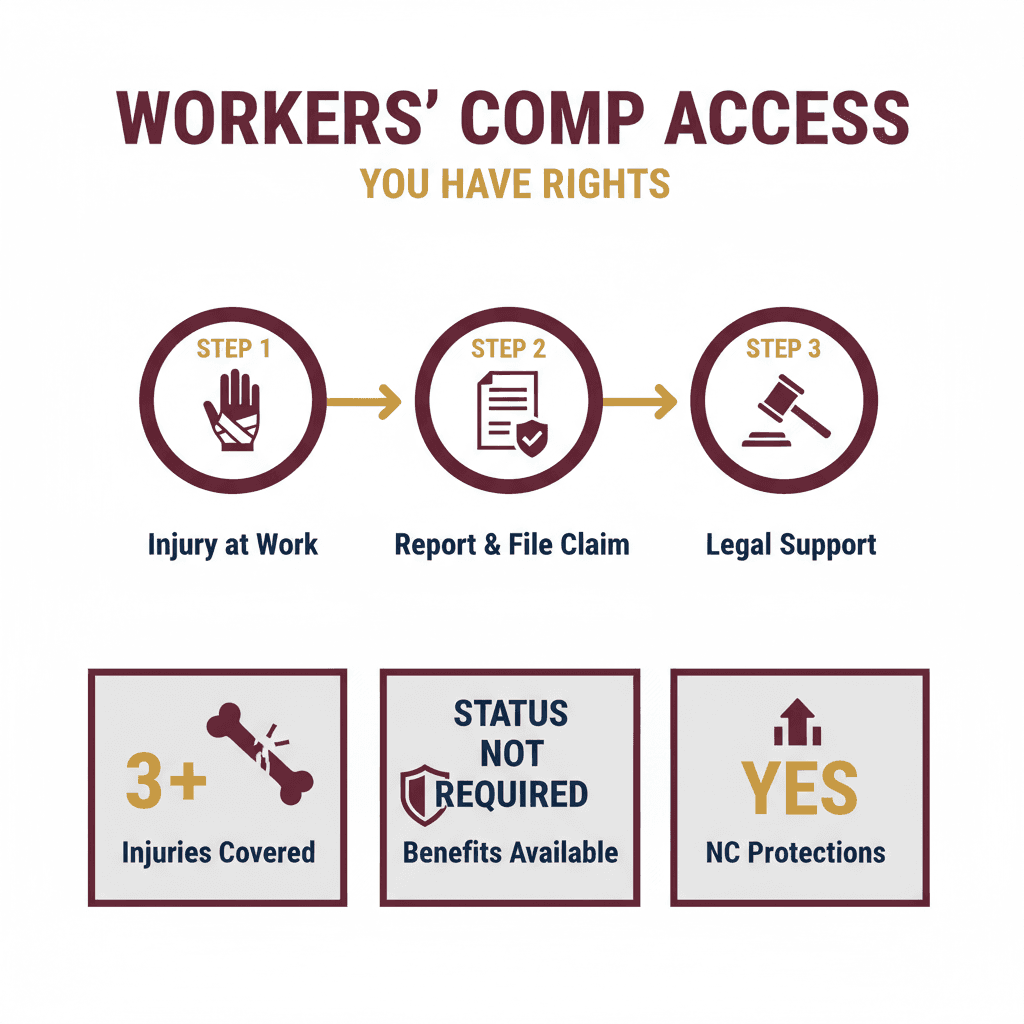
Common arguments on both sides
While each bill is different, debates often sound like this:
- Supporters of access argue workers’ comp is about safety and basic fairness—injured workers should get medical care, and safe employers should not be undercut by those who cut corners.
- Supporters of restrictions argue benefits should not incentivize unlawful hiring or should be limited when work authorization is disputed.
Even when lawmakers focus on “access,” the real effect can come from how claims are investigated, what documents are demanded, and whether workers fear reporting.
What North Carolina courts have said (important case law)
North Carolina appellate decisions have addressed whether undocumented workers can qualify as “employees” for workers’ comp purposes. One frequently cited case is Ruiz v. Belk Masonry Co., 231 N.C. App. 465, 752 S.E.2d 163 (2013), where the court analyzed eligibility issues involving an undocumented worker in the workers’ compensation context.
Case law can be fact-specific. That means the details of hiring, documents, and post-injury work capability can matter.
The real-world effect: underreporting and untreated injuries
Whatever the politics, injuries do not stop. In Raleigh and across North Carolina, underreporting can lead to:
- Injuries getting worse because workers keep working hurt
- More emergency-room visits instead of regular medical care
- Lost wages and housing instability
Worried about reporting an injury? Talk with a workers’ comp lawyer first. Call 1-844-967-3536 (Se Habla Español) or contact us here: /contact.
What Policy Changes Could Look Like (and Why Details Matter)
Because North Carolina Lawmakers Debate Workers’ Compensation Access for Immigrant Workers, workers may hear rumors like “they’re taking benefits away” or “you must prove citizenship.” In reality, changes usually happen through narrower tools—definitions, procedures, or enforcement mechanisms.
Procedural barriers that can shrink access without saying “immigrant”
Sometimes the biggest barrier is not the headline rule but the process. Policy proposals may focus on:
- Stricter documentation demands to start or continue benefits
- More aggressive employer/insurer investigations
- Changes to how disability and work restrictions are evaluated
In plain terms: if the system becomes harder to use, fewer injured workers successfully receive benefits.
Retaliation fears and job loss concerns
Many immigrant workers fear being fired or reported if they speak up. North Carolina law has protections against retaliation in certain contexts, but these cases can be complex and time-sensitive. Even the fear of retaliation can stop workers from getting medical care.
If your employer threatens you after an injury, document it. Save texts, write down dates, and talk to counsel.
How safety enforcement intersects with workers’ comp
Workers’ comp is separate from workplace safety enforcement, but the two are connected. Safety guidance and complaint processes can involve the North Carolina Department of Labor. For general workplace safety resources, see the North Carolina Department of Labor (NCDOL).
Injured at Work in Raleigh? Practical Steps Immigrant Workers Can Take
While North Carolina Lawmakers Debate Workers’ Compensation Access for Immigrant Workers, your health still comes first. The steps you take in the first hours and days after an injury can shape your claim.
Step-by-step checklist after a workplace injury
- Report the injury right away to a supervisor. If you can, follow up in writing (text or email).
- Ask for medical treatment through workers’ comp. Tell the doctor exactly how the injury happened at work.
- Take photos of the area, equipment, and visible injuries.
- Write down names of witnesses and what they saw.
- Keep copies of work notes, restrictions, and any denial letters.
What to avoid (common mistakes that hurt claims)
- Do not wait weeks to report the injury “to see if it gets better.”
- Do not guess about what paperwork means—ask questions.
- Do not exaggerate or minimize symptoms. Be consistent and truthful.
Does immigration status change your right to medical care?
Am I Eligible for Workers' Comp?
3 quick questions to check your eligibility
Question 1 / 3
Where were you injured?
Keep Reading
Many workers are surprised to learn that workers’ comp is not the same as public benefits. It is an insurance system tied to the job injury. In many cases, injured immigrant workers can still pursue benefits, even if their employment situation is complicated.
However, immigration status can affect certain disputes, including arguments about post-injury job search, wages, or whether “suitable employment” is available. That is why early legal guidance matters.
How Vasquez Law Firm, PLLC Helps Injured Immigrant Workers
When the rules feel uncertain, you need a steady plan. At Vasquez Law Firm, PLLC, we help workers understand the process, meet deadlines, and respond to insurance company tactics. Attorney Vasquez, JD has 15 years of experience and is admitted to the North Carolina State Bar and the Florida Bar.
Our approach: clear steps, strong evidence, steady communication
We focus on building claims the right way, including:
- Gathering medical records and work restrictions
- Proving wage loss and disability with correct documentation
- Preparing for recorded statements, mediations, and hearings
If you want to learn more about our work injury representation, visit our Workers Compensation services page.
Spanish-speaking help (Se Habla Español)
Misunderstandings can cost you benefits. We explain your options in plain language. Se Habla Español, and we can help you prepare for medical visits, insurer requests, and Commission procedures.
Local focus for Raleigh workers
We regularly assist people serving raleigh residents and families across Wake County. Many cases involve travel between job sites, subcontractors, and multiple employers, which can complicate who is responsible for coverage.
You can also learn more about our team on our Attorney Vasquez and attorneys page.
Frequently Asked Questions
Below are answers we often hear when North Carolina Lawmakers Debate Workers’ Compensation Access for Immigrant Workers and injured workers are unsure what to do next.
Eligibility and immigration-related concerns
1) Can an undocumented worker get workers’ compensation in North Carolina?
Often, yes. Many undocumented workers still qualify as “employees” under Chapter 97. But employers and insurers may dispute benefits, and the facts matter. Speak with counsel quickly to protect your claim.
2) Will filing a workers’ comp claim expose my immigration status?
Workers’ comp is a state insurance process, not an immigration application. Still, insurers may ask questions that make workers uncomfortable. A lawyer can object to improper requests and keep the case focused on the injury and benefits.
The claims process and common disputes
3) What if my employer tells me I’m an “independent contractor”?
That label is not final. Misclassification is common in construction and cleaning work. The NC Industrial Commission looks at the real working relationship, not just what the employer calls you.
4) What if the insurance company denies my claim?
A denial is not the end. You may have options to request a hearing, submit medical evidence, and challenge the reasons for denial. Deadlines can apply, so do not wait.
Medical care, pay, and returning to work
5) Can I choose my own doctor?
In many cases, the employer/insurer controls authorized medical treatment under North Carolina workers’ comp rules. There may be ways to request a change of physician through the Commission, depending on the facts.
6) What if I can return to work, but only with restrictions?
Work restrictions can trigger disputes about “suitable employment” and wage loss. If your employer cannot accommodate restrictions, you may still qualify for wage benefits. Keep written copies of all restrictions and job offers.
Get answers tailored to your situation. If you were hurt on the job in Raleigh or nearby, call 1-844-967-3536 or schedule your free case evaluation. Se Habla Español.
Helpful official resources: Claims information is available through the North Carolina Industrial Commission. For general workplace safety guidance, you can also review materials from the North Carolina Department of Labor.
About us: Vasquez Law Firm, PLLC represents injured workers and helps them navigate medical treatment, wage benefits, and disputes with insurance carriers. We focus on clear communication, strong evidence, and practical solutions.

William Vasquez
Founder & CEO, Vasquez Law Firm, PLLC
William Vasquez is the founder and CEO of Vasquez Law Firm, PLLC, a results-driven firm specializing in immigration, criminal defense, personal injury, and workers' compensation. A U.S. Air Force veteran and recipient of the Joint Service Achievement Medal, William is dedicated to fiercely fighting for his clients' rights.
Related Legal Services
Need legal help? Learn more about speak with a workers comp lawyer, or contact us for a free evaluation.
You can also visit North Carolina workers compensation firm for more information.