Why President Trump Limited White House Invitations in 2026
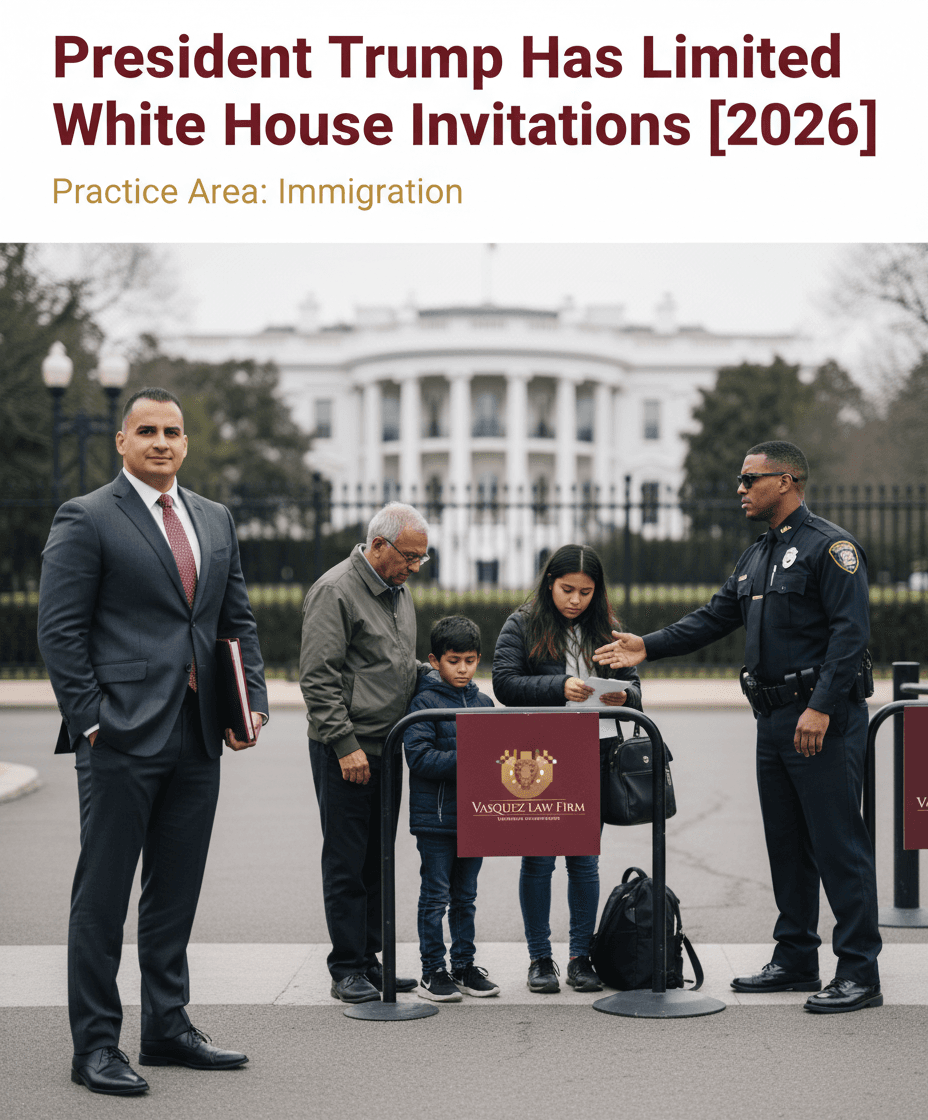
President Trump has reportedly limited White House invitations to Republican governors only. In response, 18 Democratic governors boycott the traditional dinner. Contact us for help.
Vasquez Law Firm
Published on February 11, 2026
Have questions? Talk to an attorney — free evaluation.
Call 1-844-967-3536Why President Trump Limited White House Invitations in 2026
Disclaimer: This article provides general information about immigration and political developments. It is not legal advice. For case-specific guidance, please consult an immigration attorney.
President Trump has reportedly limited White House invitations to Republican governors only. In response, 18 Democratic governors have officially announced a boycott of the traditional White House dinner. On February 1, 2026, a significant political and social divide unfolded as these Democratic governors jointly made their stance clear. The invitation list for the annual event was reportedly limited exclusively to Republican governors, excluding their Democratic counterparts. This decision has not only stirred political debate but also carries implications for immigrant communities, especially in key states like North Carolina and Florida, where the governors are central to local immigration policies and enforcement collaboration.
Worried About Immigration Policy Changes?
New policies can affect your case. Get current legal advice from an experienced immigration attorney.
If you are affected by these political developments or need personalized guidance, Schedule a Free Consultation with our trusted immigration attorneys today.
What Happened
In January 2026, media reports revealed that the White House restricted invitations for the traditional National Governors Association dinner to Republican governors only. This marked a departure from the long-standing practice of inviting governors from both major political parties. The move came as tensions heightened nationally over immigration enforcement and federal-state collaboration.
On February 1, the coalition of 18 Democratic governors officially announced their boycott, citing exclusion and the rejection of bipartisan dialogue. The list includes notable names such as Maryland Governor Wes Moore, Colorado Governor Jared Polis, and several others representing diverse states including Florida and North Carolina. This boycott underscored the political rift between federal leadership and many state governments on immigration policy and enforcement.
The White House spokesperson defended the invitation list as a focus on political alignment to foster direct policy conversations, particularly on issues like border security and immigration enforcement. However, critics argue this move politicizes a traditionally nonpartisan gathering, potentially undermining cooperative federalism.
Political Tensions and the Boycott
According to the National Governors Association, this marks one of the few instances in recent history where significant governors refused to attend this event collectively. The event’s usual attendance numbers exceed 50 governors from all states and territories, making this boycott a major disruption.
In addition to this immediate reaction, similar political exclusion scenarios have occurred in past administrations, illustrating a troubling trend towards partisanship in traditionally bipartisan venues. This intensification affects not only the political discourse but also the practical cooperation required for effective immigration enforcement nationwide.
Why It Matters: Political Divide and Immigration Policy Impact
The boycott impacts millions of Americans, particularly immigrants and immigrant communities, by signaling heightened political divisions that affect cooperative immigration governance. States like Florida and North Carolina, home to over 2.3 million and 1.1 million immigrants respectively according to 2025 US Census estimates, rely heavily on collaboration between state leaders and federal immigration agencies like ICE (Immigration and Customs Enforcement).
This incident highlights the challenges of securing consistent immigration policies amid divided government. Studies from the Migration Policy Institute indicate states with cooperative relationships with the federal government generally see more effective pathways for integration and access to legal protections. Conversely, political polarization can delay policy implementation and create uncertainty for immigrant families.
Data from USCIS show that states led by Democratic governors have higher rates of immigrants adjusting status or receiving asylum, reflecting their more inclusive policy stance. The White House dinner exclusion underscores potential conflicts ahead in federal-state immigration initiatives, with implications for labor markets, public safety, and humanitarian relief programs.
Impact on Immigrant Communities
Critics also warn that excluding Democratic governors weakens the national dialogue needed to address urgent immigration challenges, including border management, visa processing backlogs, and Temporary Protected Status (TPS) extensions. The symbolic nature of this exclusion amplifies distrust among immigrant communities wary of policy shifts impacting their rights and opportunities.
State-Level Policy Variations
Furthermore, this division may embolden states to pursue disparate immigration policies locally, resulting in a patchwork of enforcement and protections that could hinder economic stability and community cohesion. For example, in Florida, the Republican alignment with federal policy may contrast sharply with neighboring states opting for more inclusive measures, complicating regional immigration strategies.
Need for Bipartisan Efforts
These dynamics demonstrate how political discord at federal gatherings can ripple into real-world challenges for immigrants and governance alike, emphasizing the importance of renewed bipartisan efforts to address immigration reform effectively.
The Legal Landscape of White House Invitations and Immigration Cooperation
The tradition of the White House inviting all state governors to the National Governors Association event lacks codified legal mandate but serves as a political custom supporting federalism and dialogue. There are no statutes requiring invitations be extended to all governors, leaving it to executive discretion.
From an immigration law standpoint, federal policies govern enforcement and status adjustment, with statutes such as 8 U.S.C. A7 1101 et seq. (Immigration and Nationality Act) defining federal authority. State governments influence implementation through cooperation agreements under programs like 8 CFR Part 287, which regulate ICE and state/local law enforcement collaboration.
Recent federal court decisions, including Arizona v. United States, 567 U.S. 387 (2012), reinforce federal primacy on immigration enforcement while recognizing some state roles. However, political disputes, as seen in this boycott, complicate the consistent application of immigration laws across states.
The boycott also intersects with evolving federal policies on Deferred Action and DACA as the Department of Homeland Security finalizes new guidelines in 2026. States with governors participating in the boycott often serve as advocates for immigrant protections and may pursue litigation or state-level policy adaptations in response.
Expanding beyond legal statutes, this political dynamic raises questions about the limits of executive authority in excluding elected officials from important national discussions, potentially opening avenues for future legal challenges on equal access grounds. Additionally, the interaction between state sovereignty and federal discretion in immigration matters will likely be tested in this climate of divided governance.
Legal experts note that while invitations to such events are discretionary, the exclusion of a large number of governors based on party affiliation may impact the legitimacy and effectiveness of policy discussions and initiatives aimed at comprehensive immigration reform.
What This Means For You: Practical Guidance for Immigrants
For immigrants and families, this political development might signal potential shifts or delays in immigration services linked to federal-state partnerships. If you reside in states impacted by the governors boycott, staying informed about local policies is crucial.
Here are practical steps you can take:
- Monitor your state government and local agency announcements related to immigration services.
- Keep key documents updated, including immigration status paperwork, employment authorization, and travel documents.
- Track Federal deadlines, such as renewal periods for TPS, DACA, and visa applications, at USCIS.gov.
- Reach out to community organizations or legal aid for updates on policy changes affecting immigrant communities.
- Consider consulting an immigration attorney to evaluate how political changes may affect your case or status.
We encourage you to collect documents such as your I-94, employment authorization card, and proof of residence, as these may be needed for any legal proceedings or status adjustments. Staying proactive ensures you are prepared for any administrative changes.
If you are uncertain about how recent political developments may impact your immigration process, our expert attorneys are ready to help you navigate these challenges effectively. Schedule a Free Consultation and get expert legal help.
What's Your Immigration Situation?
Answer 3 questions — we'll tell you your options
Question 1 / 3
What best describes your situation?
Keep Reading
Upcoming Challenges in Immigration Enforcement and Policy
Looking ahead, the political divide illustrated by this boycott may persist through 2026. Legislative proposals pending before Congress such as the State-Federal Immigration Collaboration Act aim to formalize partnerships but face uncertain prospects.
Upcoming hearings before congressional committees, including testimony from ICE and Homeland Security officials as reported by the BBC in early 2026, will influence the direction of immigration enforcement policy. Their outcomes could either deepen or ease the current political tensions.
Governors not present at the White House dinner are expected to hold separate forums to discuss policy alternatives and coalition-building. Public and immigrant community advocacy groups are also mobilizing to push for renewed dialogue.
To stay informed, subscribe to official channels such as the National Governors Association and USCIS alerts, and follow updates from reputable news outlets and legal resources.
Moreover, states inclined to pursue independent immigration policies may collaborate more closely on regional initiatives outside federal oversight, potentially creating innovative pilot programs that could influence future national policies.
Frequently Asked Questions
- Why did the White House limit invitations to Republican governors only?
- According to official White House statements, the decision focused on aligning political dialogue on immigration enforcement policies. Critics argue it excludes diverse perspectives essential for bipartisan solutions.
- How does the boycott affect immigration policies in states like Florida and North Carolina?
- States led by boycotting governors may pursue independent policies or courts challenges, potentially causing inconsistencies in implementation of federal immigration programs, affecting immigrants access to services.
- Are governors required by law to be invited to the White House dinner?
- No federal law mandates invitations to governors for this event. It is a political tradition managed by the Executive Office and the National Governors Association.
- What immigration-related laws impact state roles in enforcement?
- The Immigration and Nationality Act (8 U.S.C. A7 1101 et seq.) sets federal authority, while regulations under 8 CFR Part 287 govern cooperation between federal agencies and state/local law enforcement.
- How can immigrants prepare for possible policy changes due to this political feud?
- Maintain up-to-date immigration documents, monitor state and federal announcements, consult with immigration lawyers, and stay connected with community organizations.
- Where can I find reliable updates on federal immigration policy in 2026?
- Trusted sources include the U.S. Citizenship and Immigration Services website (uscis.gov), Department of Homeland Security announcements, and official state government websites.
- Does the boycott affect visa application processing times?
- Indirectly, yes. Political conflicts may delay intergovernmental cooperation impacting visa processing, but federal agencies remain responsible for processing applications per law.
- What should I do if my immigration application is delayed?
- Check your case status online, gather supporting documents, and consider consulting an immigration attorney to explore options like expedite requests or legal remedies.
Disclaimer: This article contains general information and is not a substitute for personalized legal advice. Immigration law is complex and subject to change. Early consultation with a qualified attorney is recommended.
Vasquez Law Firm
Legal Team
Our experienced attorneys at Vasquez Law Firm have been serving clients in North Carolina and Florida since 2011, with 70+ years of combined attorney experience. We specialize in immigration, personal injury, criminal defense, workers compensation, and family law.
Related Legal Services
Need legal help? Learn more about NC immigration legal team, or contact us for a free evaluation.
You can also visit immigration legal services throughout NC for more information.