What to Do After an Arrest in North Carolina and How to Get Help
Need a criminal defense lawyer NC? Learn your rights, DUI refusal laws, and next steps. Call Vasquez Law Firm, PLLC at 1-844-967-3536.
Published on January 14, 2026· Updated March 3, 2026
Protect your record and your freedom
Free, confidential review. 24/7.
Free & confidential · Se habla espanol · 24/7
Have questions? Talk to an attorney - free evaluation.
Call 1-844-967-3536Protect Your Record and Your Freedom
A confidential case review - available 24/7 for emergencies.
What to Do After an Arrest in North Carolina and How to Get Help
If you are searching for a criminal defense lawyer NC, you may be facing one of the hardest moments of your life—an arrest, a court date, or an investigation. This guide explains what happens after an arrest in North Carolina, how evidence is built against you, and why DUI breath-test refusal can trigger serious, automatic consequences. We also explain how the right defense strategy can protect your record, license, and future.
Charged with DUI/DWI?
A DUI conviction affects your license, job, and record. We can fight to reduce or dismiss charges.
Worried about what comes next? Get clear answers before you speak to anyone else. Call 1-844-967-3536 or request a free case evaluation. Se Habla Español.
What This News Means for Charlotte Drivers and Defendants
Why “Refusing” a Breath Test Can Be a Bigger Problem Than People Think
A recent legal news item discussed the consequences of refusing a breath test in a DUI case (see the news source on breath-test refusal consequences). Even though that article focused on New Jersey, the core issue is the same nationwide: refusal can trigger separate penalties and create leverage for the prosecution.
In North Carolina, refusal is not a “free pass.” It can lead to a civil license revocation and other case complications, even before your criminal case is resolved.
How This Plays Out in Charlotte in Real Life
In charlotte, DUI/DWI arrests often start with a traffic stop on major corridors like I-77 or I-85, or after late-night driving near Uptown entertainment areas. Once blue lights come on, what you say and do—especially around field sobriety tests and chemical testing—can change the entire case.
As a criminal defense lawyer NC clients rely on, we often see people make decisions based on myths from social media. Your best move is to get legal advice specific to North Carolina law and your facts.
Key Takeaway: “Automatic” Penalties Require a Fast Response
Some consequences start quickly, sometimes within days. That is why timing matters. The earlier you involve counsel, the more options you may have to challenge the stop, suppress evidence, negotiate outcomes, and protect your driving privileges.
North Carolina DWI and Implied-Consent Laws (Plain English)
Implied Consent: What You Agree to by Driving
North Carolina is an “implied consent” state. That means when you drive on NC roads, you are deemed to have agreed to chemical testing (breath or blood) if lawfully arrested for an implied-consent offense. The main implied-consent statute is N.C. Gen. Stat. § 20-16.2.
You can read more about North Carolina court processes and resources through the North Carolina Judicial Branch (NCCourts.gov).
The DWI Charge Itself: The Core Rule
North Carolina DWI is generally charged under N.C. Gen. Stat. § 20-138.1. In simple terms, the state may try to prove impairment by alcohol, drugs, or a combination—using officer observations, field tests, chemical results, and sometimes video.
For the text of statutes, a reliable source is the North Carolina General Assembly site at NCGA (ncleg.gov).
What Happens If You Refuse in NC
Refusal can trigger a civil license revocation and additional hurdles. It can also affect how the state argues your case (for example, suggesting “consciousness of guilt”).
Important: whether a refusal helps or hurts depends on many factors, including prior record, the reason for the stop, and the strength of other evidence. This is a situation where a criminal defense lawyer NC can quickly spot issues that are not obvious from paperwork alone.
What Really Happens After an Arrest in NC (Step-by-Step)
The First 24 Hours: Bail, Conditions, and Mistakes to Avoid
After an arrest, you may face a magistrate, conditions of release, and a court date. This is also when people often make damaging statements. Two rules help almost everyone:
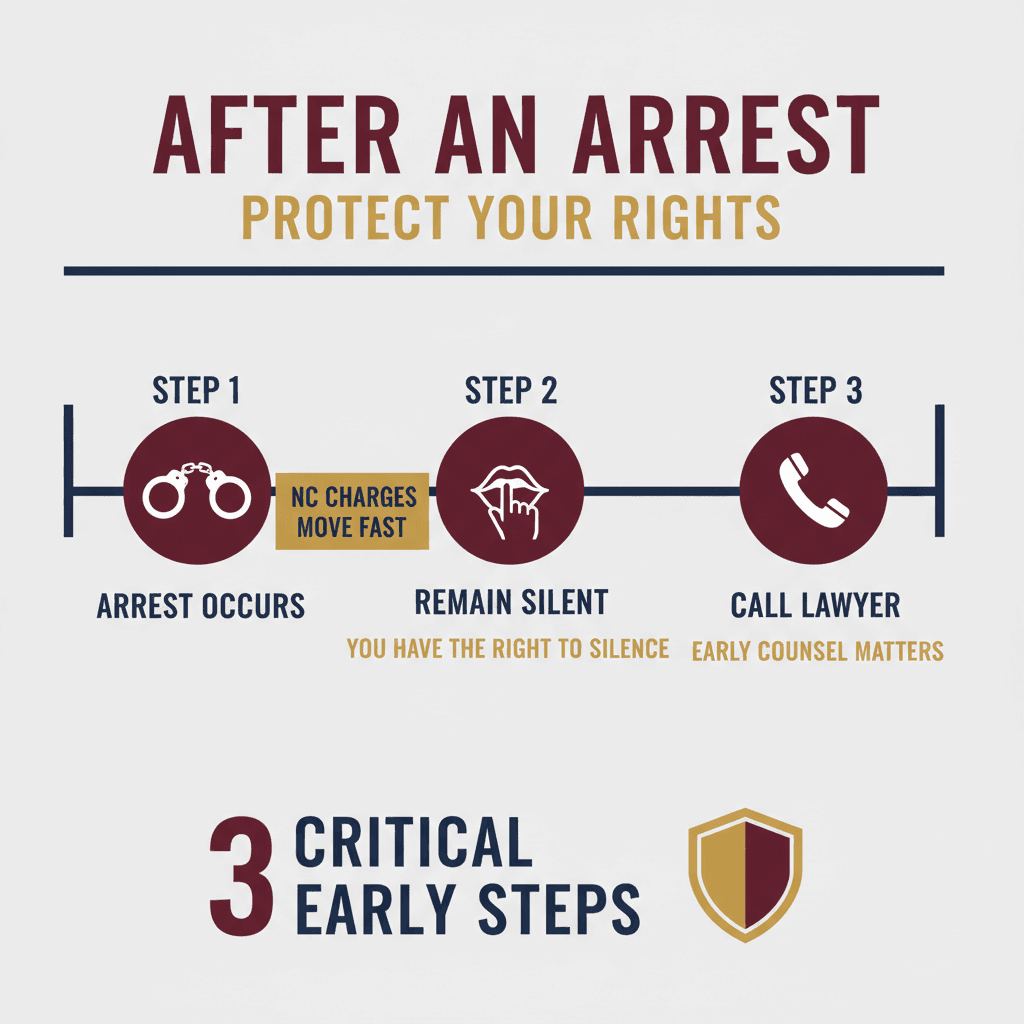
- Use your right to remain silent. Be polite, but do not explain or argue your case roadside or in booking.
- Do not consent to searches without speaking to counsel (but do not physically resist).
Charging, First Appearance, and Where Your Case May Be Heard
Many cases in Mecklenburg County move through the court system at or connected to the Mecklenburg County Courthouse in charlotte. Your charge level (misdemeanor or felony) affects procedure, exposure, and whether a grand jury indictment is involved.
Even for “common” charges, the consequences can be life-changing—jail time, probation, fines, loss of license, employment issues, and immigration concerns in certain cases.
How the State Builds a Case (and How Defense Counters It)
Prosecutors and police may rely on:
- Officer observations and reports
- Body-worn camera or dashcam video
- Witness statements
- Breath/blood test results and chain-of-custody records
- Lab testing in drug cases
A defense strategy often focuses on legality and reliability: Was the stop lawful? Were tests administered correctly? Is the evidence admissible? A skilled criminal defense lawyer NC will look for suppression issues and procedural errors that can reduce or dismiss charges.
Do not wait for your next court date to get help. Call 1-844-967-3536 today and also message us for a free case evaluation. Se Habla Español.
How a Criminal Defense Lawyer Can Protect You in NC
Early Intervention: Stopping Damage Before It Spreads
Many people hire a lawyer after they feel “behind.” But the best time is as soon as you learn you are being investigated or charged. Early representation can help:
- Preserve video and witness evidence
- Prevent accidental self-incrimination
- Address bond conditions and license issues
- Open productive negotiations with the state
Motions That Can Change the Outcome
Depending on the facts, your lawyer may file motions to suppress evidence under constitutional standards, including Fourth Amendment issues (unlawful stops/searches) and Fifth Amendment concerns (custodial interrogation). These motions can reduce evidence, improve negotiation leverage, or lead to dismissal.
In impaired-driving contexts, U.S. Supreme Court cases like Birchfield v. North Dakota (2016) and Missouri v. McNeely (2013) are often discussed nationally regarding chemical testing and warrants. How those principles interact with North Carolina procedure depends on your specific timeline and the type of test requested.
Negotiation, Trial Readiness, and Realistic Planning
A strong defense is not only about trial. It is also about preparing as if the case could go to trial so negotiations are taken seriously. When appropriate, counsel may pursue charge reductions, alternative resolutions, or sentencing advocacy.
If you want to learn how we approach cases, visit our Criminal Defense services page.
Why People Choose Vasquez Law Firm, PLLC in Charlotte
Experience, Credentials, and Local Knowledge
Vasquez Law Firm, PLLC is led by Attorney Vasquez, JD, with 15 years of experience and bar admissions in the North Carolina State Bar and the Florida Bar. That depth matters when your future is on the line.
We serve charlotte residents and clients throughout Mecklenburg County and nearby communities like Matthews, Huntersville, Pineville, Concord, and Gastonia.
Clear Communication (Se Habla Español)
Criminal court is stressful. Language barriers make it worse. Our team provides bilingual support—Se Habla Español—so you can understand your options and make informed choices.
What to Bring to Your Consultation
How Serious Are My Charges?
Find out what you're facing and your options
Question 1 / 3
What are you charged with?
Keep Reading

If possible, bring:
- Your citation(s), bond paperwork, and any release conditions
- Any notice about civil license revocation (if DWI-related)
- A written timeline of events (where you were, who was with you)
- Names of witnesses and any available video sources
Learn more about our team on the Attorney Vasquez and attorneys page.
Practical Steps to Take Right Now (Before Court)
Do This / Not That: A Simple Checklist
- Do show up to court on time and follow bond conditions.
- Do save texts, call logs, and receipts that support your timeline.
- Do not discuss your case on social media or with coworkers.
- Do not contact alleged victims or witnesses if a no-contact condition exists.
If Your License Is at Risk, Act Fast
In many cases, driving privileges can be impacted early. The steps to challenge or restore driving privileges can be time-sensitive. A criminal defense lawyer NC can review deadlines and your eligibility based on your record and the allegation.
Avoid New Charges While Your Case Is Pending
While a case is pending, even small mistakes can snowball—new charges, bond violations, or probation issues. Stay compliant, avoid risky situations, and let your lawyer communicate on your behalf when needed.
Frequently Asked Questions (FAQ)
1) Should I refuse a breath test in North Carolina?
There is no one-size-fits-all answer. Refusing can trigger civil penalties under North Carolina’s implied-consent rules (often including license consequences), and it may not prevent the state from building a case using other evidence. Talk to a lawyer about your exact facts as soon as possible.
2) Can police search my car during a traffic stop?
Sometimes, but not always. Police may search with consent, with a warrant, or under certain exceptions (like probable cause to believe evidence of a crime is present). If a search was unlawful, your attorney may file a motion to suppress what was found.
3) What is the difference between a misdemeanor and a felony in NC?
Misdemeanors usually carry lower maximum penalties and different court procedures. Felonies are more serious and may involve indictment, higher sentencing exposure, and long-term consequences like loss of firearm rights. The charge level also affects strategy and negotiation options.
4) Will I go to jail on my first offense?
Not necessarily. Many outcomes depend on the charge, criminal history, and the evidence. Some cases may qualify for alternative resolutions or reduced sentencing. However, you should never assume jail is “off the table” without legal review.
5) How long does a criminal case take in Mecklenburg County?
Timelines vary. Some cases resolve in weeks; others take months or longer depending on evidence, lab results, motions, and court calendars. In charlotte, court scheduling and continuances can also affect timing.
6) How can Vasquez Law Firm, PLLC help me right now?
Vasquez Law Firm, PLLC can help you understand your charges, protect your rights, and build a defense plan based on the stop/arrest, evidence, and your goals. We prepare for negotiation and trial, and we communicate clearly throughout the process. Se Habla Español.
Ready to protect your future? Speak with a criminal defense lawyer NC clients trust. Call 1-844-967-3536 or schedule your free case evaluation today. Se Habla Español.
Disclaimer: This article is for general information only and does not create an attorney-client relationship. Every case is different, and results depend on specific facts and law.

William Vasquez
Founder & CEO, Vasquez Law Firm, PLLC
William Vasquez is the founder and CEO of Vasquez Law Firm, PLLC, a results-driven firm specializing in immigration, criminal defense, personal injury, and workers' compensation. A U.S. Air Force veteran and recipient of the Joint Service Achievement Medal, William is dedicated to fiercely fighting for his clients' rights.
Related Legal Services
Need legal help? Learn more about NC criminal defense legal team, or contact us for a free evaluation.
You can also visit criminal defense services in Harnett County for more information.