ai news today: What It Means for Criminal Defense
ai news today impacts arrests, evidence, and your rights. Learn what to do if accused in Raleigh—call Vasquez Law Firm, PLLC at 1-844-967-3536.
Vasquez Law Firm
Published on January 29, 2026

ai news today: What It Means for Criminal Defense in Raleigh
If you follow ai news today, you have probably seen a steady stream of stories about technology changing how police investigate, how prosecutors build cases, and how juries react to digital evidence. One recent headline about the “best criminal defense lawyers” highlights a truth that matters everywhere: in a fast-moving world, the quality of your defense can make a real difference. But the “AI era” adds new twists—like deepfake videos, AI-written threats, and algorithm-driven investigation tools—that can confuse cases and raise serious due process concerns.
At Vasquez Law Firm, PLLC, Attorney Vasquez (JD) brings 15 years of experience and bar admissions in the North Carolina State Bar and the Florida Bar to help people facing charges. We serve raleigh residents and surrounding communities with practical guidance, strong courtroom advocacy, and clear communication—Se Habla Español.
Worried an AI-related accusation (or digital evidence) could hurt your case? Get answers early. Call 1-844-967-3536 or request a confidential consult—Se Habla Español—here: /contact.
What This News Means for Raleigh Residents
Why a “best lawyers” headline connects to AI and criminal defense
The news that sparked this discussion was a headline about criminal defense lawyers and reputation: Times Union coverage on criminal defense lawyer rankings. Even though it focuses on a different city, it reflects a broader point: when your freedom is at stake, you need counsel who knows how to challenge evidence, negotiate effectively, and prepare for trial.
Now add ai news today to the mix. More cases involve:
- Phone extractions, cloud data, and location records
- AI-enhanced images or “cleaned up” audio
- Automated tips, social media monitoring, and data analytics
How it shows up locally in Raleigh
In raleigh and Wake County, people can face serious consequences based on digital “breadcrumbs.” An investigation may involve social media posts, texts, app data, Ring camera footage, or computer records. These sources are often presented as “objective.” But they can be incomplete, misinterpreted, or improperly obtained.
What you should do if AI or digital evidence is involved
If you believe an accusation is tied to online content, a hacked account, a spoofed phone number, or an altered video, treat it like an emergency. Save what you can, stop talking about the case publicly, and speak to a defense lawyer before speaking to investigators.
How AI Changes Investigations and Criminal Cases
Common AI-adjacent tools used in modern policing
Not every “AI” tool is truly artificial intelligence, but many systems use automated decision-making or pattern matching. These tools can influence who gets investigated and what evidence is emphasized. Examples include:
- Facial recognition and image comparison systems
- License plate reader databases that track vehicle locations
- Digital forensics tools that extract phone and app data
- Online monitoring of posts, messages, and marketplaces
The biggest risks: mistakes, bias, and overconfidence
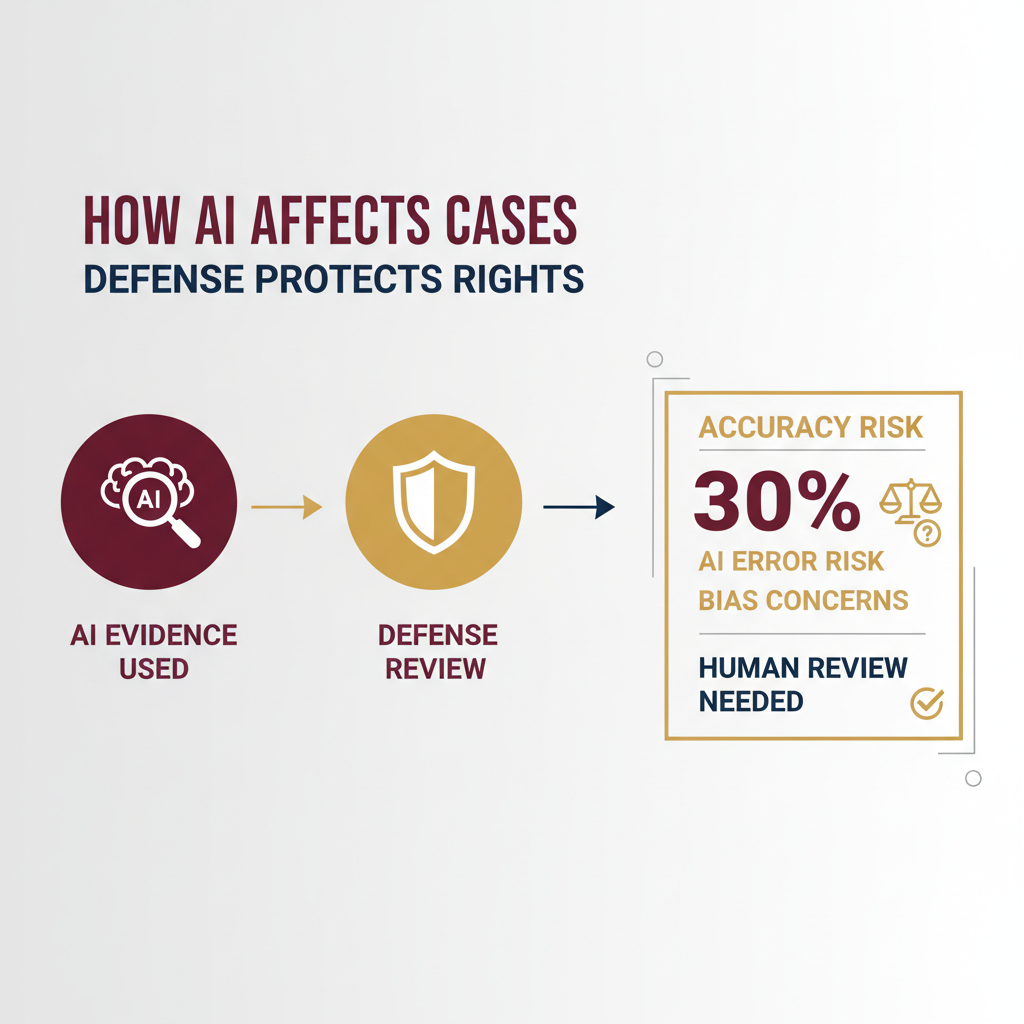
A major theme in ai news today is that automated systems can be wrong—and people often trust them anyway. In criminal court, that can look like:
- False matches (misidentification from low-quality images)
- Context loss (a joke or lyric treated as a “threat”)
- Overstated certainty (tech presented as flawless when it is not)
Deepfakes and AI-generated content: the new credibility problem
Deepfakes and AI-generated text raise a hard question: “Is this even real?” A video, voice note, or screenshot may look convincing but still be manipulated. A strong defense often requires demanding the original file, metadata, chain-of-custody records, and the method used to “enhance” or analyze the content.
Your Rights When the State Uses Digital or AI-Related Evidence
Search warrants, phones, and the Fourth Amendment
Many tech-driven cases come down to search and seizure rules. The government usually needs lawful authority (often a warrant) to search a phone or seize certain digital data. If officers overreach, a defense may challenge the evidence.
North Carolina court procedures and resources are available at the North Carolina Judicial Branch, including information about criminal court processes and courthouse operations.
Stored communications and account records
When police seek emails, private messages, cloud files, or subscriber data, federal law can come into play. One key law is the Stored Communications Act (part of the Electronic Communications Privacy Act), including 18 U.S.C. § 2703, which covers when the government may require providers to disclose customer communications or records.
Discovery and what the State must share
Digital cases often require aggressive discovery demands. In North Carolina, criminal discovery is governed in part by N.C. Gen. Stat. § 15A-903, which addresses information the State must disclose. For digital evidence, that can include reports, forensic outputs, and witness statements that explain how evidence was obtained and interpreted.
Don’t wait for court to “sort it out.” If your case involves phone data, social media, or alleged AI-generated content, get legal help now. Call 1-844-967-3536—Se Habla Español—or contact us: /contact.
AI-Related Charges We’re Seeing More Often
Identity theft, impersonation, and account takeovers
AI tools can make scams faster: fake profiles, voice cloning, and realistic “verification” messages. But in criminal court, the key issue is proof. Prosecutors must show you were the person behind the device or account—and that you acted with the required intent.
North Carolina’s identity theft law, N.C. Gen. Stat. § 14-113.20, is often relevant in these cases.
Computer crimes and “unauthorized access” allegations
Cases may involve accusations of hacking, password sharing, or accessing systems “without permission.” Federal law sometimes enters the picture, including the Computer Fraud and Abuse Act, 18 U.S.C. § 1030. These cases can turn on technical details: how access was obtained, whether permission existed, and whether damage or fraud occurred.
Threats and harassment based on AI-generated text
Another trend in ai news today is AI-generated messaging. If someone claims you sent threatening or harassing messages, the defense may involve:
- Proving spoofing, account compromise, or shared device access
- Challenging screenshots and insisting on original data
- Showing context and intent (what was meant vs. how it was read)
How a Strong Defense Is Built in an AI-Influenced Case
Step 1: Challenge authenticity and chain of custody
“Is it real?” is the first question. A defense can focus on whether a file was altered, where it came from, and who handled it. With AI-enhanced evidence, we look carefully at:
- Original files vs. copies
- Metadata (timestamps, device data, edit history)
- Collection methods and documentation
Step 2: Test reliability with experts and the right legal standards
When the State uses technical methods, the court may need to evaluate whether the approach is reliable. In North Carolina, courts look to a reliability framework reflected in cases like State v. McGrady (addressing expert testimony reliability). If the prosecution’s “AI tool” is essentially a black box, we may push to expose its limits.
Step 3: Focus on outcomes that protect your future
A good defense is not only about trial. It is also about protecting your job, immigration status, professional license, and record. Depending on facts, that may involve:
- Negotiating for dismissal or reduction
- Seeking diversion or deferred prosecution where available
- Fighting suppression issues when evidence was illegally obtained
To learn how we approach these cases, visit our Criminal Defense services page.
Why Raleigh Clients Choose Vasquez Law Firm, PLLC
Experienced counsel with real courtroom focus
Attorney Vasquez, JD, has 15 years of experience handling criminal matters and is admitted to the North Carolina State Bar and the Florida Bar. Our team understands how prosecutors build cases and how to respond with disciplined preparation.
Local knowledge that matters in Wake County
Serving raleigh residents means understanding local procedures, timelines, and courtroom expectations. Many cases proceed through the Wake County Justice Center area and related court settings, and preparation must match the pace of the local docket.
Clear communication—Se Habla Español
Technology-based allegations can be confusing and scary. We explain the process in plain language and give you a plan. We are proud to say: Se Habla Español.
Want to learn more about the team? Visit our Attorney Vasquez and attorney profiles page.
Frequently Asked Questions (FAQ)
1) Can AI-generated evidence be used against me in court?
Sometimes, yes. But it must still meet rules of admissibility, including authentication and reliability. If the evidence is altered, lacks a clear chain of custody, or was created through an unreliable process, it may be challenged. In a case influenced by ai news today trends—like deepfakes—authentication is often the central fight.
2) What if a deepfake video or voice recording is used to accuse me?
You should assume it can be persuasive to a jury unless challenged effectively. A defense may demand original files, metadata, and the method used to create or enhance the media. We may also use expert review when appropriate to show manipulation or inconsistencies.
3) Do police need a warrant to search my phone in North Carolina?
Often they do, but the answer depends on the facts (consent, incident to arrest issues, and other exceptions). If a search was unlawful, your attorney may move to suppress evidence. Your best step is to politely decline consent and ask for a lawyer.
4) If someone used my account, can I still be charged?
Yes, charges can still happen, especially if investigators assume the account owner is the user. The defense then focuses on proof: device access, IP logs, account recovery events, and whether the State can actually tie actions to you beyond a reasonable doubt.
5) I’m in Raleigh—what should I do right after an arrest involving digital evidence?
Stay calm and don’t try to “explain” the tech to officers. Don’t consent to searches. Don’t delete data. Contact counsel quickly so evidence can be preserved and requests can be made before records disappear. Serving raleigh means we are used to moving fast when timelines are tight.
6) How soon should I hire a criminal defense lawyer?
As soon as you know you’re under investigation or have been charged. Early representation helps protect your rights, secure discovery, and prevent mistakes—especially when evidence is complex. If you’re tracking ai news today and worried your case involves AI tools or digital proof, early legal guidance is even more important.
Accused of a crime involving digital evidence, social media, or AI-related allegations? Call 1-844-967-3536 today. Se Habla Español. Or request your confidential consultation online: /contact.
Disclaimer: This article is for general information only and does not create an attorney-client relationship. Every case is different. For legal advice, speak with a qualified attorney.
Free Legal Consultation
Discuss your case with our experienced attorneys. We're available 24/7.
Vasquez Law Firm
Legal Team
Our experienced attorneys at Vasquez Law Firm have been serving clients in North Carolina and Florida for over 20 years. We specialize in immigration, personal injury, criminal defense, workers compensation, and family law.