What To Do If ICE Stops You: Know Your Rights in 2026
What to do if ICE stops you: An attorney answers some questions - MPR News. Learn your rights and call Vasquez Law Firm: 1-844-967-3536.
Published on January 13, 2026· Updated August 6, 2026
Talk to an immigration attorney
Free call. A clear plan for your case.
Free & confidential · Se habla espanol · 24/7

Have questions? Talk to an attorney - free evaluation.
Call 1-844-967-3536Worried how the latest immigration news affects you?
Schedule a confidential case review with an immigration attorney - know exactly where you stand.
What to Do If ICE Stops You and How an Attorney Can Help
If you have seen What to do if ICE stops you: An attorney answers some questions - MPR News and feel worried about an ICE encounter, you are not alone. Many people—citizens and non-citizens—do not know what to say, what to show, or when they can walk away. This guide breaks it down in plain English, with practical steps you can use in real life.
ICE encounter or deportation risk?
Time-sensitive cases need quick action. We answer 24/7 for emergency immigration matters. Free 15-min call.
Important: This article is general information, not legal advice for your specific case. Immigration law is fact-based, and small details matter.
Need help now? Talk with an immigration attorney before a small problem becomes a bigger one. Call 1-844-967-3536 or request a confidential consultation. Se Habla Español.
1) Why This Topic Is in the News—and Why It Matters in charlotte
A tragic reminder of how fast ICE encounters can turn serious
Recent coverage has renewed public attention on immigration enforcement and safety during law-enforcement encounters. One article raising questions is about a woman killed during ICE activity in Minneapolis, discussed in this BBC-related news item: read the full news report about the ICE incident in Minneapolis.
What “MPR News” style questions usually focus on
Articles like What to do if ICE stops you: An attorney answers some questions - MPR News often cover the same urgent issues: Do you have to answer? Can you refuse a search? What happens if ICE asks where you were born?
Those questions matter here, too—especially for families in charlotte and nearby communities like Matthews, Pineville, Gastonia, Concord, and Monroe.
Why charlotte residents ask these questions
charlotte is a major hub for work, travel, and new arrivals. That also means people may face immigration questions at traffic stops, at work sites, or even at home.
Knowing your rights ahead of time can reduce panic, lower the risk of misunderstandings, and help protect your legal options.
2) ICE vs. Police: The Legal Basics You Need to Know
Who is ICE, and what can they do?
ICE (Immigration and Customs Enforcement) is a federal agency under the Department of Homeland Security. ICE may investigate and arrest people for suspected immigration violations. Their authority comes from federal immigration law, including 8 U.S.C. § 1357 (powers of immigration officers) and related regulations.
Even so, ICE does not have unlimited power. The Constitution still matters, and ICE must follow rules about arrests, searches, and questioning.
Key documents: judicial warrant vs. ICE “warrant”
A big point of confusion is the word “warrant.” In everyday language, people think any warrant allows entry into a home. But there are different types:
- Judicial warrant: Signed by a judge or magistrate. This is the strongest type and may allow entry/search depending on what it says.
- ICE administrative warrant: Often on forms like I-200 or I-205. These are usually signed by an immigration official—not a judge.
Whether ICE can enter your home often depends on whether they have a judicial warrant, consent, or another lawful basis.
What happens after ICE action: the immigration court process
If ICE starts removal (deportation) proceedings, you may receive a Notice to Appear (NTA), which begins a case in immigration court. In North Carolina, many matters are handled through the Charlotte Immigration Court, and hearings may be scheduled through the Executive Office for Immigration Review (EOIR).
3) What to Do If ICE Stops You in Public (Street, Store, Bus, or Traffic Stop)
Step-by-step: stay calm, find out if you can leave
If ICE approaches you in public, your first goal is to figure out whether you are being detained or if the contact is voluntary.
- Stay calm and keep your hands visible. Do not run or argue.
- Ask: “Am I free to leave?”
- If they say yes, walk away calmly.
- If they say no, you are being detained. You still have rights.
Do you have to answer questions?
You generally do not have to answer questions about where you were born or your immigration status. A simple, respectful line can help:
- “I choose to remain silent.”
- “I want to speak with a lawyer.”
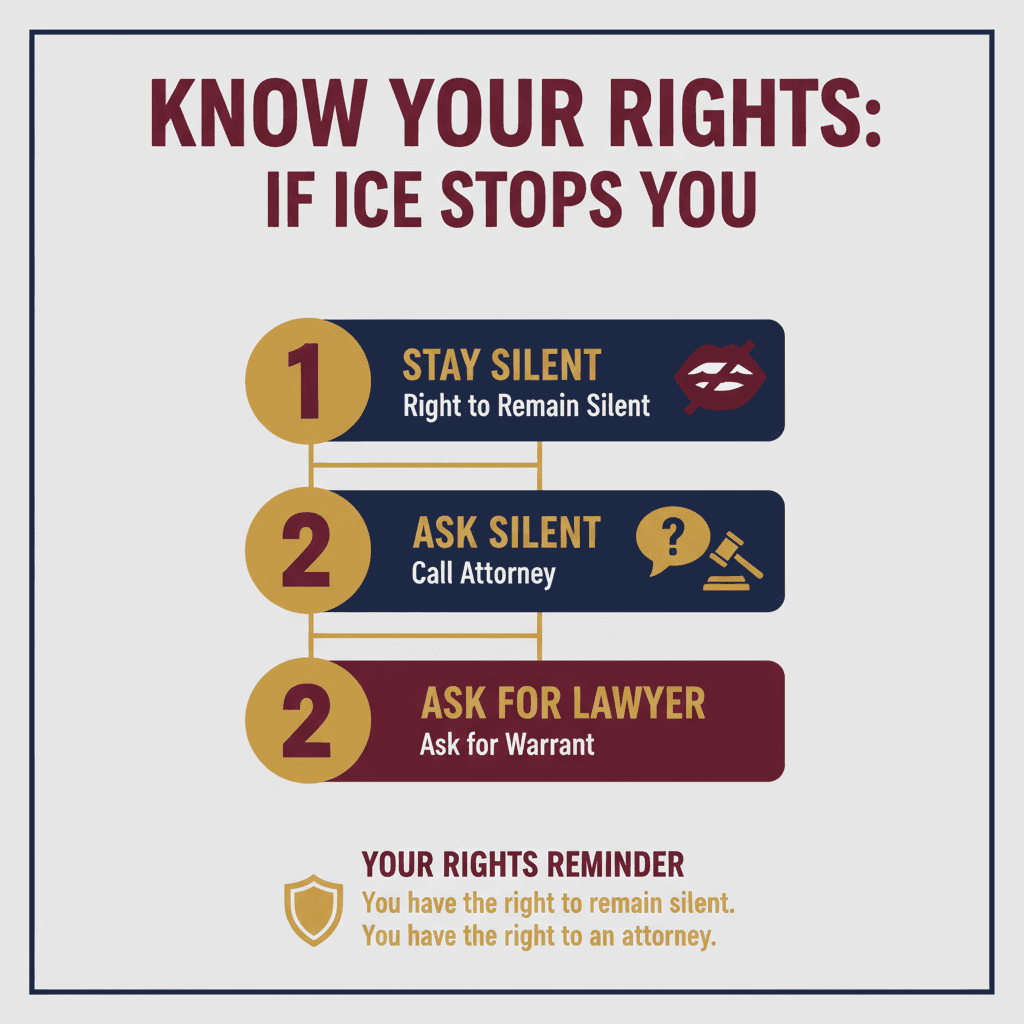
Be careful about lying or using false documents. Those actions can create serious criminal and immigration consequences.
Can ICE search your phone, car, or bag?
ICE may ask to search you or your belongings. You can say:
- “I do not consent to a search.”
They may still search in some situations, but your refusal matters. Do not physically resist. Instead, repeat that you do not consent and ask for an attorney.
Quick reminder from What to do if ICE stops you: An attorney answers some questions - MPR News style guidance: staying calm, not consenting to searches, and asking for a lawyer are often the safest starting points.
4) What to Do If ICE Comes to Your Home or Workplace
If ICE comes to your home: don’t open the door right away
If ICE knocks, you can speak through the door. Opening the door can create risks and confusion about “consent.” Ask them to show a warrant and slide it under the door or hold it up to a window.
Look for:
- A judge’s name and signature
- Your correct address
- What areas they are allowed to enter
If it is an ICE administrative warrant (common), it may not allow them to enter without permission.
If ICE comes to work: know the difference between public and private areas
Worksite enforcement can be complicated. ICE may enter public areas open to customers. Private areas may require consent or proper legal authority.
If you are an employee, you may still use the same core steps:
- Stay calm and do not run.
- Ask if you are free to leave.
- Do not consent to searches.
- Ask to speak with a lawyer.
Make a family safety plan before anything happens
Planning is not panic—it is protection. Families in charlotte can reduce risk by preparing now:
- Memorize important phone numbers (not just in your phone).
- Keep copies of key documents in a safe place.
- Identify a trusted person who can care for children if needed.
- Talk with an attorney about your options (bond, relief, status).
5) If You Are Arrested or Detained: What Happens Next (and What to Ask For)
Do not sign paperwork you do not understand
ICE may pressure people to sign forms quickly. Some forms can waive rights or speed up removal.
If you do not understand a document, say:
- “I want to speak to my attorney before I sign.”
- “I need an interpreter.”
Bond, detention, and the right to a hearing
Many people may qualify for an immigration judge bond hearing, but not everyone. Detention rules are shaped by federal statutes like 8 U.S.C. § 1226 and case law. For example, the U.S. Supreme Court has addressed detention limits and hearings in cases such as Jennings v. Rodriguez (2018).
Because detention rules are complex, getting advice fast is critical—especially if you have prior orders, criminal charges, or prior deportations.
What your family should gather while you’re detained
Families can help your lawyer by collecting:
- Your A-number (Alien Registration Number), if you have one
- Any prior immigration paperwork (NTAs, old court orders)
- Criminal disposition records (final outcomes, not just charges)
- Proof of residence and ties: lease, bills, school records
- Proof of good character: letters, community involvement, church
Time matters in detention cases. If ICE has already contacted you or a loved one, call 1-844-967-3536 now or send us a message. Se Habla Español.
What's Your Immigration Situation?
Answer 3 questions - we'll tell you your options
Question 1 / 3
What best describes your situation?
Keep Reading
6) How to Protect Your Immigration Options After an ICE Encounter
Check your case the right way (and avoid scams)
If you have a pending application, use official sources. For example, many immigration benefits are handled through USCIS (U.S. Citizenship and Immigration Services). Your attorney can help you gather receipts, confirm deadlines, and reduce mistakes.
Be cautious of notarios and “consultants” who promise quick fixes. Wrong filings can lead to denials or even removal proceedings.
Travel risks: do not leave the U.S. without legal advice
After ICE contact, some people think leaving the U.S. will “reset” the problem. That can backfire. Departing can trigger bars to reentry or abandon certain applications.
If you have to travel for an emergency, review visa and entry rules first at the U.S. Department of State visa information page—and talk to an attorney before you go.
Document everything about the stop
As soon as you can, write down:
- Date, time, and location
- How many officers and what agency they claimed
- What questions were asked and what you answered
- Whether they showed a warrant (and what it said)
- Names/badge numbers (if you saw them)
This information can help your lawyer challenge an unlawful stop or protect you in immigration court.
Many readers searching What to do if ICE stops you: An attorney answers some questions - MPR News are looking for one clear rule: do not guess—get advice based on your exact facts.
7) How Vasquez Law Firm, PLLC Helps People Facing ICE and Removal Cases
Real legal guidance from an immigration attorney
At Vasquez Law Firm, PLLC, we help clients understand what is happening and what options they may have. Attorney Vasquez, JD, has 15 years of experience in immigration law and is admitted to the North Carolina State Bar and the Florida Bar.
We regularly advise clients on ICE encounters, detention, bond, removal defense, and long-term immigration strategies.
Serving charlotte residents with local awareness
We serve charlotte residents and families across the region. We understand the practical realities of local processing, including how cases move through the Charlotte Immigration Court and how timing and paperwork affect outcomes.
We also recognize that many families live and work near major corridors and landmarks—like the Charles R. Jonas Federal Building area—where federal activity may feel more visible.
What we may do first in your case
Every case is different, but common first steps include:
- Reviewing immigration history, entries, and prior court orders
- Requesting records (FOIA) and checking your status
- Evaluating relief: bond, asylum, cancellation, adjustment, waivers
- Preparing a plan for your family if detention happens
Learn more about our Immigration Law services or meet our team on the Attorney Vasquez page.
Frequently Asked Questions (FAQ)
Questions people ask after reading MPR-style guidance
1) Can ICE stop me just for “looking undocumented”?
ICE can approach people in public and ask questions, but stopping or detaining someone still must follow legal rules. Appearance alone should not be the only basis for a detention. If you believe you were unlawfully stopped, write down details and speak with an attorney.
2) Do I have to show ID to ICE?
Rules vary by situation. In many public encounters, you can ask if you are free to leave and you can choose to remain silent. If you are driving, state law may require you to show a driver’s license to police during a lawful traffic stop. If you are unsure, ask to speak with a lawyer before answering immigration questions.
3) What if ICE asks to come inside my home?
You can refuse entry unless they show a valid judicial warrant signed by a judge. Ask them to slide the warrant under the door or show it through a window, and check the name/address. Do not physically block officers; instead, state clearly that you do not consent to entry.
4) Should I carry my immigration papers with me?
Carrying original documents can be risky if they get lost. Many people carry copies and keep originals in a safe place. The right approach depends on your status and history. An attorney can help you decide what makes sense for your situation.
5) If ICE detains me, can I get bond?
Some people may request a bond hearing, but eligibility depends on factors like prior orders, certain criminal convictions, and how the government classifies the case. Bond issues often involve 8 U.S.C. § 1226 and immigration judge discretion. A lawyer can quickly identify whether bond is possible and what evidence helps.
6) What is the safest thing to say if I’m scared?
Keep it simple and respectful: “Am I free to leave?” If not, say “I choose to remain silent. I want to speak with a lawyer.” This approach—often emphasized in What to do if ICE stops you: An attorney answers some questions - MPR News—reduces the chance of accidental admissions or contradictions.
A note about your specific case
Immigration outcomes depend on details like your entries, prior applications, criminal history, and family ties. If you have had ICE contact in charlotte or anywhere in North Carolina, get legal advice tailored to your facts.
Ready to protect yourself and your family? Call 1-844-967-3536 or schedule a confidential consultation with Vasquez Law Firm, PLLC. Se Habla Español. The sooner you act, the more options you may have.
Keyword note: This article is inspired by public interest in What to do if ICE stops you: An attorney answers some questions - MPR News and aims to give practical, rights-focused guidance.

William Vasquez
Founder & CEO, Vasquez Law Firm, PLLC
William Vasquez is the founder and CEO of Vasquez Law Firm, PLLC, a results-driven firm specializing in immigration, criminal defense, personal injury, and workers' compensation. A U.S. Air Force veteran and recipient of the Joint Service Achievement Medal, William is dedicated to fiercely fighting for his clients' rights.
Related Legal Services
Need legal help? Learn more about experienced immigration attorneys in Charlotte, or contact us for a free evaluation.
You can also visit immigration attorneys across North Carolina for more information.