What To Do If ICE Stops You: Know Your Rights in 2026
What to do if ICE stops you: An attorney answers some questions - MPR News—know your rights. Call 1-844-967-3536 (Se Habla Español).
Published on January 13, 2026· Updated August 6, 2026
Talk to an immigration attorney
Free call. A clear plan for your case.
Free & confidential · Se habla espanol · 24/7

Have questions? Talk to an attorney - free evaluation.
Call 1-844-967-3536Worried how the latest immigration news affects you?
Schedule a confidential case review with an immigration attorney - know exactly where you stand.
What to Do If ICE Stops You and Your Legal Rights Explained
If you’re worried about immigration enforcement, you are not alone. The questions raised in What to do if ICE stops you: An attorney answers some questions - MPR News matter even more as states and communities respond to changing federal immigration priorities. Below is a plain-English guide to help you protect yourself and your family if ICE approaches you at home, in public, or during a traffic stop.
ICE encounter or deportation risk?
Time-sensitive cases need quick action. We answer 24/7 for emergency immigration matters. Free 15-min call.
Need calm, private legal advice now? Call 1-844-967-3536 or request a free case evaluation. Se Habla Español.
1) Why this news matters for Orlando residents
Recent headlines about immigration crackdowns and state responses can make everyday life feel uncertain. Even if you have a pending case, a work permit, or a long history in the U.S., a surprise ICE encounter can happen quickly and feel overwhelming.
A quick note on the news context
One example is coverage of increased enforcement activity and political pushback, including this report on Minnesota’s lawsuit over federal immigration enforcement. While the legal fight is complex, the takeaway is simple: enforcement priorities can shift fast, and the safest plan is to know your rights before you’re stopped.
What this means on the ground in Central Florida
In orlando and nearby cities like Kissimmee, Winter Park, Apopka, and Sanford, ICE encounters may start after a traffic stop, a workplace inquiry, or a visit to a home address. It is also common for people to confuse local law enforcement with federal immigration officers, or to feel pressured into signing papers they do not understand.
Your goal during an ICE encounter
Your goal is to stay safe, avoid making your case worse, and preserve defenses for later. The advice in What to do if ICE stops you: An attorney answers some questions - MPR News can be a good starting point—but your situation may require a tailored legal plan.
2) Your rights when ICE stops you (the basics)
Many people believe they have “no rights” in an immigration stop. That is not true. Even in civil immigration enforcement, basic constitutional protections and immigration rules still apply.
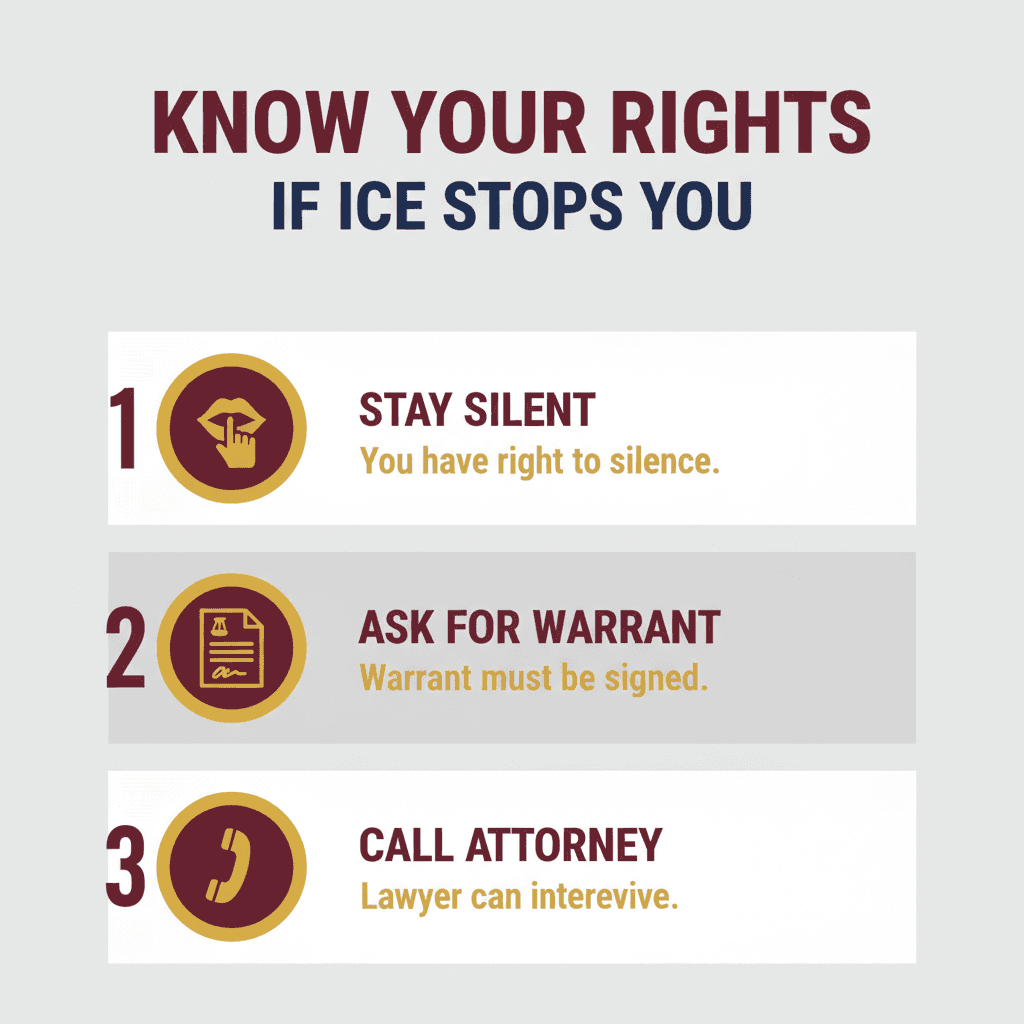
You can remain silent—and you should use that right
You can say: “I am exercising my right to remain silent. I want to speak to a lawyer.” Then stop talking. Do not explain your immigration history, your entry, or where you were born.
- Do not lie or use fake documents. Misrepresentation can trigger serious immigration consequences.
- Do not guess if you are unsure. Silence is safer than a wrong answer.
Ask one key question: “Am I free to leave?”
If ICE approaches you in public, you can calmly ask: “Am I free to leave?” If they say yes, walk away calmly. If they say no, you are being detained—use your right to remain silent and request counsel.
What documents should you carry?
For non-U.S. citizens, U.S. immigration law has document-carry rules in certain situations. Still, carrying the wrong paperwork—or handing it over without thinking—can create risk. In general:
- Carry only valid, true documents.
- Keep copies of important filings (like receipts or court notices) in a safe place.
- If you have proof of status, parole, or pending cases, ask your attorney what to keep on you.
3) What to do in common ICE stop scenarios
What you do next depends on where the encounter happens. Below are practical steps that often matter in real cases.
If ICE comes to your home
Stay calm and keep the door closed. You can speak through the door. ICE may ask you to open the door “just to talk.” You do not have to open the door unless they show a valid judicial warrant signed by a judge.
- Ask: “Do you have a warrant signed by a judge?”
- Ask them to slide it under the door or hold it up to a window.
- Check: Is it signed by a judge (not just ICE), and does it list your correct address and name?
- If no judge-signed warrant: you can refuse entry.
Many ICE “warrants” are administrative forms (often I-200 or I-205). These are not the same as a judge-signed warrant. If you are unsure, do not open the door—ask a lawyer to review it.
If ICE contacts you during or after a traffic stop
Sometimes a local traffic stop leads to questions about immigration status. If an ICE officer shows up or you suspect immigration questioning:
- Provide your driver’s license and registration as required by state traffic laws.
- Do not answer immigration questions about birthplace or status.
- Do not consent to a vehicle search.
If you are taken into custody, say clearly: “I want to speak to an immigration lawyer.”
If ICE approaches you at work or in public
Worksite actions can be chaotic. In public, ICE may try to separate people, ask rapid-fire questions, or pressure you to show papers.
- Keep your hands visible and stay polite.
- Ask if you are free to leave.
- If detained, remain silent and request counsel.
This is one of the main themes readers look for in What to do if ICE stops you: An attorney answers some questions - MPR News: staying calm is not “giving up”—it is how you protect your future options.
4) Warrants, paperwork, and signing documents: what to watch for
Many immigration cases are lost not in court, but in the first few hours—because someone signed something they did not understand.
Judicial warrant vs. administrative ICE warrant
A judicial warrant is signed by a judge. An administrative warrant is issued within the agency. That difference can affect entry into a home and later legal challenges.
If ICE shows paperwork, you can say: “I will not sign anything. I want to speak with a lawyer.”
Do not sign “voluntary departure” or removal papers without advice
You may be pressured to sign forms that waive your right to a hearing. Signing can lead to fast removal and can damage future options like adjustment of status, asylum, cancellation of removal, or consular processing.
- If you do not understand the document, do not sign it.
- If you need an interpreter, ask for one.
- Ask to call your attorney or family.
How to identify ICE and document what happened
If it is safe, try to note:
- Officer names and badge numbers
- Agency (ICE, CBP, local police)
- Time, location, and what was said
- Whether they showed any warrant and what it looked like
These details can help your lawyer evaluate defenses, bond, and possible violations.
Worried ICE contact may happen soon? Talk to an immigration attorney before it escalates. Call 1-844-967-3536 (Se Habla Español) or message us here.
5) If ICE detains you: immediate steps for you and your family
If you are detained, time matters. Your family may need to locate you, get your A-number, and gather key documents.
The first 24 hours: what to do
- Stay silent about immigration history and past entries.
- Request an attorney and do not sign paperwork.
- Call a trusted person to find your documents and contact a lawyer.
Bond, immigration court, and your right to counsel
Many detained individuals may qualify for bond, but not everyone does. Immigration court procedures are handled through the Executive Office for Immigration Review (EOIR), and timelines can move quickly.
Federal law provides a right to be represented (at no expense to the government) in removal proceedings. A lawyer can assess bond eligibility, relief options, and whether any prior orders or criminal issues affect your case.
What your family should gather for your lawyer
- Your full name, date of birth, and A-number (if any)
- Any prior immigration paperwork, notices, or court dates
- Proof of residence, work history, and community ties
- Marriage and birth certificates (spouse/children)
- Any criminal records or court dispositions (if applicable)
These items can be crucial for bond requests and defenses to removal.
What's Your Immigration Situation?
Answer 3 questions - we'll tell you your options
Question 1 / 3
What best describes your situation?
Keep Reading

6) How Vasquez Law Firm, PLLC helps after an ICE stop (Orlando-focused)
Real legal help means more than repeating general tips. It means reviewing your facts, your documents, and your goals, then choosing the safest strategy.
Experience and qualifications that matter
Vasquez Law Firm, PLLC focuses on immigration law and helps clients navigate high-stakes enforcement issues. Attorney Vasquez, JD, brings 15 years of experience and is admitted to the North Carolina State Bar and the Florida Bar. Se Habla Español.
What an immigration attorney can do quickly
After an ICE stop or detention, we can help by:
- Evaluating whether ICE had lawful authority and what paperwork was used
- Explaining bond options and preparing bond evidence
- Reviewing relief options (asylum, cancellation, adjustment, waivers)
- Coordinating with family to gather documents and plan next steps
For readers searching What to do if ICE stops you: An attorney answers some questions - MPR News, the most important point is this: your next steps should be guided by a lawyer who can see your whole immigration picture.
Serving Orlando and nearby communities
We regularly assist people serving orlando residents and families across Central Florida. If you live in orlando, Kissimmee, Winter Garden, Lake Buena Vista, or Altamonte Springs, fast legal guidance can help you avoid mistakes that are hard to undo.
To learn more about our work, visit our Immigration Law services page or meet our team on the Attorney Vasquez profile page.
Frequently Asked Questions
These are common questions we hear from families after reading pieces like What to do if ICE stops you: An attorney answers some questions - MPR News.
1) Do I have to tell ICE my immigration status?
You generally do not have to answer questions about where you were born, how you entered, or your current immigration status. You can say you are exercising your right to remain silent and you want a lawyer. Do not provide false information.
2) Can ICE enter my home without a warrant?
ICE may try to enter by asking for consent. If you open the door and invite them in, that can count as consent. You can refuse entry unless they show a judge-signed warrant. If they show only an administrative ICE form, you can still refuse entry and ask your lawyer to review it.
3) What if ICE says they will come back with a warrant?
Stay calm and do not argue. Repeat that you do not consent to entry and that you want to speak with counsel. Then contact an attorney immediately. Planning early can protect your family and help preserve evidence of what was said and shown.
4) If I’m undocumented in Orlando, should I carry my passport?
It depends on your risk profile and your goals. Carrying ID can help confirm identity, but handing over foreign documents can also give ICE information they may use. A lawyer can advise what is safest in your specific situation in orlando, especially if you have a pending filing with USCIS or immigration court.
5) Where can I verify my case status or immigration options?
For immigration benefits, the official source is USCIS. For visa and consular processing information, see the U.S. Department of State visa page. For immigration court information, consult EOIR. These sites provide reliable rules and updates, but they do not replace legal advice for your case.
6) Will an ICE stop automatically lead to deportation?
Not always. Some people qualify for bond, some have defenses in court, and others may have pathways through family petitions, asylum-related protections, or other relief. The outcome often depends on prior orders, criminal history, and what was said or signed during the encounter—another reason to follow the guidance discussed in What to do if ICE stops you: An attorney answers some questions - MPR News and speak with counsel right away.
If ICE has contacted you or your family, don’t wait. Call 1-844-967-3536 to speak with an immigration lawyer about next steps. Se Habla Español. You can also schedule a confidential consultation online.
Legal note: This article is general information, not legal advice. Every case is different. If you need advice about your situation, talk to a licensed attorney.
Keyword reference: This post discusses practical safety steps inspired by What to do if ICE stops you: An attorney answers some questions - MPR News, with a focus on real-world scenarios and legal strategy.

William Vasquez
Founder & CEO, Vasquez Law Firm, PLLC
William Vasquez is the founder and CEO of Vasquez Law Firm, PLLC, a results-driven firm specializing in immigration, criminal defense, personal injury, and workers' compensation. A U.S. Air Force veteran and recipient of the Joint Service Achievement Medal, William is dedicated to fiercely fighting for his clients' rights.
Related Legal Services
Need legal help? Learn more about learn about our immigration practice, or contact us for a free evaluation.
You can also visit immigration legal services throughout NC for more information.