U.S. immigration lawyers brace for new enforcement guidance
U.S. immigration lawyers brace for new enforcement guidance as Trump-era rules revisited—learn what may change and when to call for help. Consult now.
Published on January 9, 2026· Updated August 6, 2026
Talk to an immigration attorney
Free call. A clear plan for your case.
Free & confidential · Se habla espanol · 24/7

Have questions? Talk to an attorney - free evaluation.
Call 1-844-967-3536Worried how the latest immigration news affects you?
Schedule a confidential case review with an immigration attorney - know exactly where you stand.
USCIS Case Status
Check your USCIS case status
Enter your receipt number and get the official status. Free, no registration.
U.S. immigration lawyers brace for new enforcement guidance
Across the country, U.S. immigration lawyers brace for new enforcement guidance as Trump-era rules revisited. For many families, that headline means one thing: uncertainty. In this post, we break down what “new guidance” can mean in real life, what may happen if enforcement priorities shift again, and how to protect your case with clear documentation and a plan.
Worried About Immigration Policy Changes?
New policies can affect your case. Get current legal advice from an experienced immigration attorney.
At Vasquez Law Firm, PLLC, we help people prepare for policy changes without panic. We focus on practical steps you can take now, especially if you have a pending case with USCIS, an immigration court date, or an old removal order.
Worried about how new enforcement guidance could affect you or your family? Call 1-844-967-3536 or request help online. Se Habla Español.
1) What this news means for Raleigh residents
Why “guidance” matters even before laws change
In immigration, policy memos and internal “guidance” can change how agencies act day to day. Even if Congress does not pass a new law, enforcement priorities can shape who is more likely to be detained, placed in removal proceedings, or asked for extra proof.
The news and public debate also affect how people interact with officers, how employers handle I-9 compliance, and how families plan travel.
How shifting enforcement can show up locally in Raleigh
If you live in Raleigh or the Triangle area, you may deal with USCIS interviews, Requests for Evidence (RFEs), or notices at the USCIS field office level. Arrests and detention may involve cooperation between local and federal systems, and cases can move quickly once ICE becomes involved.
Many North Carolina court hearings for removal take place at the Charlotte Immigration Court, but the impact is still felt by families and employers serving Raleigh residents.
The event that sparked renewed attention
A recent opinion piece has renewed public focus on immigration enforcement actions and the real-life stakes involved. You can read the referenced coverage here: USA Today opinion coverage via Google News. While opinions vary, the underlying point is consistent: enforcement decisions can carry serious, sometimes irreversible consequences.
2) Why U.S. immigration lawyers are “bracing” for new guidance
Enforcement priorities can shift fast
When administrations revisit prior-era policies, agencies may change how they prioritize:
- Arrests and detention decisions (including who is labeled a “priority”)
- Notices to Appear (NTAs) that start removal cases
- Stipulated removals, expedited processes, and custody reviews
- Prosecutorial discretion (whether government attorneys agree to pause or dismiss certain cases)
This is why U.S. immigration lawyers brace for new enforcement guidance as Trump-era rules revisited: lawyers must adjust strategies quickly to protect clients’ rights.
The law may stay the same, but outcomes can differ
Immigration enforcement is driven by the Immigration and Nationality Act (INA), agency regulations, and court decisions. But the same legal framework can be applied differently depending on:
- How ICE sets operational priorities
- How USCIS handles interviews and discretionary decisions
- How DHS attorneys litigate cases in immigration court
That is why preparation matters even if you think your case is “routine.”
Who may feel the biggest impact
While every case is unique, changes in enforcement guidance often hit hardest for people who have:
- Prior removal orders
- Old criminal charges or convictions (even minor or dismissed cases can raise questions)
- Missed court dates or in-absentia orders
- Prior border encounters or expedited removal history
- Pending asylum or withholding cases without work authorization yet
3) What “Trump-era rules revisited” can refer to (and what to watch)
Removal and detention tools that often get expanded
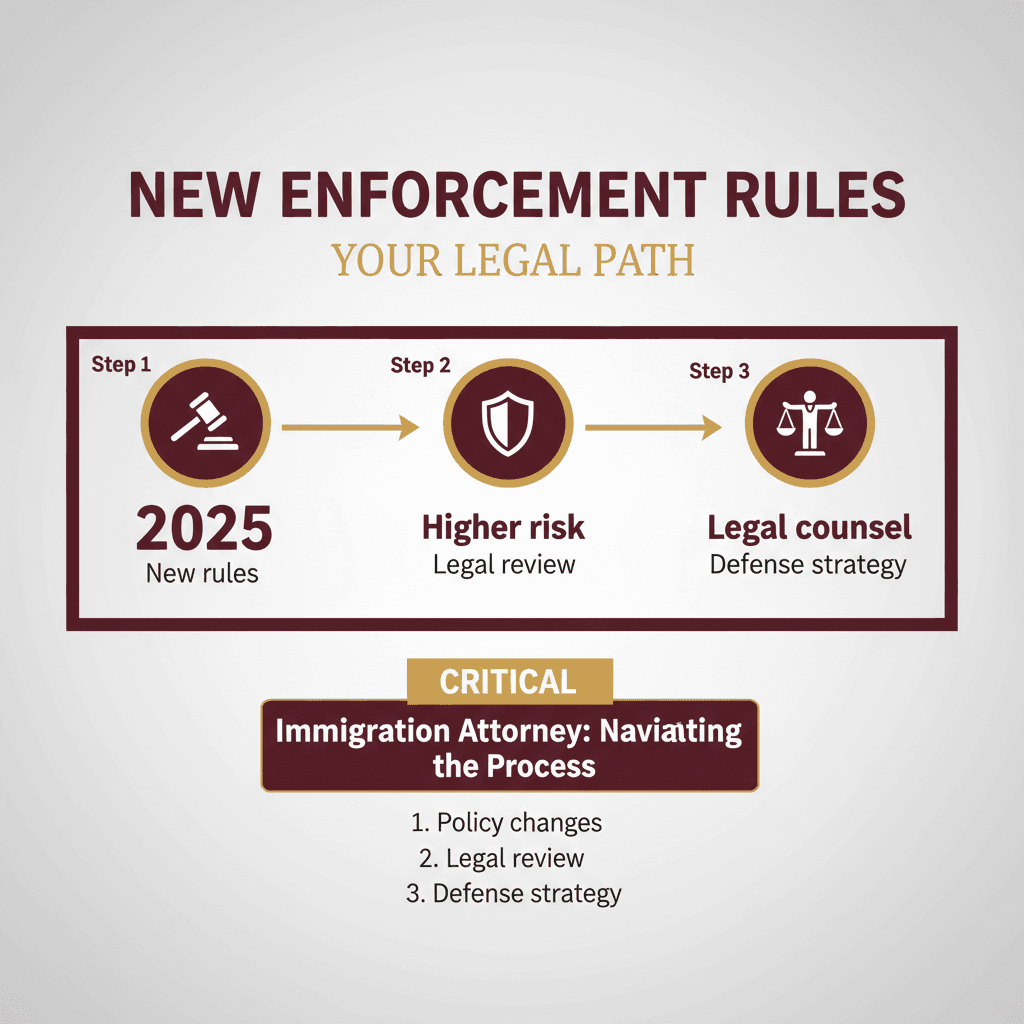
When people say “Trump-era rules,” they may be talking about a mix of regulations, policy memos, and enforcement practices. Some practices that get revisited include:
- Broader detention under INA custody authority (often cited under 8 U.S.C. § 1226)
- Faster initiation of removal proceedings through NTAs and referrals from USCIS to ICE
- Stricter discretionary review for benefits like adjustment of status, waivers, and parole
These changes can increase risk for people who previously felt “under the radar.” That is another reason U.S. immigration lawyers brace for new enforcement guidance as Trump-era rules revisited.
Asylum and border processing approaches
Asylum law is especially sensitive to policy change. Depending on guidance, you may see shifts in how credible fear screening, detention, and release decisions are handled at the border and in interior cases.
Even if you live in Raleigh, border-related history (a past entry or encounter) can still affect your case through records and biometrics.
Public charge, benefits, and “self-sufficiency” debates
Public charge standards have changed multiple times in recent years. If agencies revive stricter interpretations, applicants may see more questions about finances and sponsorship.
For accurate, current filing guidance, always check official sources like USCIS and consider legal advice before filing.
4) Legal background: the rules that don’t change (and the ones that do)
Key statutes and regulations that govern enforcement
Enforcement “guidance” sits on top of statutes and regulations. Some key legal anchors include:
- Detention authority under 8 U.S.C. § 1226
- Inadmissibility grounds under 8 U.S.C. § 1182
- Adjustment of status rules under 8 U.S.C. § 1255
- Motions practice in immigration court and the BIA under 8 C.F.R. Part 1003
Guidance cannot erase these rules. But it can affect how strictly they are applied and how much discretion is used.
Court decisions that set guardrails
Federal courts also set limits. Examples often cited in enforcement and detention discussions include:
- Arizona v. United States, 567 U.S. 387 (2012) (federal authority over immigration enforcement)
- Zadvydas v. Davis, 533 U.S. 678 (2001) (limits on indefinite detention after a removal order in certain situations)
Your facts matter. Detention, bond, and due process arguments can look very different depending on your history and status.
Which agencies you may deal with
Many people think “immigration” is one agency. In reality, these agencies have different roles:
- USCIS handles many benefits applications (official USCIS site)
- U.S. Department of State processes visas at consulates (U.S. visas information)
- EOIR runs immigration courts (Executive Office for Immigration Review)
- ICE enforces removal and detention
Don’t wait until you get a notice or an ICE check-in to make a plan. Call 1-844-967-3536 to discuss options with an immigration attorney. Se Habla Español.
5) Practical steps to protect yourself and your family right now
Build a “ready file” (simple, but powerful)
When U.S. immigration lawyers brace for new enforcement guidance as Trump-era rules revisited, we often advise clients to prepare a clean, organized file. If something changes fast, you do not want to search for documents under stress.
Your ready file may include:
- All prior immigration paperwork (I-94s, approvals, denials, NTAs, court orders)
- Proof of long-term residence (leases, bills, tax returns, school records)
- Family evidence (birth certificates, marriage certificate, photos, joint records)
- Work records (pay stubs, W-2s, job letters)
- Any criminal case dispositions (certified copies are best)
Know your case posture (USCIS vs. court vs. old order)
Different “postures” carry different risks and options. Ask yourself:
- Do I have a pending application with USCIS?
- Do I have an upcoming immigration court hearing with EOIR?
- Do I have a prior removal order, even if it is old?
If you are unsure, an attorney can help request records and review your history. For court case status, EOIR provides official information through its channels at EOIR.
Avoid mistakes that trigger preventable problems
Small errors can become big issues when enforcement is more aggressive. Common problems include:
What's Your Immigration Situation?
Answer 3 questions - we'll tell you your options
Question 1 / 3
What best describes your situation?
Keep Reading

- Traveling internationally without checking the risks (even with “valid” documents)
- Filing a benefit request with inconsistent addresses or dates
- Missing biometrics or an interview notice
- Not updating your address with USCIS and the court
If you are in Raleigh and you receive an RFE, NOID, NTA, or any ICE-related paperwork, act quickly. Delays can limit options.
6) How Vasquez Law Firm, PLLC can help you prepare for changing enforcement
Experience and local focus
Vasquez Law Firm, PLLC serves North Carolina and Florida clients and supports families and workers navigating fast-moving policy shifts. Attorney Vasquez (JD) has 15 years of experience and is admitted to the North Carolina State Bar.
We regularly help clients serving Raleigh residents prepare for USCIS interviews, respond to RFEs, and assess enforcement risks based on real records—not rumors.
Immigration matters we handle during enforcement shifts
Our team can help with:
- Family-based green cards and adjustment of status (INA 8 U.S.C. § 1255)
- Consular processing and visa planning using official State Department guidance (travel.state.gov)
- Asylum-related strategy and court preparation (EOIR process)
- Motions to reopen or reconsider where legally appropriate (see 8 C.F.R. Part 1003)
- Risk reviews for people with old orders, prior entries, or criminal records
Explore our Immigration Law services to see the kinds of cases we handle.
What to expect when you contact us
We aim to make the process clear and calm. When you reach out, we focus on:
- What status you have now and what documents prove it
- What your risk level looks like under different enforcement approaches
- What filings, deadlines, and backup plans make sense
Meet our team and background on our Attorney Vasquez page. Se Habla Español.
7) Frequently asked questions
Will new ICE enforcement guidance change my pending USCIS case?
It can. USCIS is separate from ICE, but information can move between agencies in certain situations. If policies push more referrals to enforcement or stricter scrutiny, people with prior issues (old orders, certain arrests, misrepresentation concerns) may feel the impact. Check your case status at USCIS and talk with counsel before you file anything new.
What if I have an old removal order and I live in Raleigh?
An old order can create risk if enforcement increases. Options may include a motion to reopen, a stay request, or other relief depending on facts and deadlines. Motions and court procedure are governed by EOIR rules, including 8 C.F.R. Part 1003. Get your records reviewed before you assume nothing can be done.
Can I travel while policies are changing?
Travel can be risky even for people with valid documents, especially if there is any prior overstay, prior removal, or pending application. Consult an attorney before leaving the U.S. For consular visa rules and travel basics, start with the U.S. Department of State, but do not rely on general information alone.
Does a dismissed criminal charge still matter for immigration?
Sometimes. Immigration consequences depend on the statute, the record, and how immigration law classifies the conduct. Even without a conviction, arrests can trigger questions and delays. Always get certified dispositions and have an attorney review them, especially if U.S. immigration lawyers brace for new enforcement guidance as Trump-era rules revisited and agencies begin taking a harder line.
What should I do if ICE contacts me or comes to my home?
Stay calm and avoid sudden movements. You generally have the right to remain silent and to speak with a lawyer. Do not sign documents you do not understand. Ask to see paperwork and note names and badge numbers if possible. Then call counsel as soon as you can.
How do I choose the right immigration lawyer?
Look for: (1) licensed attorneys (not “notarios”), (2) experience with your case type, (3) clear fee agreements, and (4) a plan that matches the law and your facts. Ask how the lawyer adapts strategy when policies shift. Our team offers bilingual support—Se Habla Español—and we serve clients in and around Raleigh, including nearby communities like Cary, Durham, and Chapel Hill.
One more time: U.S. immigration lawyers brace for new enforcement guidance as Trump-era rules revisited because small details can decide outcomes. If you want clarity about your next step, do not wait for a crisis.
Ready for a clear plan? Call 1-844-967-3536 or request your free case evaluation today. We help families and workers protect their options as policies change. Se Habla Español.
Disclaimer: This article is for general information only and is not legal advice. Immigration outcomes depend on the facts of your case and changing agency practices.

William Vasquez
Founder & CEO, Vasquez Law Firm, PLLC
William Vasquez is the founder and CEO of Vasquez Law Firm, PLLC, a results-driven firm specializing in immigration, criminal defense, personal injury, and workers' compensation. A U.S. Air Force veteran and recipient of the Joint Service Achievement Medal, William is dedicated to fiercely fighting for his clients' rights.
Related Legal Services
Need legal help? Learn more about our immigration law practice, or contact us for a free evaluation.
You can also visit our NC immigration team for more information.