Trump administration to shutter an immigration court, adding to judges' backlog - Georgia Public Broadcasting | What It Means
Trump administration to shutter an immigration court, adding to judges' backlog - Georgia Public Broadcasting: learn impacts & options. Call 1-844-967-3536.
Published on January 13, 2026· Updated August 6, 2026
Talk to an immigration attorney
Free call. A clear plan for your case.
Free & confidential · Se habla espanol · 24/7

Have questions? Talk to an attorney - free evaluation.
Call 1-844-967-3536Check your case status now
Look up your immigration case below, then talk to an attorney about what it means — free.
Questions about your result?
Talk to an attorney about your case — free, no obligation.
Trump administration to shutter an immigration court, adding to judges' backlog - Georgia Public Broadcasting | What It Means
When headlines say Trump administration to shutter an immigration court, adding to judges' backlog - Georgia Public Broadcasting, it is not just politics—it can change timelines, hearing dates, and strategy for people in removal proceedings or seeking relief. Court closures and shifting resources often mean longer waits, more rescheduling, and higher stress for families and employers. If you live in Raleigh or nearby, these changes can also affect where your case is heard and how you prepare.
Worried About Immigration Policy Changes?
New policies can affect your case. Get current legal advice from an experienced immigration attorney.
Important: This article is general information, not legal advice. Immigration outcomes depend on your record, documents, and court history.
Worried about a delayed hearing or a sudden court notice? Speak with an immigration lawyer before deadlines pass. Call 1-844-967-3536 or request a consultation with Se Habla Español.
What the News Means for raleigh Families and Employers
Why an immigration court closure matters
The phrase Trump administration to shutter an immigration court, adding to judges' backlog - Georgia Public Broadcasting signals a practical problem: fewer courtrooms and calendars to handle the same (or rising) number of cases. When a court is shut down or consolidated, cases may be transferred, rescheduled, or placed into already-crowded dockets.
That can affect people seeking asylum, cancellation of removal, adjustment of status, or other relief in immigration court (EOIR).
Backlogs mean real delays—and real risk
Immigration court backlogs have consequences even when you are “waiting.” For many people, a pending case can affect work authorization timing, travel plans, family stability, and stress levels. Delays can also increase the chance that rules, policies, or enforcement priorities change mid-case.
The local impact for raleigh residents
For residents of Raleigh and the Triangle, EOIR hearings are often not local, and many people already travel for court. A closure in another region can still ripple nationwide by reallocating judges, changing scheduling practices, and increasing continuance pressure everywhere.
In practice, that may mean:
- More master calendar hearings set farther out
- Merits hearings pushed back (sometimes by years)
- Harder-to-get continuances unless well supported
- More confusion about venue, notice, and filings
What Happens to Your Case if a Court Shuts Down?
Case transfers, venue changes, and new hearing locations
When EOIR consolidates or closes a court, cases may be moved to a different immigration court. That can change the venue (the court location) and may change how fast—or slow—your case moves.
Even if your case is not in that specific court, the headline Trump administration to shutter an immigration court, adding to judges' backlog - Georgia Public Broadcasting is a warning sign that transfers and scheduling disruptions can increase nationally.
Why notices and addresses become even more important
Court closures can lead to re-issued hearing notices, new court addresses, and updated instructions. Missing a notice can be devastating because failure to appear can result in an in absentia removal order under the immigration court rules.
Make sure you:
- Update your address properly and on time
- Keep copies of every notice and filing
- Track deadlines for evidence submissions
Continuances, “good cause,” and faster filings
As courts struggle with backlog, judges often tighten continuance policies. Continuances are not automatic. A well-prepared motion with documentation can matter, especially when you are waiting for supporting evidence, a visa petition decision, or records.
One key precedential decision on continuances is Matter of L-A-B-R-, which explains how immigration judges evaluate continuance requests when a person is pursuing collateral relief (like a pending petition).
Legal Background: Who Runs Immigration Courts and What Rules Apply?
EOIR (Immigration Court) vs. USCIS vs. the State Department
Immigration cases often involve multiple agencies. Immigration court is under the Executive Office for Immigration Review (EOIR), part of the U.S. Department of Justice. USCIS handles many applications and petitions outside court, and the State Department controls visa issuance at consulates.
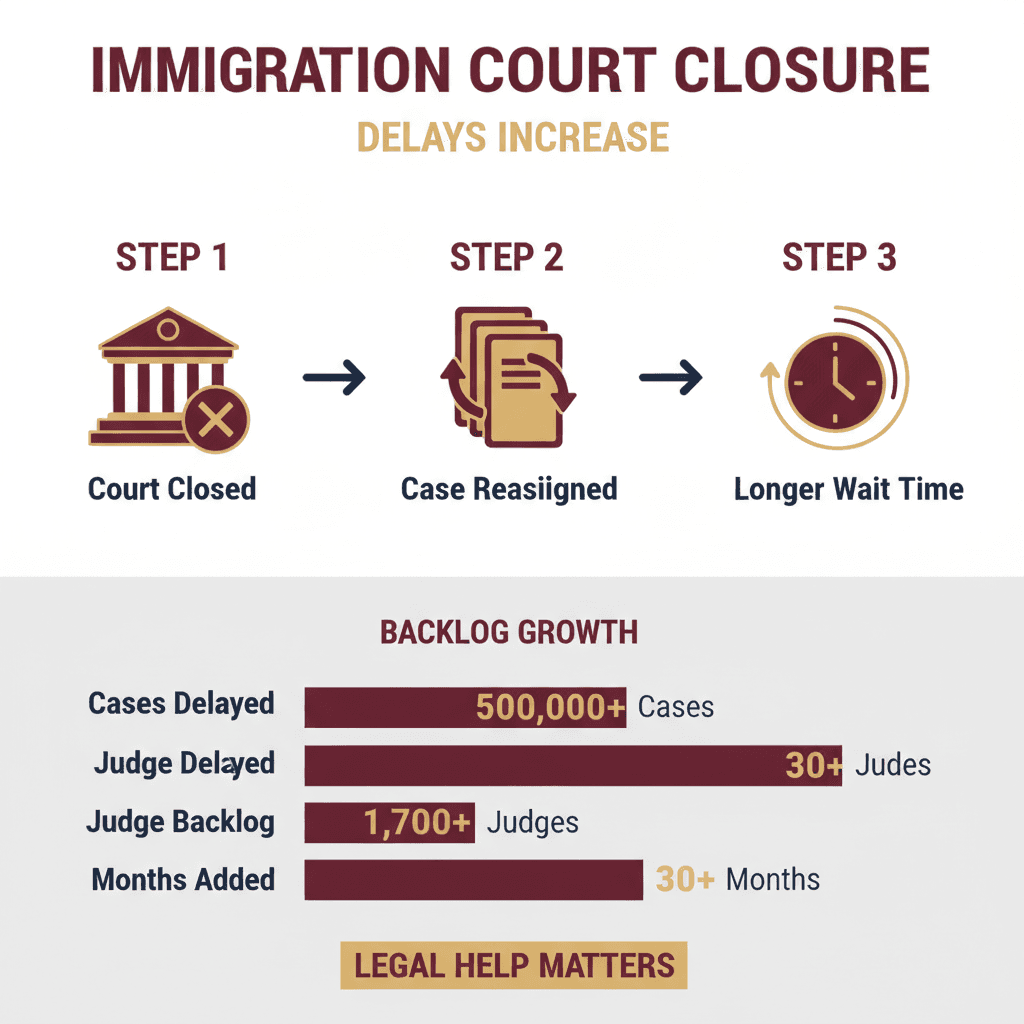
When you read Trump administration to shutter an immigration court, adding to judges' backlog - Georgia Public Broadcasting, that typically refers to the EOIR court system and how it manages dockets and judge assignments.
The law behind removal proceedings
Most immigration court cases are “removal proceedings” governed by the Immigration and Nationality Act (INA). A core statute is INA § 240 (codified at 8 U.S.C. § 1229a), which sets the framework for hearings, rights, and orders of removal.
Immigration court procedures are also governed by regulations in 8 C.F.R. Part 1003, which cover filings, motions, and appeals.
Case law that can affect timing and strategy
Court backlogs can make it more important to get the basics right at the start of a case. Several Supreme Court decisions have shaped how Notices to Appear (NTAs) are analyzed:
- Pereira v. Sessions (2018): addressed defective NTAs and the stop-time rule in certain contexts.
- Niz-Chavez v. Garland (2021): held that, for stop-time purposes, required information must generally be in a single notice.
These cases do not “erase” every case, but they can be relevant to eligibility for cancellation of removal and how time is counted.
Backlogs + Enforcement Changes: Why People Feel the Pressure
Visa revocations and travel problems can rise quickly
Many readers find this topic because of broader immigration enforcement news, including reports about visa revocations and increased scrutiny. For the related news context, see this report: Al Jazeera report on visa revocations.
For official visa information and traveler guidance, the most reliable starting point is the U.S. Department of State’s visa page.
Work permits, family plans, and uncertainty
When hearings get delayed, people can get stuck in limbo. Depending on the case type, delays may affect when you can apply for work authorization or renew it, whether your family can plan travel, and how long you remain in removal proceedings.
USCIS processing times can also influence court strategy. You can start with USCIS for forms, instructions, and case status tools.
Why policy shifts hit pending cases hardest
Backlog is not just “wait time.” It creates a larger window where law, policy memos, prosecutorial discretion priorities, and agency practices can change. That is why the headline Trump administration to shutter an immigration court, adding to judges' backlog - Georgia Public Broadcasting matters even for people who think their case is straightforward.
If your hearing date moved, or you’re worried about missing a filing deadline, do not guess. Call Vasquez Law Firm, PLLC at 1-844-967-3536 to discuss next steps—Se Habla Español.
Practical Steps to Protect Yourself During Court Disruptions
1) Confirm court and case information the right way
During periods of change, verify where your case is pending and what your next hearing date is. Keep a simple case folder (digital and paper) with:
- Your NTA and any hearing notices
- Proof of address updates
- Receipts for applications (USCIS and EOIR)
- A calendar of deadlines and appointment dates
2) Build your evidence packet earlier than you think
Backlogs often lead to short notice for resets or accelerated deadlines. Start gathering key evidence now, such as identity documents, entries and exits, police/court dispositions, and hardship evidence for qualifying relatives.
If you are in Raleigh, it can help to plan ahead for obtaining certified records from local agencies and courthouses.
3) Avoid common mistakes that create extra delays
When courts and agencies are overloaded, small errors can trigger big setbacks. Common problems include:
- Filing the wrong form edition or sending it to the wrong place
- Missing biometrics or medical exam timing
- Not translating documents properly
- Failing to disclose arrests (even if dismissed) and not providing certified outcomes
What's Your Immigration Situation?
Answer 3 questions - we'll tell you your options
Question 1 / 3
What best describes your situation?
Keep Reading

How Vasquez Law Firm, PLLC Helps Clients Navigate Court Backlogs
Experience, credentials, and what that means for your case
Vasquez Law Firm, PLLC focuses on immigration law and supports clients facing removal proceedings, family-based options, and complex timeline issues. Attorney Vasquez, JD, has 15 years of experience and is admitted to the North Carolina State Bar and the Florida Bar.
When the system is strained—as described in Trump administration to shutter an immigration court, adding to judges' backlog - Georgia Public Broadcasting—strategy and preparation matter more. A strong case file can reduce surprises when hearing dates change.
Serving raleigh residents with practical, court-ready planning
Serving Raleigh residents means we understand the local realities: families balancing work and school schedules, the need to coordinate travel for hearings, and the importance of planning around local documentation and records. We also regularly help clients from nearby areas like Cary, Durham, Chapel Hill, Garner, and Wake Forest.
We can also help you organize documentation tied to local institutions—like records that may be obtained through the Wake County area—so your file is ready when the court sets deadlines.
What we can do (examples)
Depending on your situation, our team may assist with:
- Evaluating relief options in removal proceedings (asylum, cancellation, adjustment, waivers)
- Preparing and filing motions (continuance, change of venue, reopen/reconsider where appropriate)
- Coordinating USCIS filings that affect court strategy
- Preparing clients for master calendar and merits hearings
- Reviewing NTA defects and stop-time rule issues where relevant
Meet our team and credentials here: Attorney Vasquez.
Frequently Asked Questions
1) If an immigration court shuts down, does my case get dismissed?
Usually, no. A court closure typically means your case is transferred to another immigration court or docket. You should expect new hearing notices and possibly a new location. Keep your address updated and watch for mail.
2) Will a backlog help my case because I have more time?
More time can help you gather evidence, but it can also create risk. Policies can change, witnesses can become harder to find, and work permits may require careful renewal planning. Backlogs also mean rescheduling can happen with short notice.
3) Can I move my case to a different city if hearings are far from raleigh?
Possibly. A “change of venue” request may be available, but it is discretionary and must be supported. You typically need to show that the new venue is appropriate and that the move will not cause undue delay or prejudice. Each case is different.
4) What law controls my immigration court hearing?
Removal proceedings are generally governed by INA § 240 (8 U.S.C. § 1229a) and EOIR regulations (8 C.F.R. Part 1003). The specific relief you seek—like adjustment, asylum, or cancellation—has additional statutes and rules that apply.
5) How do I check whether my visa or immigration status is affected?
For visa-related issues, start with official State Department guidance at travel.state.gov. For immigration benefits and pending applications, consult USCIS. If you are in court proceedings, EOIR controls hearing dates and many filings.
6) When should I talk to a lawyer about delays or closures?
As soon as you receive a rescheduled hearing notice, learn that a court is being consolidated, or have a pending USCIS petition that affects court strategy. Early review can prevent missed deadlines and help you build a stronger record. If you are in Raleigh, a consultation can also help you plan logistics, evidence gathering, and realistic timelines.
For more context on the broader trend, the headline Trump administration to shutter an immigration court, adding to judges' backlog - Georgia Public Broadcasting reflects a system-wide pressure that can impact scheduling and outcomes across the country.
Need immigration help? Our immigration attorneys can review your case.
Do not wait for a last-minute hearing notice to find out you are unprepared. Call 1-844-967-3536 or request your free case evaluation today. Se Habla Español.
Related reading topics we can publish next: immigration court continuances and motions; how to update your address with EOIR and USCIS; what to do after receiving a Notice to Appear in North Carolina.

William Vasquez
Founder & CEO, Vasquez Law Firm, PLLC
William Vasquez is the founder and CEO of Vasquez Law Firm, PLLC, a results-driven firm specializing in immigration, criminal defense, personal injury, and workers' compensation. A U.S. Air Force veteran and recipient of the Joint Service Achievement Medal, William is dedicated to fiercely fighting for his clients' rights.
Related Legal Services
Need legal help? Learn more about our immigration legal services, or contact us for a free evaluation.
You can also visit immigration lawyers serving all of North Carolina for more information.