NC House introduces Jesse's Law to enhance child protection in family court cases - WCTI | What NC Parents Should Know
NC House introduces Jesse's Law to enhance child protection in family court cases - WCTI. Learn how it may affect custody—call 1-844-967-3536.
Published on January 14, 2026

Have questions? Talk to an attorney - free evaluation.
Call 1-844-967-3536NC House introduces Jesse's Law to enhance child protection in family court cases - WCTI | What NC Parents Should Know
The headline NC House introduces Jesse's Law to enhance child protection in family court cases - WCTI is drawing attention because it targets one of the hardest parts of family law: keeping children safe while parents fight over custody and visitation. For families in smithfield and across North Carolina, proposals like this can change what judges look at, what evidence matters most, and how quickly safety concerns are addressed.
Fighting for Custody?
Your children's wellbeing comes first. We advocate for fair custody arrangements.
Below, we break down what this legislation could mean, how North Carolina custody law already works, and what parents can do now if they are worried about abuse, neglect, or unsafe visitation. This is general information, not legal advice for your specific case.
Worried about your child’s safety during a custody dispute? Talk with our team about practical next steps. Call 1-844-967-3536 or request a free consultation. Se Habla Español.
What This News Means for smithfield Parents Right Now
Why a new child-protection bill matters in custody cases
Family court decisions can move fast, but evidence about safety risks does not always arrive in a clean package. A bill like the one described in NC House introduces Jesse's Law to enhance child protection in family court cases - WCTI signals that lawmakers want clearer rules and stronger tools to spot danger earlier.
In practical terms, these proposals often focus on improving:
- How courts evaluate risk when a parent claims abuse or coercive control
- What records the court can access (or must consider) when safety is at issue
- How supervised visitation is ordered and monitored
How this could play out in smithfield and Johnston County
Many custody disputes for smithfield families involve the same urgent questions: Who is the child safe with? Should visits be supervised? Do we need an emergency order? If Jesse’s Law moves forward, families in Johnston County may see more detailed court expectations around evidence and safety planning.
Local cases are typically heard in the Johnston County Courthouse in Smithfield (depending on your case type and filing). Even when the law is statewide, implementation often depends on how local court calendars and procedures operate.
The news source and why it’s being discussed
Our discussion is prompted by this news item: NC House introduces Jesse's Law to enhance child protection in family court cases - WCTI (via Google News).
What Is “Jesse’s Law” and What Could It Change?
Common goals of child-protection reforms in family court
While every bill has its own text and scope, reforms like Jesse’s Law often aim to strengthen child protection by closing gaps between:
- Domestic violence concerns and custody outcomes
- Criminal or DSS information and what the family court hears
- Emergency relief and longer-term custody plans
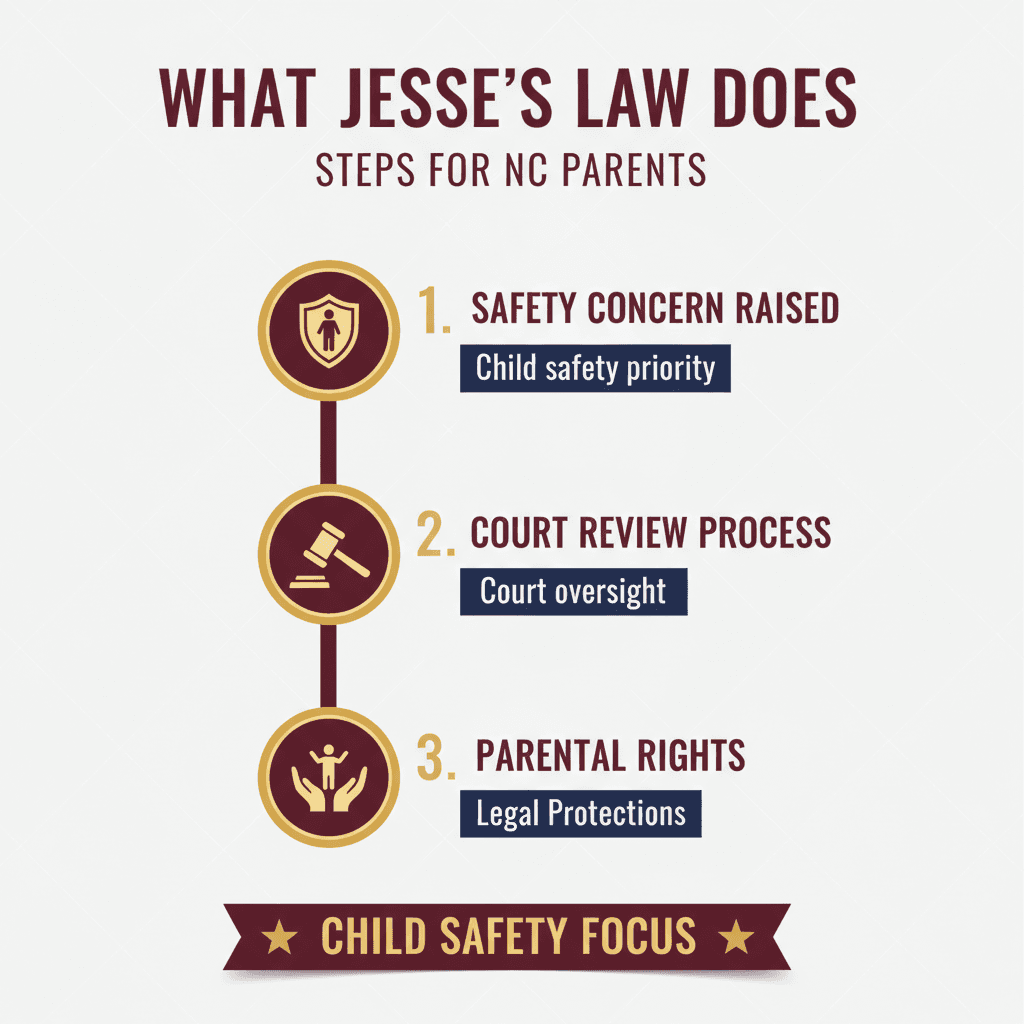
The message behind NC House introduces Jesse's Law to enhance child protection in family court cases - WCTI is that child safety must be front and center, even when adults disagree about everything else.
Potential impact on custody, visitation, and supervision
If a parent raises credible concerns about violence, substance misuse, sexual abuse, severe neglect, or dangerous living conditions, courts can already act. The proposed law may push the system toward more consistent screening and stronger protective steps.
That can mean more use of:
- Temporary custody orders while facts are investigated
- Supervised visitation when unsupervised contact is risky
- Clearer findings in court orders explaining how safety was evaluated
What a bill cannot do by itself
No single law instantly solves every custody conflict. Judges still need reliable evidence, and families still need to follow court orders while cases are pending. Also, accusations (even serious ones) must be supported with documentation whenever possible.
How North Carolina Custody Law Handles Child Safety Today
The “best interests of the child” standard
In North Carolina, custody decisions generally turn on the child’s best interests. Courts look at many factors, including each parent’s ability to provide a safe, stable home. The key custody statute is N.C. Gen. Stat. § 50-13.2, which authorizes courts to award custody “as will best promote the interest and welfare of the child.”
You can find North Carolina court resources and guidance at the North Carolina Judicial Branch website.
Domestic violence and protective orders (Chapter 50B)
If domestic violence is present, a parent may seek a Domestic Violence Protective Order (DVPO) under Chapter 50B. A DVPO can include custody provisions and restrictions on contact in appropriate cases. Custody and DV issues often overlap, and careful planning matters because inconsistent statements across cases can harm credibility.
Even if you live in smithfield, you may be dealing with events that occurred elsewhere (work travel, moves, prior counties). The court will still focus on safety and jurisdiction rules.
Evidence that often matters most in child-safety disputes
When child protection is the core issue, the most persuasive evidence is usually specific and verifiable. Examples include:
- Law enforcement reports and case numbers
- Medical records and discharge instructions
- DSS/CPS records (when available and relevant)
- School attendance/discipline reports
- Photographs with dates, and messages showing threats
- Witness statements from neutral sources
Headlines like NC House introduces Jesse's Law to enhance child protection in family court cases - WCTI highlight a reality: courts need good information, fast, and parents often need help organizing it.
If You Fear for Your Child’s Safety: Steps Parents Can Take
1) Document concerns in a safe, organized way
Try to record facts, not conclusions. Short entries are fine, but be consistent. Include dates, times, locations, and who was present.
Helpful documentation habits include:
- Saving texts/emails in a secure location
- Backing up photos to a private account
- Keeping a timeline of incidents and police/DSS contact
- Notifying the child’s school if there are safety restrictions
2) Understand emergency options (and their risks)
Depending on the situation, a parent might seek emergency custody, request temporary orders, or pursue a DVPO. Emergency filings can be powerful, but they must be accurate and supported. If a judge believes a parent exaggerated or withheld key facts, it can backfire later.
For procedural information, see the North Carolina Courts Family & Children help topics.
3) Follow current court orders while seeking change
Even when you believe an order is unsafe, violating it can create serious legal trouble and may undermine your position. Instead, talk with a lawyer about lawful ways to request changes, including temporary restrictions or supervised visitation.
Need a plan before the next exchange or hearing? Call 1-844-967-3536 to speak with our office. You can also request help through /contact. Se Habla Español.
How a Family Lawyer Can Use Safety-Focused Laws to Protect Children
Building a case strategy that matches what judges look for
When child safety is the issue, the goal is not “winning” arguments—it’s presenting a clear, credible picture that supports a protective order. That usually means organizing evidence, identifying witnesses, and requesting narrow, workable relief (like supervised visitation, safe exchange locations, or no-contact terms).
At Vasquez Law Firm, PLLC, we approach these cases with a safety-first mindset and practical courtroom strategy.
What Are My Options in Family Court?
Answer 3 questions to understand your rights
Question 1 / 3
What family legal issue are you facing?
Keep Reading

Navigating the court process in Johnston County and beyond
Families in smithfield often need guidance on what to expect with filings, service, calendars, mediation (when ordered), and temporary hearings. The process can feel overwhelming, especially when a child’s safety is on the line.
We also help clients who live near Clayton, Raleigh, Garner, Goldsboro, and Wilson, where work and school connections often cross county lines.
Experience and trust (E‑A‑T)
Attorney Vasquez, JD has 15 years of experience handling family law matters. He is admitted to the North Carolina State Bar and the Florida Bar. Our team understands how to present child-safety issues with the seriousness and structure courts expect—without unnecessary drama.
Learn more about our team on our Attorney Vasquez page, and review our Family Law services for custody and related matters.
How Jesse’s Law Could Affect Real Custody Cases (Examples)
Example 1: Supervised visitation and safer exchanges
Imagine one parent has a pattern of violent outbursts and the child reports fear during exchanges. Under existing law, the court can order supervised visitation or structured exchanges. If reforms like those discussed in NC House introduces Jesse's Law to enhance child protection in family court cases - WCTI pass, courts may be encouraged to apply clearer safety screening and more consistent protective terms.
Common safety-focused provisions include:
- Exchanges at a public place (or designated exchange location)
- No direct contact between parents during exchanges
- Third-party or professional supervision during visits
Example 2: Records and patterns of risk
In many cases, the risk is not one dramatic event but a pattern—substance misuse, repeated police calls, instability, or violations of prior orders. Legislative reforms sometimes focus on ensuring courts can consider reliable records and patterns, not just a single snapshot.
Example 3: Addressing false or exaggerated claims
Child-protection reforms must also guard against misuse. Courts take false allegations seriously because they can harm children and distort custody outcomes. If you are accused unfairly, you need a calm, evidence-based defense—witnesses, records, timelines, and compliance with every court order.
When people search NC House introduces Jesse's Law to enhance child protection in family court cases - WCTI, many are looking for one thing: what will the court do with competing stories? The answer is that documentation and credibility are often decisive.
Frequently Asked Questions (FAQ)
Custody, evidence, and child safety
1) What does “best interests of the child” mean in North Carolina custody cases?
It means the judge focuses on what arrangement best supports the child’s safety, stability, and overall welfare, not what is easiest for either parent. Courts may consider home stability, parenting ability, the child’s needs, and any safety concerns. The main custody statute is N.C. Gen. Stat. § 50-13.2.
2) Can a judge order supervised visitation in North Carolina?
Yes. If the court believes unsupervised contact may endanger the child or place the child at risk, it can order supervision and set rules for visits and exchanges. Supervision can be a neutral third party, a professional supervisor, or another structure the court finds appropriate.
Protective orders and emergency relief
3) Should I file a DVPO (50B) if the other parent is abusive?
If you have experienced domestic violence (as defined by North Carolina law), a DVPO may be an option. It can include custody-related provisions and restrictions on contact. Because timing and evidence matter, it is wise to speak with a lawyer before filing when possible—especially if there is already a custody case pending.
4) What if DSS/CPS is involved—does that automatically change custody?
Not automatically. DSS involvement can be important evidence, but the custody court still makes its own decision based on admissible information and the child’s best interests. In some situations, a juvenile court case may also impact what happens in family court.
Process, timelines, and legal help
5) How long does a custody case take in Johnston County?
It varies widely based on the court calendar, whether temporary orders are needed, whether mediation is required, and whether the case settles. Some issues can be addressed quickly through temporary hearings, while final custody decisions may take longer.
6) How can a lawyer help if my ex is making false accusations?
A lawyer can help you respond in a structured way: gathering records, preparing a timeline, identifying witnesses, and presenting your side clearly in court. The goal is to protect the child while also protecting your rights and your relationship with your child.
As bills like the one discussed in NC House introduces Jesse's Law to enhance child protection in family court cases - WCTI develop, families should stay focused on what helps today: clear evidence, safe interim solutions, and a court strategy tailored to your facts.
Ready to protect your child and move your case forward? Contact Vasquez Law Firm, PLLC for a focused family-law consultation. Call 1-844-967-3536 or book through /contact. Se Habla Español. We serve smithfield residents and families across the region.

William Vasquez
Founder & CEO, Vasquez Law Firm, PLLC
William Vasquez is the founder and CEO of Vasquez Law Firm, PLLC, a results-driven firm specializing in immigration, criminal defense, family law, personal injury, and workers' compensation. A U.S. Air Force veteran and recipient of the Joint Service Achievement Medal, William is dedicated to fiercely fighting for his clients' rights.