Minnesota judge declines to block federal immigration agent surge
Minnesota judge declines to block federal immigration agent surge. Learn what the ruling means and next steps, call Vasquez Law Firm, PLLC: 1-844-967-3536.
Published on January 31, 2026· Updated June 26, 2026
Talk to an immigration attorney
Free call. A clear plan for your case.
Free & confidential · Se habla espanol · 24/7
Have questions? Talk to an attorney - free evaluation.
Call 1-844-967-3536Worried how the latest immigration news affects you?
Schedule a confidential case review with an immigration attorney - know exactly where you stand.
USCIS Case Status
Check your USCIS case status
Enter your receipt number and get the official status. Free, no registration.
Minnesota judge declines to block federal immigration agent surge
The headline “Minnesota judge declines to block federal immigration agent surge Status: Confirmed / Monitoring 1️⃣ A federal judge rejected Minnesota’s emergency request to halt the increase of federal immigration agents operating in the state. 2️⃣ The ruling allows the enforcement surge to continue while the broader legal challenge remains pending. 3️⃣ The decision does not rule on the ultimate legality of the operation, only on the request for immediate relief. Create a controversial infographic and faq” is getting attention because it signals more on the ground federal enforcement, even while the legal fight is still underway. If you are an immigrant, a family member, or an employer, it is normal to feel anxious when you hear “surge,” especially when rumors spread faster than facts.
Need legal help?
Immigration in NC and FL. Personal injury and workers compensation across NC. Criminal defense in Johnston and Harnett counties, and traffic tickets in 10 NC counties. Tell us your county and we will tell you exactly what we can do.
Even though this case is in Minnesota, national enforcement priorities can affect people everywhere, including families serving charlotte residents and workers across the Southeast. Below is a plain English breakdown of what the judge’s decision really means, what it does not mean, and how to protect your rights if you are approached by immigration officers.
Need a calm, confidential plan? Call Vasquez Law Firm, PLLC at 1-844-967-3536 or request a free case evaluation. Se Habla Español.
What happened in Minnesota, and why people are watching
The emergency request was about speed, not the final outcome
Minnesota asked a federal judge for emergency relief to pause an increase in federal immigration agents operating in the state. Emergency requests are usually framed as requests for a temporary restraining order or a preliminary injunction, meaning a court order that stops something right now while the case continues.
According to the reporting that sparked this post, the judge declined to grant that immediate relief, so the surge can continue for now. You can read the news item here: Boundless Immigration roundup via Google News RSS.
What the decision did not do
This is the part many headlines miss. Denying emergency relief does not automatically mean the government’s operation is lawful, or that Minnesota’s arguments are weak. It often means the court did not think the high legal standard for immediate relief was met at that early stage.
In other words, the broader case can still move forward, evidence can be developed, and a later ruling could look very different.
Why a Minnesota enforcement surge can matter nationally
Federal immigration enforcement is coordinated, and priorities can shift quickly. When one state becomes a focus, it can be a sign of broader strategy that may later show up in other regions.
For many families in charlotte, the practical question is not “What is the final ruling,” it is “What should I do today if agents come to my home, my workplace, or my check in appointment?”
What the judge actually decided, in plain English
Emergency relief has a tough legal standard
To win emergency relief in federal court, a party usually must show several things, including a likelihood of success on the merits and a risk of irreparable harm without immediate court action. A commonly cited Supreme Court case for this framework is Winter v. Natural Resources Defense Council, 555 U.S. 7 (2008).
If a judge thinks the record is too limited early on, or that harm is not legally “irreparable,” the judge may deny emergency relief while still allowing the lawsuit to proceed.
“Confirmed and monitoring” is not the same as “approved”
People see “confirmed” and assume it means the court approved the surge. A more accurate reading is that the surge is happening, the court has not stopped it at the emergency stage, and the legal challenge continues.
That nuance matters because it affects how you should respond. Panic decisions can create avoidable risk, like missing court, signing documents without advice, or relying on internet myths.
What to watch next in the lawsuit
As the case develops, watch for:
- Briefing schedules, meaning deadlines for legal arguments and evidence.
- Hearings on a preliminary injunction, if requested.
- Merits decisions that address statutory authority, constitutional claims, or administrative procedure issues.
Legal background, what authority agents have, and what limits exist
Where federal immigration authority comes from
Immigration enforcement authority generally comes from federal law, including provisions of the Immigration and Nationality Act in Title 8 of the U.S. Code. For example:
- 8 U.S.C. § 1103 covers the administration and enforcement of immigration laws.
- 8 U.S.C. § 1357 addresses powers of immigration officers, including certain arrest and search related authorities.
- 8 C.F.R. Part 287 contains key regulations on enforcement and field operations.
Limits that still apply during a surge
A surge does not suspend the Constitution, and it does not erase procedural rules. Limits can come from several sources, including:
- The Fourth Amendment, which generally requires valid consent or a warrant for entry into a home.
- Due process, including the right to a fair hearing in removal proceedings.
- Agency rules and internal guidance, which can matter when courts review federal action.
For people in charlotte, the key is learning what you must do, what you should not do, and when to ask for legal help immediately.
How courts review federal actions
When a lawsuit challenges federal agency conduct, one legal pathway can involve the Administrative Procedure Act, including 5 U.S.C. § 706, which allows courts to set aside certain agency action that is arbitrary, capricious, or not in accordance with law.
Not every immigration enforcement decision is reviewable in the same way, and jurisdiction limits can apply. That is one reason these cases can be complex and fact specific.
Practical impacts for immigrants, families, and employers
If you are approached by agents: safe steps that protect you
If federal immigration agents approach you, your rights and your best strategy depend on the situation. Here are practical steps that generally reduce risk:
- Stay calm and do not run. Sudden movement can escalate a routine contact.
- Ask if you are free to leave. If yes, you can leave quietly.
- Do not consent to a home entry. Ask to see a warrant signed by a judge.
- Do not sign documents you do not understand. Ask to speak with a lawyer.
- Carry key contact information. Have a trusted person and attorney number ready.
These are general tips, not a substitute for advice about your specific case. Your immigration history, prior orders, and criminal record, if any, matter a lot.
Workplaces, I-9 audits, and sudden enforcement activity
Employers may worry about I-9 inspections, requests for records, or unexpected visits. A surge can increase the odds of audits and interviews. Employers should consider training staff on:
- Who can accept legal paperwork and subpoenas.
- How to respond to a notice of inspection.
- How to avoid discriminatory practices while staying compliant.
Employees should also be cautious about misinformation at work. Many people lose opportunities because someone incorrectly claims, “There is no way to fix papers,” or “ICE can enter anywhere.”
Build a family safety plan before there is a knock at the door
In our experience serving charlotte families, the best time to prepare is before a crisis. Consider a simple plan:
- Choose an emergency contact and memorize their phone number.
- Store copies of immigration documents in a safe place.
- Identify childcare backup, especially for mixed status families.
- Talk to a lawyer about realistic options and timelines.
Reminder: If you or a loved one is worried about enforcement changes, call 1-844-967-3536. You can also reach us through /contact. Se Habla Español.
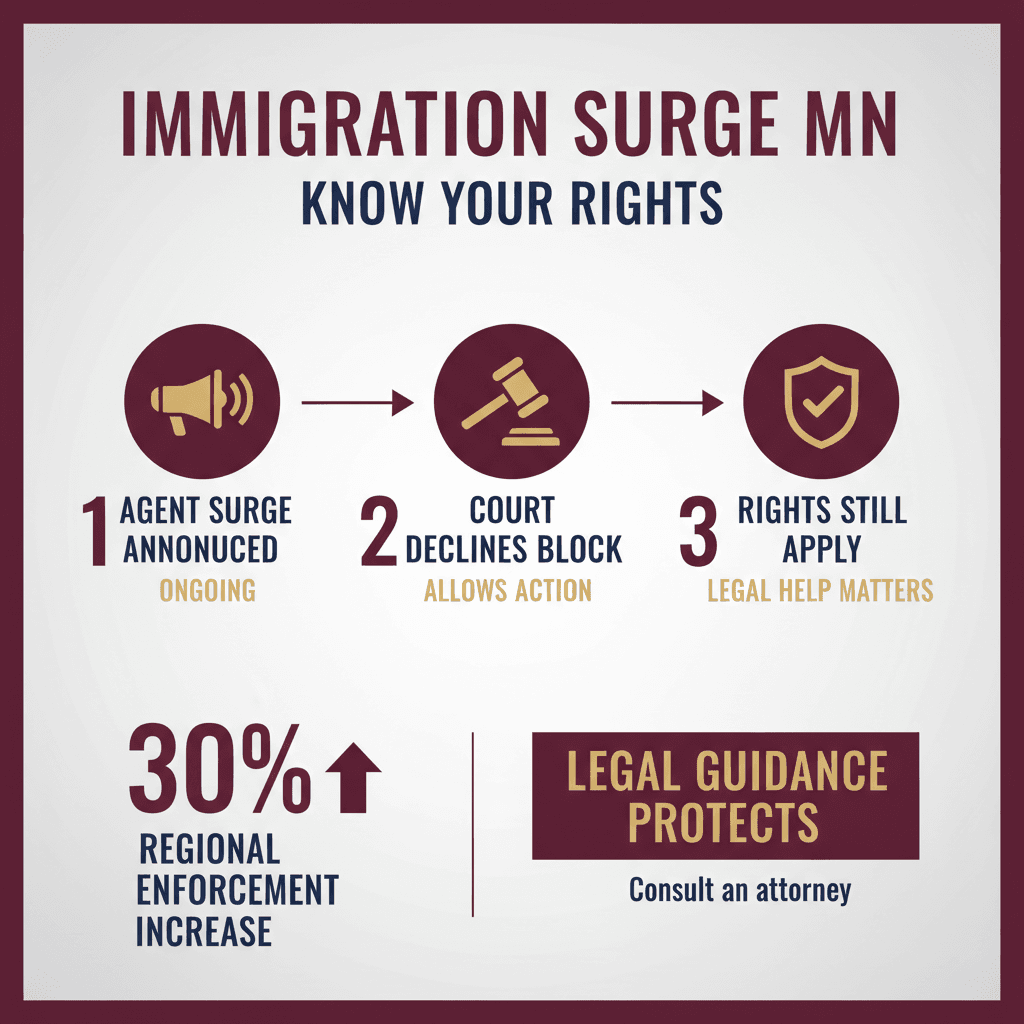
A controversial infographic: enforcement surge, safety vs civil liberties
Why this is controversial
Enforcement surges often split communities. Some residents see them as a public safety tool. Others see them as a civil liberties risk that can chill reporting of crimes and separate families. Both concerns can exist at the same time.
Infographic: the same facts, two very different stories
Headline being shared: Minnesota judge declines to block federal immigration agent surge Status: Confirmed / Monitoring 1️⃣ A federal judge rejected Minnesota’s emergency request to halt the increase of federal immigration agents operating in the state. 2️⃣ The ruling allows the enforcement surge to continue while the broader legal challenge remains pending. 3️⃣ The decision does not rule on the ultimate legality of the operation, only on the request for immediate relief. Create a controversial infographic and faq
| What people hear | Pro-enforcement framing | Civil liberties framing |
|---|---|---|
| “Judge declines to block the surge” | Courts will not stop needed operations without strong evidence. | Emergency relief is hard to win, this is not a ruling that the surge is lawful. |
| “More agents in the community” | Deters crime and enforces the law consistently. | Can discourage victims and witnesses from contacting police. |
| “Case still pending” | Let the process play out, enforcement continues. | More time can mean more detentions and family separation before final review. |
| “What should I do now?” | If you have lawful status, keep documents handy. | Everyone should learn their rights and talk to counsel before a crisis. |
Takeaway: The court’s emergency ruling is a procedural moment. Your best protection is preparation, accurate information, and case specific legal advice.
How to use this infographic responsibly
What's Your Immigration Situation?
Answer 3 questions - we'll tell you your options
Question 1 / 3
What best describes your situation?
Keep Reading

Share information without doxxing, harassment, or panic. If you are in charlotte and you are unsure what applies to your situation, talk to a licensed immigration lawyer before you rely on social media summaries.
What you can do right now if you are worried
Verify your case status using official sources
Start with official information, not rumors. These sites can help you understand processes and next steps:
- USCIS for benefits, forms, and case tools.
- U.S. Department of State visa information for consular processing and visa categories.
- Executive Office for Immigration Review for Immigration Court information and updates.
Do a personal “document audit”
Gather and organize copies of documents that often matter in emergencies:
- Passport, state ID, and any immigration documents.
- Prior court notices, removal orders, or bond paperwork.
- Marriage certificates, birth certificates, and proof of long term residence.
- Any criminal case dispositions, if applicable.
This preparation can save hours when time matters, including when a loved one is detained.
Get a legal screening before you get surprised
Many people wait until after an arrest, a denial, or a detainer. In many cases, options are better before a crisis, such as evaluating eligibility for family based petitions, humanitarian relief, adjustment strategies, or defense options in removal proceedings.
How Vasquez Law Firm, PLLC helps clients facing fast moving immigration enforcement
Experience that matters when the news shifts quickly
Vasquez Law Firm, PLLC focuses on immigration law, and Attorney Vasquez, JD has 15 years of experience helping clients navigate high stress situations. He is admitted to the North Carolina State Bar. That background matters because immigration cases often require coordinated planning, careful timelines, and clear communication.
Serving charlotte residents with practical, step by step guidance
Our team regularly works with individuals and families in charlotte and nearby communities like Concord, Gastonia, and Matthews. We also understand how stressful it can feel to walk into a federal building or courthouse without a plan. In charlotte, people often mention the area around the Charles R. Jonas Federal Building when they talk about federal legal issues, and the fear of the unknown is real.
What we can help with
Depending on your situation, we may help with:
- Case evaluations and eligibility screening for immigration benefits.
- Preparing for USCIS interviews and responding to requests for evidence.
- Removal defense support and strategy planning, including understanding hearing posture and risks.
- Family preparedness planning, including what to do if a loved one is detained.
If you are reacting to “Minnesota judge declines to block federal immigration agent surge Status: Confirmed / Monitoring 1️⃣ A federal judge rejected Minnesota’s emergency request to halt the increase of federal immigration agents operating in the state. 2️⃣ The ruling allows the enforcement surge to continue while the broader legal challenge remains pending. 3️⃣ The decision does not rule on the ultimate legality of the operation, only on the request for immediate relief. Create a controversial infographic and faq,” the most useful next step is not guessing. It is a confidential conversation about your exact facts.
Need immigration help? Our immigration attorneys can review your case.
Frequently asked questions
Quick answers to common questions
Below are common questions we hear after news like “Minnesota judge declines to block federal immigration agent surge Status: Confirmed / Monitoring 1️⃣ A federal judge rejected Minnesota’s emergency request to halt the increase of federal immigration agents operating in the state. 2️⃣ The ruling allows the enforcement surge to continue while the broader legal challenge remains pending. 3️⃣ The decision does not rule on the ultimate legality of the operation, only on the request for immediate relief. Create a controversial infographic and faq.”
1) Does the judge’s decision mean the surge is legal?
No. A denial of emergency relief usually means the court is not ordering an immediate pause. The court may still decide later that parts of the operation are unlawful, depending on evidence, jurisdiction, and legal claims.
2) Can immigration agents enter my home without permission?
In many situations, entry into a home generally requires valid consent or a judicial warrant. You can ask to see a warrant and you can ask the officer to slide it under the door or hold it up to a window. Do not physically block an officer, and do not lie, but you can refuse consent.
3) If I have a pending USCIS case, am I safe from enforcement?
Not always. A pending application can be helpful, but it does not automatically prevent arrest or detention. Risk depends on many factors, including prior orders, criminal history, and whether you have lawful status right now.
4) What should I do if a family member is detained?
Write down the person’s full name, date of birth, and A-number if known. Avoid sharing unverified detention location information on social media. Contact an immigration lawyer quickly to evaluate bond, custody status, and court posture.
5) I live in charlotte, does this Minnesota case affect me directly?
The lawsuit is specific to Minnesota, but enforcement trends can spread and priorities can change nationwide. The most direct impact for someone in charlotte is the increased need to prepare, stay informed through official sources, and get individualized legal advice.
6) When should I talk to a lawyer?
Talk to a lawyer before you are in a crisis, especially if you have any prior immigration court history, any arrest record, or you are unsure about your current status. Early planning often opens options that are harder to use later.
Ready for a clear plan? Call 1-844-967-3536 or schedule through /contact. Vasquez Law Firm, PLLC serves charlotte residents, Se Habla Español.

William Vasquez
Founder & CEO, Vasquez Law Firm, PLLC
William Vasquez is the founder and CEO of Vasquez Law Firm, PLLC, a results-driven firm specializing in immigration, criminal defense, personal injury, and workers' compensation. A U.S. Air Force veteran and recipient of the Joint Service Achievement Medal, William is dedicated to fiercely fighting for his clients' rights.
Related Legal Services
Need legal help? Learn more about speak with an immigration lawyer, or contact us for a free evaluation.
You can also visit North Carolina immigration law firm for more information.