What to Know About Immigration Detention Deportation and Getting Help
Need an immigration lawyer? Learn options for detention, deportation, visas & court. Call Vasquez Law Firm, PLLC: 1-844-967-3536.
Published on January 8, 2026· Updated August 6, 2026
Talk to an immigration attorney
Free call. A clear plan for your case.
Free & confidential · Se habla espanol · 24/7

Have questions? Talk to an attorney - free evaluation.
Call 1-844-967-3536Check your case status now
Look up your immigration case below, then talk to an attorney about what it means — free.
Questions about your result?
Talk to an attorney about your case — free, no obligation.
What to Know About Immigration Detention Deportation and Getting Help
If you or a loved one is facing ICE detention, a deportation case in immigration court, or a confusing USCIS process, an immigration lawyer can help you understand your rights and act fast. Recent advocacy and news reports have renewed attention on how detention and deportation decisions affect real families—often with little time to prepare. This guide explains practical steps, common legal options, and how local help can make a difference for people serving smithfield residents and nearby communities.
ICE encounter or deportation risk?
Time-sensitive cases need quick action. We answer 24/7 for emergency immigration matters. Free 15-min call.
Worried about detention, removal, or a USCIS deadline? Talk with Vasquez Law Firm, PLLC about your next step. Se Habla Español. Call 1-844-967-3536 or request a free case evaluation.
What This News Means for smithfield Residents
Why detention and deportation concerns are rising
Advocacy groups have been sounding the alarm about expanded detention and faster deportation practices, including concerns about safety, due process, and family separation. One example is a recent report and call-to-action published through Google News about stopping policies that “enable” detention and aggressive removal efforts (read the Amnesty-related news coverage on ICE detention and deportation concerns).
For many families, the biggest issue is time. Detention, transfer to a far-away facility, or a quick court date can make it hard to gather records, find witnesses, and apply for relief correctly.
Local impact in Johnston County and nearby cities
People living in smithfield and nearby areas like Clayton, Garner, Raleigh, and Goldsboro often share the same worries: “Where is my family member being held?” “How do we request a bond hearing?” “What paperwork matters most?” Even if your immigration court is not physically in Johnston County, your life, job, and children’s school are here—so your legal strategy should reflect your local ties.
Building a strong case usually requires proof of residence, work history, family relationships, and community support—things that are easier to document when you start early.
3 actions to take immediately if ICE is involved
If ICE contacts you, shows up at your home, or someone is detained, these steps can protect options:
- Do not guess or sign without advice. A single signature can waive rights in removal proceedings.
- Collect key documents. IDs, prior immigration papers, court records, marriage and birth certificates, and proof of time in the U.S.
- Call for legal help fast. Deadlines for motions, bond requests, and applications can be short.
What an Immigration Lawyer Actually Does (and When You Need One)
Common roles: USCIS cases, court defense, and ICE detention help
An immigration lawyer is not just a “form filler.” Depending on your situation, the job may include:
- Preparing and filing petitions with USCIS (family-based petitions, adjustment of status, naturalization, work authorization)
- Handling consular processing through the Department of State
- Defending people in immigration court during removal proceedings
- Requesting bond hearings and challenging detention when possible
- Managing deadlines, evidence, affidavits, and legal arguments
For official government guidance on benefits and forms, you can review USCIS resources, but be careful—government pages explain general rules, not your best strategy.
When hiring counsel is most urgent
Some situations require immediate legal planning because mistakes are hard to fix later:
- You received a Notice to Appear (NTA) for immigration court
- A loved one is detained and needs a bond hearing
- You have any criminal history (even old charges or dismissals)
- You may face bars for unlawful presence or prior removal
- You are seeking asylum or fear return to your home country
In removal proceedings, the government is represented by an attorney. Your side should be prepared with a clear plan, evidence, and legal authority.
Red flags to avoid when choosing legal help
Notarios and unlicensed “consultants” can cause lasting damage. Watch for:
- Promises of guaranteed results
- Advice to lie or “just say” something at an interview
- Refusal to provide copies of what was filed
- No written agreement or unclear fees
A qualified immigration lawyer should explain risks in plain language and put the plan in writing.
Legal Background: Detention, Deportation, and Due Process Basics
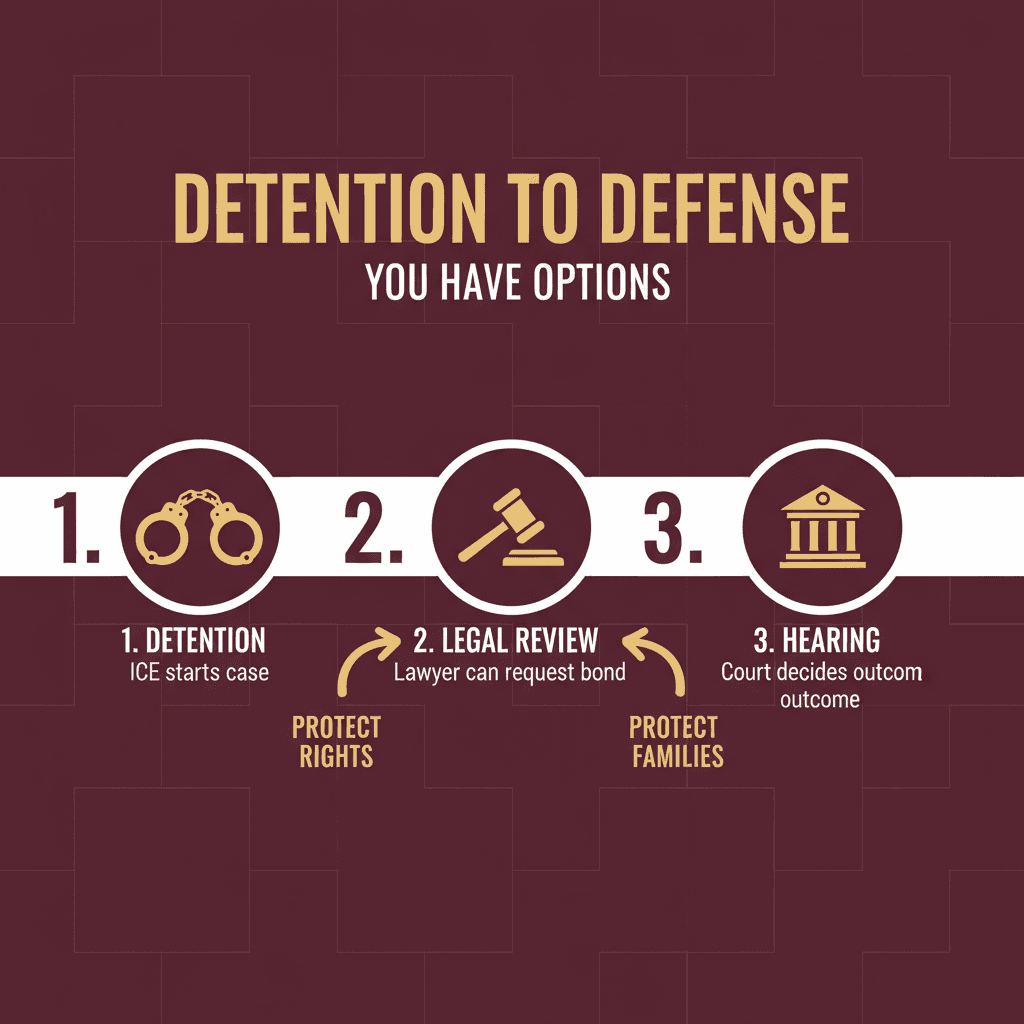
Detention vs. removal proceedings: what’s the difference?
Detention is about custody—whether DHS/ICE holds someone while their case is pending. Removal proceedings are the court process that decides whether someone can stay or must leave. Some people are detained for only a short time; others may remain detained while they fight their case.
Immigration court is overseen by the Executive Office for Immigration Review (EOIR). You can learn more about the court system at EOIR’s official site.
Bond hearings and custody reviews
Many detained immigrants can ask an immigration judge for bond, but not everyone is eligible. Bond eligibility can depend on:
- Immigration status and how someone entered
- Prior removal orders
- Certain criminal convictions
- Whether DHS claims “mandatory detention”
Evidence for bond often includes proof of stable address (for example, living in smithfield), work history, family support, and community ties.
Key laws and court decisions that may matter
Immigration law is federal. Common rules show up in the Immigration and Nationality Act (INA) and related regulations. Examples include:
- Adjustment of status for green cards under certain conditions (see 8 U.S.C. § 1255).
- Removal proceedings procedures (see 8 U.S.C. § 1229a).
- Detention and bond procedures are shaped by statutes, regulations, and case decisions.
Case law can also affect strategy. For example, Padilla v. Kentucky, 559 U.S. 356 (2010), recognized that immigration consequences of criminal pleas are serious and require proper legal advice—an issue that often comes up when a past charge triggers detention or deportation risk.
Common Immigration Paths: Visas, Green Cards, Asylum, and Defense Options
Family-based options and adjustment of status
Many people in North Carolina and Florida pursue family-based immigration. Depending on your situation, a pathway might include:
- A petition filed by a qualifying relative
- Either consular processing or adjustment of status
- An interview and final approval
This is where details matter: prior unlawful presence, old removal orders, or missing records can derail a case. A careful plan from an immigration lawyer can prevent avoidable delays and denials.
Consular processing and travel/visa rules
When a case goes through a U.S. consulate abroad, the Department of State’s visa rules and timelines come into play. For general information, see U.S. Department of State visa resources. Real-life cases may involve waivers, security checks, and document requests that require quick, accurate responses.
Defenses in immigration court: relief that may stop deportation
Even if someone is in removal proceedings, there may be forms of relief, such as:
- Asylum, withholding of removal, or protection under the Convention Against Torture (CAT)
- Cancellation of removal for certain permanent residents or nonpermanent residents (requires meeting strict rules)
- Adjustment of status if eligible, sometimes with waivers
- Motions to reopen based on changed circumstances or legal errors
The best option depends on facts, documents, and credibility. This is not a “one-size-fits-all” process.
Reminder: If you have a court date, an ICE check-in, or a detained family member, waiting can make your case harder. Se Habla Español. Call 1-844-967-3536 or visit /contact to speak with our team.
Why Local Guidance Matters in smithfield (Even in Federal Immigration Cases)
Proving community ties: the “local evidence” that helps
Immigration is federal law, but your life is local. If you live in smithfield, strong documentation can include:
- Lease, mortgage statements, or utility bills
- Pay stubs, tax filings, and employer letters
- School records for children
- Medical records and caregiving proof
- Letters from faith leaders, neighbors, and community groups
These details can support bond requests, discretion arguments, or hardship claims—depending on the type of relief.
What's Your Immigration Situation?
Answer 3 questions - we'll tell you your options
Question 1 / 3
What best describes your situation?
Keep Reading

Nearby courts, landmarks, and practical planning
Many families know the Johnston County Courthouse in Smithfield for local matters, but immigration cases are handled in the federal immigration court system. Even so, organizing documents, affidavits, and certified records often starts right here in the community. A local plan also helps with childcare, transportation, and quick responses when a detention or transfer happens.
Serving surrounding communities
Vasquez Law Firm, PLLC serves smithfield residents and people throughout the region, including Clayton, Selma, Benson, Garner, and Raleigh. If you are detained or placed in proceedings, you should not have to navigate it alone—especially when your family’s stability is on the line.
How Vasquez Law Firm, PLLC Helps: Strategy, Experience, and Communication
Experience and credentials that support your case
Immigration cases require careful fact work and legal analysis. At Vasquez Law Firm, PLLC, cases are guided by Attorney Vasquez, JD, with 15 years of experience in immigration law and bar admissions in the North Carolina State Bar and the Florida Bar. We focus on clear steps, honest timelines, and building strong evidence.
You can learn more about our team on our Attorney Vasquez page.
Types of immigration matters we commonly handle
Every case is different, but our immigration practice often includes:
- Family-based immigration (petitions, adjustment of status)
- Green card and naturalization planning
- Removal defense and immigration court representation
- Detention and bond hearing preparation
- Consular processing support
For an overview of our services, visit our Immigration Law services page.
Communication matters: Se Habla Español
Fear and confusion are common in immigration cases. We prioritize communication and practical checklists. And because language should never be a barrier to getting help, Se Habla Español.
Frequently Asked Questions About Hiring an Immigration Lawyer
Detention and immigration court FAQs
1) What should I do if a family member is detained by ICE?
Start by finding where the person is being held, collecting their A-Number, and gathering immigration and criminal records. Do not assume they are ineligible for bond or relief. An immigration lawyer can request records, evaluate bond eligibility, and prepare evidence of community ties and stability.
2) Can a person fight deportation if they already have a court date?
Yes. A court date means the case is active, not decided. The person may be able to request relief such as asylum, cancellation of removal, adjustment of status, or other options depending on their history. Procedures are governed in part by 8 U.S.C. § 1229a, which outlines removal proceedings.
3) What is a bond hearing, and how do we prepare?
A bond hearing is a custody hearing before an immigration judge to decide if someone can be released while the case continues. Preparation usually includes a release plan (address in smithfield or nearby), financial sponsor proof, employment evidence, and letters of support. Eligibility depends on the legal reason for detention and any disqualifying issues.
Hiring and case-planning FAQs
4) How much does an immigration lawyer cost?
Fees vary based on the type of case (USCIS filing vs. immigration court defense), complexity, and timelines. A good office will explain the scope in a written agreement and discuss government filing fees separately. Beware of anyone who quotes a price without asking detailed questions about your history.
5) Do I really need a lawyer for a USCIS application?
Some straightforward filings can be done without representation, but many “simple” cases have hidden issues like prior unlawful presence, past denials, or criminal charges. An immigration lawyer helps spot risks early, choose the right process (adjustment vs. consular), and avoid inconsistencies that can lead to requests for evidence or denials. Official forms and basic instructions are available at USCIS, but those instructions do not replace legal advice.
6) What documents should I bring to a consultation?
Bring every immigration document you have (notices, receipts, approvals/denials), passports, birth/marriage certificates, any criminal or traffic paperwork, and proof of residence and work. If your loved one is detained, bring their A-Number and any booking or facility information.
Next Steps: How to Protect Your Family and Your Status
A simple checklist to start today
If you are concerned about detention or deportation, start with this:
- Write down key dates (entries, exits, arrests, court dates, prior filings).
- Collect documents and keep copies in a safe place.
- Avoid new legal trouble and get advice before traveling.
- Get a plan for court or USCIS: deadlines, evidence, and the relief you seek.
Talk to a lawyer before the situation gets worse
Whether you need a defense strategy in immigration court, help responding to a USCIS notice, or guidance after an ICE arrest, getting advice early can preserve options. The right plan can also reduce stress by replacing rumors with facts and next steps.
Ready to get answers? Contact Vasquez Law Firm, PLLC to speak with an experienced immigration lawyer team serving smithfield and surrounding communities. Se Habla Español. Call 1-844-967-3536 or schedule your consultation today.

William Vasquez
Founder & CEO, Vasquez Law Firm, PLLC
William Vasquez is the founder and CEO of Vasquez Law Firm, PLLC, a results-driven firm specializing in immigration, criminal defense, personal injury, and workers' compensation. A U.S. Air Force veteran and recipient of the Joint Service Achievement Medal, William is dedicated to fiercely fighting for his clients' rights.
Related Legal Services
Need legal help? Learn more about learn about our immigration practice, or contact us for a free evaluation.
You can also visit statewide immigration legal services for more information.