What H-1B Visa Reform Means for Your Future in 2026
Understand H-1B visa reform and new rules for 2026. Protect your immigration future with insights from Vasquez Law Firm. Contact us for a free consultation.
Published on March 7, 2026
Talk to an immigration attorney
Free call. A clear plan for your case.
Free & confidential · Se habla espanol · 24/7
Have questions? Talk to an attorney - free evaluation.
Call 1-844-967-3536Worried how the latest immigration news affects you?
Schedule a confidential case review with an immigration attorney - know exactly where you stand.
USCIS Case Status
Check your USCIS case status
Enter your receipt number and get the official status. Free, no registration.
What H-1B Visa Reform Means for Your Future in 2026
The landscape of U.S. immigration is constantly shifting, and in 2026, those changes significantly impact the H-1B visa program. For many skilled professionals and the employers who rely on their talent, understanding the nuances of H-1B visa reform is not just beneficial, it's essential for planning careers and business operations. Recent discussions about revamping the H-1B system, spurred by calls from figures like U.S. Rep. Chip Roy to pause all immigration until the system is fixed, highlight the urgency of staying informed. This guide will help you navigate the new rules and potential challenges, ensuring you are prepared for what lies ahead in the H-1B visa process.
Need help with your H-1B visa case? Our experienced immigration attorneys are ready to fight for you. Se Habla Español.
Schedule Your Free Case Evaluation
Or call us now: 1-844-967-3536
Quick Answer
H-1B visa reform in 2026 primarily focuses on strengthening the integrity of the lottery system, prioritizing U.S. workers, and potentially adjusting wage requirements. New rules aim to reduce fraud and ensure the program serves its intended purpose of bringing highly skilled foreign workers to fill critical gaps. Applicants and employers must adhere to stricter compliance measures and be aware of potential increases in application scrutiny.
- Lottery system changes to prevent multiple registrations.
- Increased scrutiny on employer-employee relationships.
- Potential adjustments to prevailing wage levels for H-1B workers.
- Enhanced site visits and fraud detection efforts by USCIS.
- Focus on H-1B specialty occupations and higher education.
Understanding H-1B Visa Reform in 2026
The H-1B visa program, designed for foreign nationals in specialty occupations, has been a cornerstone of U.S. innovation for decades. However, it has also been a subject of ongoing debate and calls for H-1B visa reform. As of 2026, the U.S. Citizenship and Immigration Services (USCIS) has implemented several key changes aiming to enhance the program's fairness and integrity, particularly concerning the H-1B visa lottery. For instance, new regulations now link each lottery registration directly to a unique passport or travel document number for the beneficiary, rather than allowing multiple registrations by different employers for the same individual. This change directly addresses concerns about fraud and abuse in previous lottery cycles.
These reforms are not just minor tweaks; they represent a significant shift in how H-1B visas are allocated and managed. Employers seeking to sponsor H-1B workers in North Carolina, Florida, and across the nation must now navigate a more stringent application process. The goal is to ensure that the H-1B program truly brings in the best and brightest to fill roles where U.S. workers are unavailable, rather than being exploited for cheaper labor. This includes a renewed emphasis on what constitutes a "specialty occupation," typically requiring a bachelor's degree or higher in a specific field, as defined by 8 U.S.C. § 1184(i)(1).
The impact of these H-1B new rules extends beyond the lottery. We are seeing increased scrutiny on the authenticity of job offers and the employer-employee relationship, especially for third-party placements. USCIS is conducting more site visits to verify employment conditions and compliance. For individuals hoping to secure an H-1B visa, understanding these changes is crucial for a successful application. Vasquez Law Firm is closely monitoring these developments to provide up-to-date guidance.
Key Changes to H-1B Visa Lottery and Application
A major focus of H-1B visa reform in 2026 is the integrity of the lottery system itself. Historically, the lottery has faced criticism for allowing multiple registrations for the same individual, artificially inflating selection chances. The new "beneficiary-centric" selection process aims to eliminate this. Instead of selecting registrations, USCIS now selects beneficiaries, ensuring each individual has an equal chance regardless of how many employers register them. This change, outlined in 8 C.F.R. § 214.2(h)(8)(i)(A)(5), significantly levels the playing field for all applicants.
Beyond the lottery, H-1B visa requirements have seen subtle but important shifts. Employers are under greater pressure to demonstrate a legitimate employer-employee relationship, particularly when the H-1B worker will be placed at a third-party client site. This means providing more detailed documentation about the work to be performed, supervision, and control over the employee. For example, a consulting firm sponsoring an H-1B worker to work at a client's office must now provide clear evidence that they, not the client, maintain primary control over the worker's employment.
Another area of reform concerns prevailing wage requirements. While not a direct "$100,000" payment rule, there's ongoing discussion and potential for adjustments to ensure H-1B workers are paid fairly and not used to undercut U.S. wages. This could impact businesses in Smithfield and across the country, requiring them to review their compensation structures for H-1B employees. These changes underscore the need for meticulous H-1B visa application preparation and a deep understanding of the updated regulations.
H-1B Visa Eligibility and Specialty Occupations
To qualify for an H-1B visa, the position must meet the definition of a "specialty occupation." This means the job typically requires a bachelor's degree or higher in a specific specialty field, or its equivalent, as a minimum for entry into the occupation. Examples include IT professionals, engineers, architects, doctors, and certain types of analysts. The H-1B visa full form (Form I-129, Petition for a Nonimmigrant Worker) requires employers to clearly articulate how the position meets these criteria, often through detailed job descriptions and academic requirements. In 2026, USCIS is placing renewed emphasis on this definition, scrutinizing job duties and educational backgrounds more closely than before.
For the beneficiary, general H-1B visa requirements include possessing the required bachelor's or higher degree, or its equivalent through a combination of education and experience. This often involves a credential evaluation for foreign degrees to ensure they are equivalent to a U.S. bachelor's degree. Additionally, the applicant must have a valid job offer from a U.S. employer in a specialty occupation. Any past immigration violations or criminal history could also affect eligibility, making a thorough review of one's background critical before applying.
The employer must also meet specific criteria. They must demonstrate the ability to pay the H-1B worker the prevailing wage for the occupation in the geographic area of employment. This is a significant factor in the H-1B visa application process. Furthermore, the employer must attest to fulfilling labor condition application (LCA) requirements, which include notifying U.S. workers of the intent to hire foreign workers and ensuring working conditions will not adversely affect U.S. workers. These stringent requirements ensure that the H-1B program is not misused.
Don't face complex H-1B visa new rules alone. Our team is here to help you every step of the way.
Call today: 1-844-967-3536 | Se Habla Español
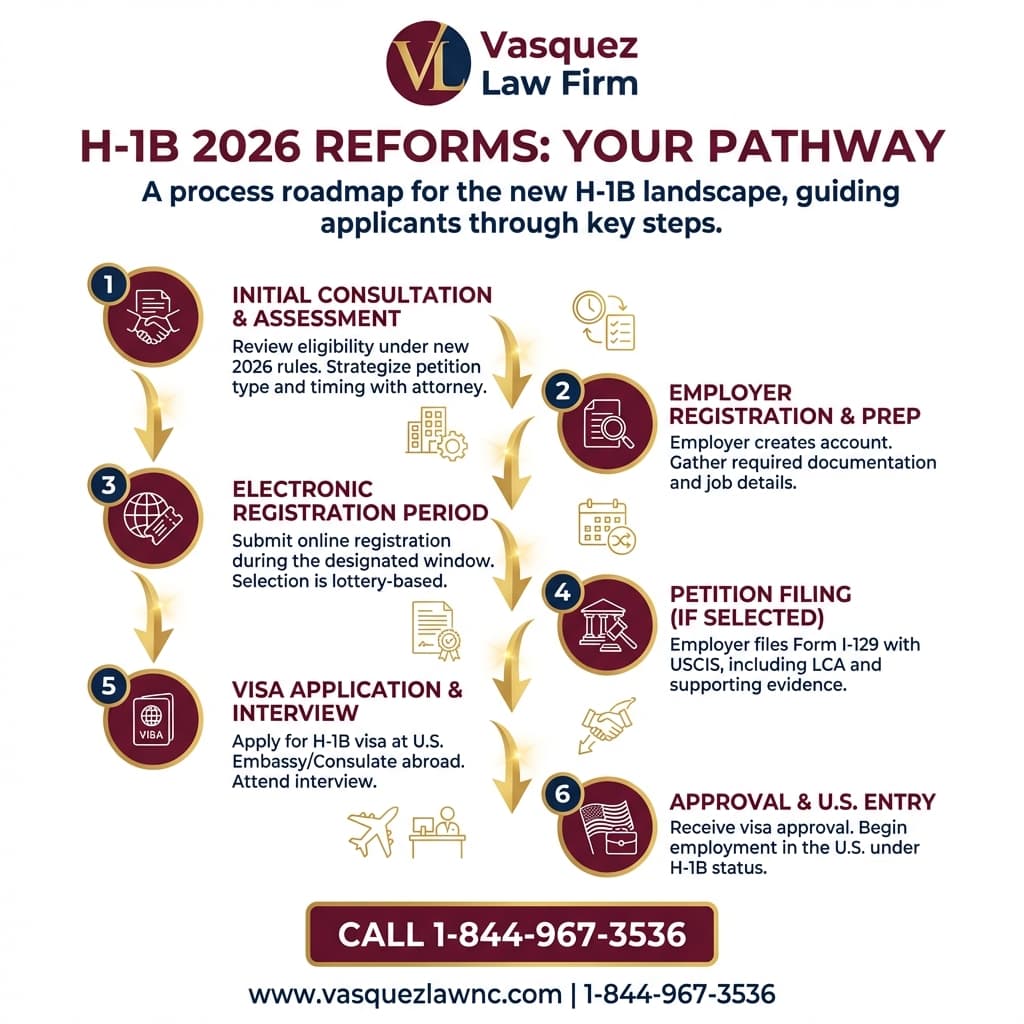
Timeline and What to Expect for H-1B Lottery 2027
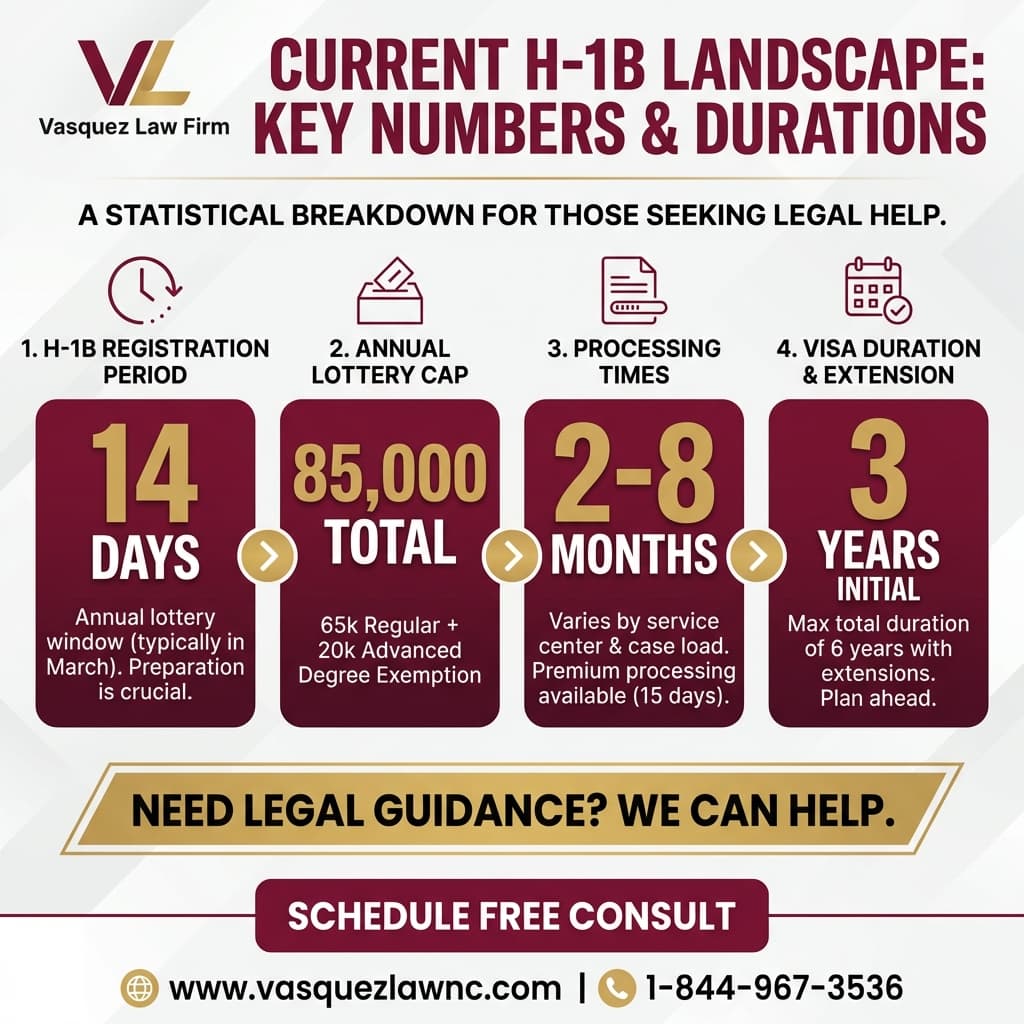
Planning for the H-1B lottery 2027 requires understanding a precise timeline. The registration period for the fiscal year 2027 H-1B cap typically opens in early March 2026, usually lasting for about two to three weeks. During this window, prospective employers must electronically register each beneficiary they wish to sponsor. Each registration requires a $10 non-refundable fee. After the registration period closes, USCIS conducts the lottery if the number of registrations exceeds the annual cap (65,000 regular cap, plus 20,000 for those with a U.S. master's degree or higher). Results are usually announced by the end of March.
If a registration is selected, the employer receives a selection notice and then has a specific filing window, typically 90 days, to submit the full H-1B petition (Form I-129) to USCIS. This period usually begins on April 1st. It is crucial to submit all required documentation accurately and on time during this phase. Missing deadlines or submitting incomplete paperwork can lead to a denial, even if the registration was selected in the lottery. The earliest an approved H-1B petition can start employment is October 1st of the fiscal year for which it was filed.
For those not selected in the initial lottery, there is a possibility of a second lottery later in the year if not enough petitions are filed from the initial selections. However, this is not guaranteed and depends on various factors. Given the increased scrutiny under the H-1B visa new rules 2026, meticulous preparation of the H-1B visa application is more important than ever. Staying informed about announcements from USCIS (USCIS official guidelines) is vital for both employers and beneficiaries.
Common Mistakes in H-1B Applications and How to Avoid Them
Even with thorough preparation, mistakes can occur in the H-1B visa application process, leading to delays or denials. One common error is filing multiple registrations for the same beneficiary in the H-1B lottery. While this was previously a grey area, the H-1B visa reform in 2026 explicitly prohibits this practice, leading to disqualification for all associated registrations. Ensure only one registration per beneficiary is submitted. Another frequent mistake is failing to adequately prove the "specialty occupation" requirement. Employers sometimes submit generic job descriptions that don't clearly articulate the need for a specific bachelor's degree. Provide detailed job duties, educational requirements, and how the position is complex enough to warrant a specialty occupation worker.
Incomplete documentation is a significant pitfall. Missing a required form, failing to include all academic transcripts, or not providing sufficient evidence of the employer-employee relationship can result in a Request for Evidence (RFE) or outright denial. Double-check all forms, include every supporting document, and ensure all information is consistent across the application. Furthermore, employers sometimes fail to meet the prevailing wage requirement, either by offering less than the determined wage or by not accurately calculating it for the specific geographic area. Utilize the Department of Labor's Foreign Labor Certification Data Center to determine the correct prevailing wage.
Another mistake is failing to respond to RFEs or Notices of Intent to Deny (NOID) within the given timeframe. These notices provide an opportunity to correct deficiencies, but if ignored, they will lead to a denial. Always consult with an experienced immigration attorney to craft a comprehensive and timely response. Lastly, not understanding the intricacies of the H-1B visa full form (Form I-129) and its supplements can lead to errors. An attorney can ensure all sections are completed accurately and all necessary addendums are included. These steps are crucial for navigating the H-1B visa new rules effectively.
If you only remember one thing: The H-1B visa process in 2026 demands meticulous attention to detail and strict adherence to the new beneficiary-centric rules. Seek legal guidance early to avoid common pitfalls.
Navigating H-1B Visa Challenges in NC, FL, and Nationwide
Whether you are in Smithfield, North Carolina, or Miami, Florida, the H-1B visa challenges presented by recent reforms are largely consistent across the United States. The H-1B program is federal, meaning the core H-1B visa new rules and regulations are applied uniformly by USCIS nationwide. However, the practical implications can vary based on local economic conditions and the prevalence of certain industries. For example, tech hubs in North Carolina's Research Triangle or Florida's growing technology sectors may see a higher volume of H-1B applications, potentially increasing competition within the lottery. While the process itself is federal, the local job market dynamics can influence the demand for H-1B workers.
North Carolina Notes
North Carolina, particularly areas like Raleigh, Durham, and Charlotte, has a robust technology and research sector that heavily relies on H-1B workers. Businesses in these areas must be acutely aware of the H-1B visa reform changes, especially regarding specialty occupation definitions and prevailing wage requirements. The H-1B visa application process for employers in North Carolina needs to reflect the high standards set by the new federal regulations. Ensuring compliance with all labor condition application (LCA) rules is particularly important for employers in the state.
Florida Notes
Florida's diverse economy, including tourism, healthcare, and emerging tech, also attracts a significant number of H-1B professionals. Cities like Orlando, Miami, and Tampa are key destinations. Employers in Florida must pay close attention to the beneficiary-centric lottery system and the increased scrutiny on employer-employee relationships, especially for companies utilizing H-1B workers at client sites. Understanding the H-1B visa new rules 2026 is critical for Florida businesses to maintain their talent pipelines and avoid compliance issues.
Nationwide Concepts
Across the nation, the overarching goal of H-1B visa reform is to streamline the process, reduce fraud, and ensure the program serves its intended purpose. This means a nationwide emphasis on authentic job offers, qualified beneficiaries, and compliant employers. All employers, regardless of location, must understand the updated H-1B visa requirements and the implications of the new lottery system. The U.S. Department of State (U.S. Department of State) also provides guidance on visa processes, which are influenced by these reforms.
When to Call an Immigration Lawyer Now
The complexities of H-1B visa reform in 2026 mean that proactive legal guidance is more important than ever. If you are an employer considering sponsoring an H-1B worker, or if you are a foreign professional seeking an H-1B visa, reaching out to an experienced immigration attorney can make a significant difference. Here are critical triggers indicating it's time to call a lawyer:
- You are an employer unsure how the new beneficiary-centric lottery system impacts your registration strategy for H-1B lottery 2027.
- You received a Request for Evidence (RFE) or Notice of Intent to Deny (NOID) on an H-1B petition.
- You need assistance in determining if a position qualifies as a "specialty occupation" under the new H-1B visa requirements.
- Your company is undergoing a merger or acquisition, and you need to assess the impact on existing H-1B employees.
- You have concerns about meeting prevailing wage requirements or labor condition application (LCA) compliance.
- You have a complex employment history or educational background that might impact your H-1B visa eligibility.
- You are considering an H-1B transfer and need to understand the new rules for change of employer.
- You are an H-1B visa holder approaching your maximum six-year limit and need to explore green card options.
- You suspect fraud or misrepresentation in an H-1B application you are involved with.
- You need help preparing and submitting a meticulous H-1B visa application to avoid common mistakes.
About Vasquez Law Firm
At Vasquez Law Firm, we combine compassion with aggressive representation. Our motto "Yo Peleo" (I Fight) reflects our commitment to standing up for your rights. We understand the anxieties and challenges that come with navigating complex immigration laws, especially with significant H-1B visa reform underway. Our dedicated team, led by Attorney Vasquez, provides personalized and strategic legal counsel to individuals and businesses in North Carolina, Florida, and across the nation.
- Bilingual Support: Se Habla Español - our team is fully bilingual, ensuring clear communication.
- Service Areas: We offer comprehensive immigration services nationwide, with local presence in North Carolina and Florida.
- Experience: With over 15 years of dedicated legal experience, we have a proven track record of helping clients achieve their immigration goals.
- Results: Thousands of successful cases across multiple practice areas demonstrate our commitment to favorable outcomes.
Attorney Trust and Experience
Attorney Vasquez holds a Juris Doctor degree and is admitted to practice in both the North Carolina State Bar and Florida Bar. With over 15 years of dedicated legal experience, he has built a reputation for providing personalized attention and achieving favorable outcomes for his clients. He understands the intricacies of federal immigration law, including the latest H-1B visa reform, and is committed to protecting your interests.
Frequently Asked Questions
What is the new rule for H-1B visa in 2026?
The primary new rule for H-1B visas in 2026 is the beneficiary-centric lottery system. This means USCIS selects individual beneficiaries, not registrations, making it impossible for multiple employers to register the same person to increase their chances. This aims to reduce fraud and ensure fair allocation of the limited H-1B visas.
Who will pay $100,000 for H-1B?
There is no current rule requiring a $100,000 payment for H-1B visas. This figure likely refers to past legislative proposals or discussions about increasing minimum wage requirements for H-1B workers. While wage requirements are frequently reviewed, the $100,000 figure is not a current H-1B visa requirement as of 2026.
Will H-1B ever get a green card?
Yes, many H-1B visa holders eventually obtain green cards. The H-1B visa is considered "dual intent," meaning you can seek permanent residency while holding it. The process typically involves an employer sponsoring the H-1B worker for an employment-based green card, which can be a lengthy process depending on the visa category and country of origin.
Is the U.S. visa banned in 2026?
No, there is no blanket ban on U.S. visas in 2026. While there have been calls for immigration pauses and specific restrictions in the past, the H-1B visa program and other visa categories continue to operate. However, policies can change, and applicants should stay informed about any new regulations or proclamations that might affect their specific visa type.
What are the H-1B visa new rules 2026 regarding multiple registrations?
The H-1B visa new rules 2026 strictly prohibit multiple registrations for the same beneficiary. Under the new beneficiary-centric system, USCIS selects individuals based on their unique identifying information (like a passport number). Any attempt to submit multiple registrations for one person will result in the disqualification of all registrations for that individual.
How do H-1B visa requirements for specialty occupations affect me?
H-1B visa requirements for specialty occupations mean your job must demand a bachelor's degree or higher in a specific field. This affects you by requiring your employer to demonstrate this specific need and for you to possess the requisite education or equivalent experience. USCIS is scrutinizing these definitions more closely in 2026 to ensure compliance.
What should employers know about H-1B visa reform?
Employers need to know about the beneficiary-centric lottery system, increased scrutiny on employer-employee relationships, and potential adjustments to prevailing wage levels. Compliance with labor condition applications (LCAs) and meticulous documentation for H-1B visa applications are more critical than ever to avoid RFEs or denials under the new H-1B visa new rules.
What is the H-1B lottery 2027 timeline?
The H-1B lottery 2027 timeline typically begins with the registration period in early March 2026. Selections are usually announced by the end of March, followed by a 90-day filing window for selected petitions starting April 1st. The earliest employment start date for approved petitions is October 1, 2026, for fiscal year 2027.
Can I change employers on an H-1B visa with the new rules?
Yes, H-1B visa holders can still change employers. This is known as H-1B "portability." The new employer must file a new H-1B petition on your behalf. While the core portability rules remain, the increased scrutiny on employer-employee relationships and specialty occupation definitions means the new petition must be meticulously prepared to avoid issues.
Where can I find the H-1B visa full form?
The H-1B visa full form is Form I-129, Petition for a Nonimmigrant Worker, along with its specific H-1B supplement. You can find this form and its instructions on the official U.S. Citizenship and Immigration Services (USCIS) website. It is crucial to use the most current version of the form for your H-1B visa application.
Sources and References
- U.S. Citizenship and Immigration Services (USCIS)
- U.S. Department of State
- Executive Office for Immigration Review (EOIR)
- 8 U.S.C. § 1184 - Admission of nonimmigrants
- 8 C.F.R. § 214.2 - Petitions for nonimmigrant workers
Need immigration help? Our immigration attorneys can review your case.
Ready to take the next step? Contact Vasquez Law Firm today for a free, confidential consultation. We're committed to fighting for your rights and achieving the best possible outcome for your case, especially with the latest H-1B visa reform.
Start Your Free Case Evaluation Now
Call us: 1-844-967-3536
Se Habla Español - Estamos aquí para ayudarle.
William Vasquez
Founder & CEO, Vasquez Law Firm, PLLC
William Vasquez is the founder and CEO of Vasquez Law Firm, PLLC, a results-driven firm specializing in immigration, criminal defense, personal injury, and workers' compensation. A U.S. Air Force veteran and recipient of the Joint Service Achievement Medal, William is dedicated to fiercely fighting for his clients' rights.
Related Legal Services
Need legal help? Learn more about our immigration legal services, or contact us for a free evaluation.
You can also visit immigration lawyers serving all of North Carolina for more information.