Explain why Congress approved general funding but excluded DHS from a full-year budget
Explain why Congress approved general funding but excluded DHS from a full-year budget, and what it means for immigrants. Call 1-844-967-3536.
Published on January 31, 2026· Updated August 6, 2026
Talk to an immigration attorney
Free call. A clear plan for your case.
Free & confidential · Se habla espanol · 24/7
Have questions? Talk to an attorney - free evaluation.
Call 1-844-967-3536Worried how the latest immigration news affects you?
Schedule a confidential case review with an immigration attorney - know exactly where you stand.
USCIS Case Status
Check your USCIS case status
Enter your receipt number and get the official status. Free, no registration.
Explain why Congress approved general funding but excluded DHS from a full-year budget
When Congress passes a broad funding bill but leaves the Department of Homeland Security (DHS) out of a full-year budget, it can feel confusing and alarming, especially for families dealing with immigration applications, travel, or court cases. This article will Explain why Congress approved general funding but excluded DHS from a full-year budget, what that choice says about politics and border policy, and what it can mean for real people waiting on USCIS decisions or appearing in immigration court.
Need legal help?
Immigration in NC and FL. Personal injury and workers compensation across NC. Criminal defense in Johnston and Harnett counties, and traffic tickets in 10 NC counties. Tell us your county and we will tell you exactly what we can do.
If you are worried about how shifting federal funding could affect your case, you do not have to guess. Speak with our team about your options and timing.
Serving charlotte residents and clients across North Carolina and beyond, Vasquez Law Firm, PLLC helps people plan around government delays and policy changes.
Contact us for a free case evaluation or call 1-844-967-3536. Se Habla Español.
What happened and why it made news
The basic setup: full-year funding vs DHS
Congress can fund the government through annual appropriations, or it can pass short-term extensions called continuing resolutions. In the news discussed this week, lawmakers approved broad funding for many agencies, but DHS was treated differently.
Why DHS often becomes the fight
DHS sits at the center of border security, interior enforcement, and humanitarian processing. That means DHS funding debates often become stand-ins for larger policy fights about the border, asylum, detention, and executive authority.
News source and what to watch
For the immigration news item that triggered this conversation, see the Boundless Immigration roundup via Google News: This Week in Immigration coverage referenced in the news cycle.
How federal funding works in plain English
Appropriations are not optional
The Constitution requires that federal money be spent only as Congress allows. In simple terms, agencies cannot legally keep paying bills without a valid appropriation.
What a continuing resolution does
A continuing resolution, often called a CR, usually extends prior funding levels for a limited time. It buys Congress time when there is no agreement on a full-year budget.
- It prevents an immediate shutdown for covered agencies.
- It can restrict new initiatives because spending stays close to last year.
- It increases uncertainty for planning and staffing.
Why DHS can be separated from other agencies
Congress often packages agencies into different appropriations bills. DHS is frequently paired with other issues that are politically charged, so it may be left out even when broader government funding moves forward.
The core reasons DHS was excluded
Border policy conflict drives the split
If you want to Explain why Congress approved general funding but excluded DHS from a full-year budget, start with this: DHS money is where lawmakers try to force decisions on border strategy. One side may demand changes tied to asylum, parole programs, detention capacity, or wall construction. The other side may see those demands as unacceptable or harmful.
Because DHS controls major operational levers through agencies like CBP, ICE, and USCIS, DHS funding is often used to pressure the administration on enforcement and humanitarian processing.
Policy riders and conditions
Budget negotiations are not only about dollar amounts. They can include riders, which are policy conditions attached to funding. DHS is a common target for riders related to:
- Asylum screening standards and expedited removal rules
- Limits on parole programs and eligibility categories
- Detention funding requirements and bed minimums
- Border barrier contracting and land use rules
- Information sharing between federal and state partners
Election-year incentives
In high-stakes political seasons, some lawmakers may prefer to keep DHS unresolved because the border remains a major campaign issue. That political incentive can make it harder to compromise on a full-year DHS bill, even if there is agreement to fund many other parts of government.
What this means for immigration processes and real families
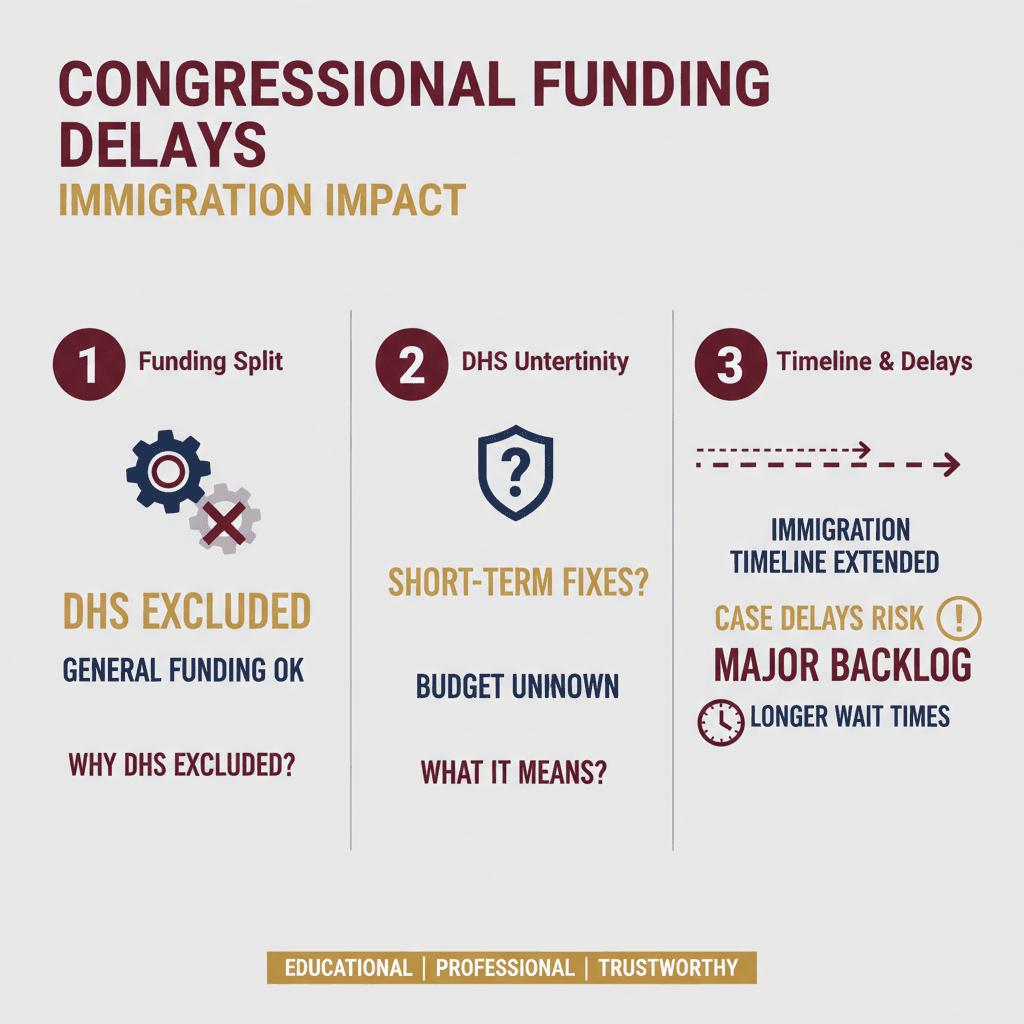
USCIS processing and fee-funded work
Many USCIS operations are primarily funded by filing fees, not annual appropriations. That can reduce the direct shutdown risk for certain USCIS functions, but DHS-wide budget instability can still affect staffing, technology projects, and interagency coordination.
You can verify filing processes and alerts directly with USCIS official guidance, especially if you are tracking a receipt notice, interview, biometrics appointment, or request for evidence.
Border and travel issues
DHS funding can shape how quickly agencies respond to surges, how they staff ports of entry, and how policies are implemented. For families traveling on visas, or for those waiting abroad for consular processing, uncertainty can create practical delays and confusion.
For visa categories and travel updates, review U.S. Department of State visa information, since consular processing is handled by State, not DHS.
Immigration court and EOIR
Immigration courts are part of the Department of Justice, through the Executive Office for Immigration Review (EOIR), not DHS. Even so, DHS funding debates can affect the government attorneys who appear in court and broader case management priorities.
For court locations, policies, and notices, check EOIR resources. In charlotte, many clients are focused on hearing dates, deadlines, and whether their case can move faster through strong preparation.
Reminder: If your hearing is at the Charlotte Immigration Court or you have a case tied to the Western District of North Carolina, keep a written timeline of filings and notices. Budget headlines do not change deadlines automatically.
Need a plan for your immigration timeline? Call 1-844-967-3536 to discuss next steps. Se Habla Español.
The legal framework: DHS funding and immigration authority
Why the Antideficiency Act matters
Federal agencies generally cannot spend money that Congress has not appropriated. The Antideficiency Act, found in 31 U.S.C. Section 1341, is one reason shutdown threats matter. If appropriations lapse, many activities must stop unless they fall into specific exceptions.
DHS and INA authority
DHS carries major immigration responsibilities under the Immigration and Nationality Act (INA). For example, DHS has broad authority over the administration and enforcement of immigration laws under 8 U.S.C. Section 1103. Funding choices can influence how that authority is operationalized, including staffing levels and program capacity.
What budget fights do not change
Even when Congress delays a full-year DHS budget, core legal standards for benefits do not automatically change. Eligibility for adjustment of status, naturalization, asylum, and many other benefits remains governed by statutes and regulations, plus agency guidance.
That is another key point when you Explain why Congress approved general funding but excluded DHS from a full-year budget: it is about leverage and operations, not an overnight rewrite of immigration law.
Practical steps if you have an immigration case right now
Protect your deadlines and proof
Whether you live in charlotte or you are helping a family member from another state, the safest approach is to assume deadlines still apply. Keep copies of everything you send and receive.
- Save receipt notices, tracking numbers, and delivery confirmations.
- Print online case status updates and appointment notices.
- Track expiration dates for work permits, travel documents, and passports.
Build a delay-resistant strategy
DHS budget uncertainty can create backlogs and shifting priorities. A strong case strategy anticipates delays by filing early when eligible, responding quickly to requests for evidence, and avoiding preventable mistakes that trigger rejections.
If you want us to review your filings, deadlines, and risk areas, explore our Immigration Law services.
When to get legal help
Consider speaking with an attorney if any of the following apply:
- You have an upcoming hearing or missed a court date.
- You received a Notice to Appear, denial, or intent to deny.
- You have prior arrests, removals, or immigration violations.
- You are unsure whether travel is safe while your case is pending.
- Your family situation changed, marriage, divorce, or a new child.
At Vasquez Law Firm, PLLC, Attorney Vasquez brings 15 years of immigration experience and is admitted to the North Carolina State Bar. Our team works with clients in charlotte, as well as nearby communities like Matthews, Huntersville, Gastonia, and Concord.
How our firm helps during budget uncertainty
What's Your Immigration Situation?
Answer 3 questions - we'll tell you your options
Question 1 / 3
What best describes your situation?
Keep Reading

Case triage and timeline planning
Budget headlines can create anxiety, but your case needs a grounded plan. We focus on what you can control, including eligibility, evidence quality, filing timing, and compliance with court and agency instructions.
Representation before agencies and court
Depending on your needs, we can help with family-based cases, removal defense strategy, work authorization planning, and other immigration matters. We also help clients understand what DHS actions could mean for their specific posture, including whether a benefit is discretionary and how to present equities clearly.
Bilingual support: Se Habla Español
Immigration is stressful, and language barriers can make it worse. We communicate clearly and respectfully in English and Spanish so you can make informed choices. Se Habla Español.
Frequently Asked Questions
1) Does excluding DHS from a full-year budget mean DHS shuts down right away?
Not always. Congress may fund DHS through a short-term continuing resolution, or DHS may keep some functions running under shutdown exceptions. Still, uncertainty can affect planning and can increase delays. Always follow official notices and your case deadlines.
2) Is USCIS going to stop processing applications if DHS is not fully funded?
USCIS is largely fee-funded, so many functions often continue. However, DHS-wide funding disruptions can still cause ripple effects, like slower support services or delayed modernization. Check USCIS for alerts and keep copies of all filings.
3) Why is DHS treated differently than other agencies in budget negotiations?
Because DHS is where Congress fights about border enforcement, asylum processing, detention capacity, and executive branch discretion. That political intensity is a major reason people ask us to Explain why Congress approved general funding but excluded DHS from a full-year budget.
4) Can Congress use DHS funding to change asylum rules?
Congress can attach riders that limit how funds are used, but riders do not automatically rewrite the INA in a clean way. Courts may also review certain policy shifts depending on how they are implemented. Practical impact often depends on agency guidance and enforcement priorities.
5) What should I do if I have a hearing at the Charlotte Immigration Court?
Assume your hearing date still stands unless the court tells you otherwise. Confirm your next hearing date, prepare documents early, and talk to an attorney if you have not filed key applications or evidence. Many charlotte clients benefit from a clear checklist and a calendar of deadlines.
6) How can a lawyer help if this is just politics in Washington?
Even when the issue is political, the consequences are personal. A lawyer can help you pick the best filing strategy, avoid mistakes that cause delays, respond to agency requests, and prepare for court. We also help you understand which parts of your case are time-sensitive and which can be paced strategically.
Bottom line: If you are trying to Explain why Congress approved general funding but excluded DHS from a full-year budget, it explains the politics. If you want to protect your family, you need a case plan.
To speak with a lawyer, contact Vasquez Law Firm, PLLC today. Call 1-844-967-3536 or schedule your free case evaluation. Se Habla Español.
Key takeaways for immigrants and families
Funding headlines create risk, but you still have options
Uncertainty can increase stress and sometimes delays, but it does not automatically erase eligibility or cancel filings. Your strongest move is to stay organized and proactive.
Know which agency controls which step
DHS includes USCIS, CBP, and ICE. The Department of State handles visas at consulates abroad. EOIR runs immigration court. Understanding the agency map helps you respond correctly.
Local help matters
If you are in charlotte and dealing with a pending case, a missed notice, or a court deadline, local support can help you act quickly and correctly. With 15 years of experience, Attorney Vasquez focuses on practical steps that match the law and the facts of your case.
Call now: Contact us or call 1-844-967-3536 to discuss your next step. Se Habla Español.
Disclaimer: This article is for general information and does not create an attorney-client relationship. Immigration laws and policies can change, and outcomes depend on the facts of each case.

William Vasquez
Founder & CEO, Vasquez Law Firm, PLLC
William Vasquez is the founder and CEO of Vasquez Law Firm, PLLC, a results-driven firm specializing in immigration, criminal defense, personal injury, and workers' compensation. A U.S. Air Force veteran and recipient of the Joint Service Achievement Medal, William is dedicated to fiercely fighting for his clients' rights.
Related Legal Services
Need legal help? Learn more about speak with an immigration lawyer, or contact us for a free evaluation.
You can also visit North Carolina immigration law firm for more information.