What the Legal Elite 2026 List Doesn't Tell You About Divorce in NC
Need a divorce lawyer NC trusts? Legal Elite 2026 buzz can mislead. Learn what matters in North Carolina divorce—and call 1-844-967-3536.
Published on January 6, 2026

Have questions? Talk to an attorney - free evaluation.
Call 1-844-967-3536What the Legal Elite 2026 List Doesn't Tell You About Divorce in NC
If you’re searching for a divorce lawyer NC families can rely on, you’ve probably seen “top lawyer” lists shared everywhere after Legal Elite 2026. The part most people miss: awards can be helpful, but they don’t automatically tell you who will protect your custody rights, your finances, and your peace of mind in a North Carolina divorce.
Going Through a Divorce in North Carolina?
NC requires 1 year of separation. We protect your assets, custody rights, and future.
Quick Summary (Read This First)
What happened: Business North Carolina highlighted its Legal Elite 2026 class—spotlighting lawyers considered “top-performing” in their fields.
Why it matters to you: If you’re choosing a divorce lawyer NC residents trust, “elite” labels may not reflect the skills that decide custody, property division, and support in your county.
What to do now: Compare attorneys using court-specific questions, confirm real family-law experience, and protect evidence and finances before the situation escalates.
What This News Means for North Carolina Residents
Why Legal Elite 2026 is getting attention
Lists like Business North Carolina’s Legal Elite 2026 coverage can reassure the public that some attorneys have strong reputations among peers. That’s real information—but it’s incomplete for divorce.
The missing piece: divorce outcomes aren’t “one size fits all”
In a North Carolina divorce, your results can turn on facts that don’t show up in an award profile: your separation date, who stayed in the home, how money moved, whether there are texts about threats, or how parenting time has actually worked in the last 90 days.
Those details matter in real courtrooms—like the Wake County Courthouse in Raleigh or Mecklenburg County courts in Charlotte—where local rules, scheduling, and judicial expectations shape your case.
How to use this news the smart way
If the Legal Elite 2026 news made you start searching for a divorce lawyer NC residents recommend, treat “top lawyer” lists as a starting point—not the final filter. Your best choice is usually the attorney who can (1) explain the law in plain English, (2) prove they handle cases like yours, and (3) execute quickly without creating avoidable conflict.
KEY TAKEAWAY:
Awards can reflect reputation. But in divorce, what protects you is a plan: clear evidence, clean finances, and county-specific courtroom experience.
What to Do in the Next 24-48 Hours
1) Stabilize safety and daily life first
Even when a divorce starts “civil,” the first 48 hours can turn emotional fast. Your goal is stability: protect kids from conflict, keep routines, and avoid scenes that can be used against you later.
2) Preserve evidence (legally) before it disappears
Divorce often involves proof: who paid which bills, what was said in writing, and what the parenting schedule really looks like. Preserve it now so you’re not rebuilding later.
3) Protect finances without doing anything that looks sneaky
There’s a difference between getting informed and hiding the ball. Don’t drain accounts or run up debt out of fear. Instead, document balances and transactions, then get legal advice on next steps.
If this situation applies to you, take these steps NOW:
- Step 1: Document everything: save texts/emails, screenshot co-parenting apps, and write a timeline (separation date, moves, major incidents, child schedule).
- Step 2: Pull financial snapshots: last 12 months of bank/credit statements, retirement balances, mortgage/rent info, and recent pay stubs.
- Step 3: Do NOT sign separation agreements, quit your job, move out with the kids, or “agree by text” to custody changes without legal review.
- Step 4: Consult with a legal expert to understand your rights and options
Warning Signs & Red Flags to Watch For
Red flag: you’re being pressured to hire based on a badge, not a plan
Some people feel rushed after reading “top lawyer” news and hire the first name they recognize. In divorce, rushing can create expensive mistakes—especially around custody schedules, moving out, and temporary support.
Red flag: sudden money moves or secrecy
In many cases, the first sign of trouble is financial: accounts drained, credit cards opened, tax refunds diverted, or paychecks rerouted. These are not “private marital decisions” once divorce is on the table.
Red flag: threats about the kids or immigration status
Threats like “you’ll never see the kids again” or “I’ll ruin you” are common—and they can be used to seek protections. If language barriers exist, it’s even more important to have counsel who can communicate clearly. (Se Habla Español matters more than people think.)
These are signs your case may be in jeopardy:
- Your spouse is draining accounts, hiding passwords, or refusing access to basic records.
- You’re being pushed to sign a “quick” separation agreement before you’ve seen full financial disclosures.
- Parenting time is changing informally (and you’re being told “it’s temporary”)—but nothing is written down.
Seeing these signs? Vasquez Law Firm, PLLC has handled hundreds of denied claims in North Carolina. Attorney Vasquez knows the tactics insurers use. Get a free case evaluation.
Your Rights: What You CAN and CANNOT Do
What you CAN do to protect yourself
North Carolina divorce law rewards preparation and punishes chaos. You can take lawful steps to protect children, preserve property, and keep communications calm and usable in court.
What you CANNOT do without risking your case
Some common “advice” online can backfire in court—especially advice that encourages hiding assets, cutting off the other parent, or recording people illegally.
YOU HAVE THE RIGHT TO:
- Ask the court for temporary custody/child support rules when you can’t safely or calmly “work it out” informally.
- Request equitable distribution (a fair division) of marital property and debts if you qualify under North Carolina law.
- Seek protective orders when domestic violence is present (and to request temporary custody provisions when appropriate).
YOU CANNOT:
- Hide assets, “sell” property to friends, or move money around to make it disappear—judges can penalize this.
- Ignore deadlines or assume informal parenting schedules will protect your rights long-term.
Vasquez Law Firm, PLLC helps North Carolina clients understand and protect their rights every day.
Documents You'll Need (Save This Checklist)
Financial records (to stop guessing)
Most divorce fights come from uncertainty: “How much is there?” and “Where did it go?” The right records reduce conflict and attorney time.
Parenting and household records (to show reality)
Custody decisions are fact-driven. Keep proof of what’s actually happening with school, medical appointments, daycare, and day-to-day parenting.
Gather these documents NOW (before they disappear):
- Last 12–24 months of bank and credit card statements (all accounts you can access).
- Pay stubs (both spouses if available), W-2s/1099s, and the last 2–3 years of tax returns.
- Retirement statements (401(k), pension, IRA), stock/crypto statements, and any employment benefits summaries.
- Mortgage statements, deeds, vehicle titles, insurance declarations, and a list of major household assets.
- Children’s records: school/daycare info, medical summaries, schedules, and messages about exchanges.
Tip: Keep all documents organized in one folder - it makes the process much easier.
KEY TAKEAWAY:
In divorce, the person with clean, organized records often negotiates from strength—because they can prove what’s true.
Legal Background and Context
How absolute divorce works in North Carolina
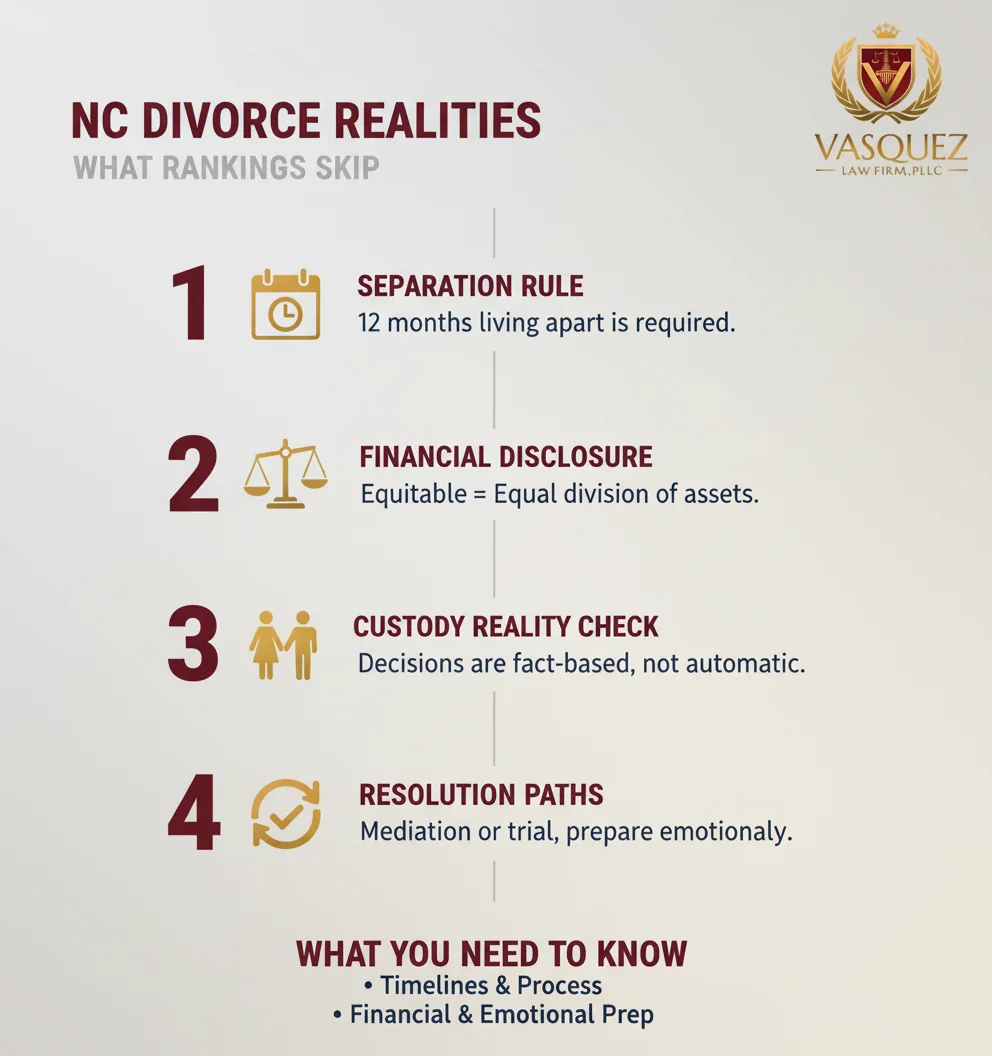
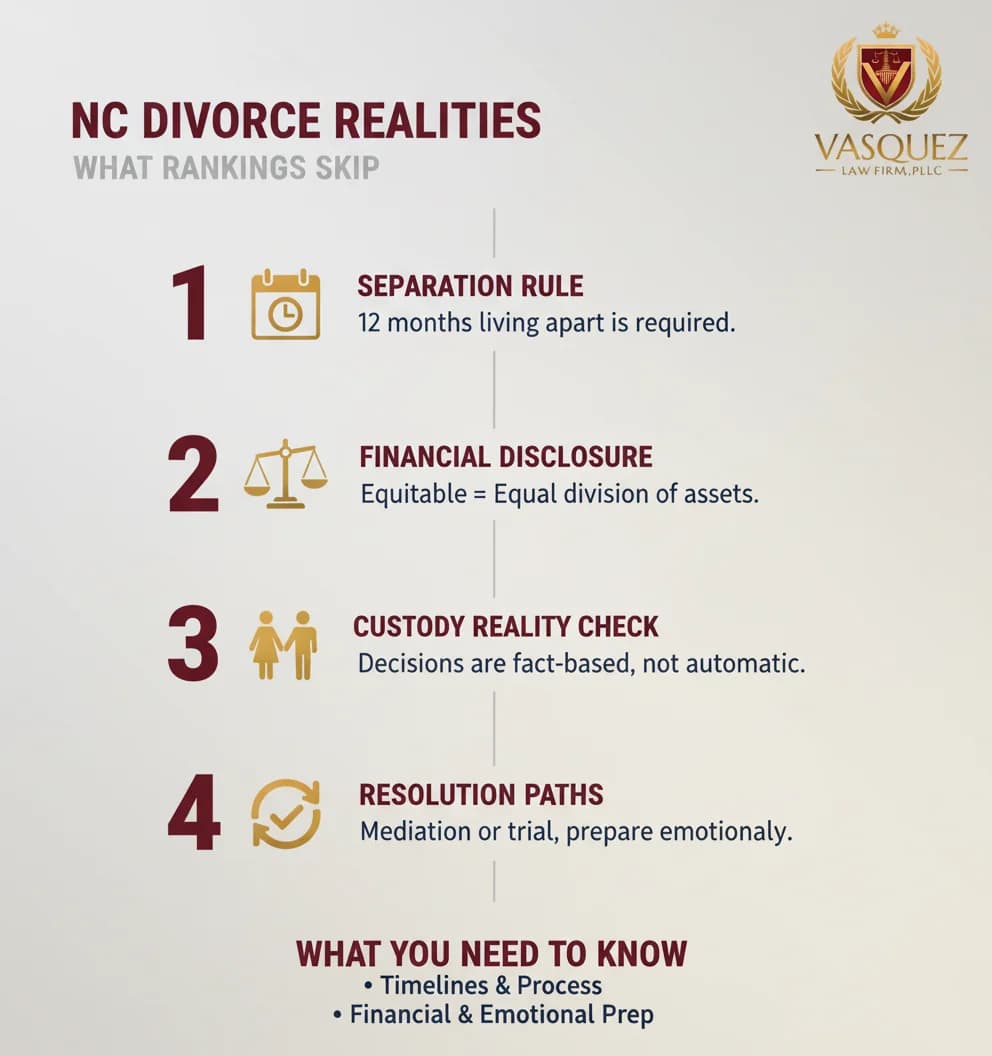
In North Carolina, “absolute divorce” is the court order that ends the marriage. The most common path is a one-year separation requirement. Key rules come from the North Carolina General Statutes, including N.C. Gen. Stat. § 50-6 (grounds for divorce) and N.C. Gen. Stat. § 50-10.1 (resumption of marital relations and separation).
Property, debt, and support: where most people get surprised
Ending the marriage is only one piece. Many people need related claims such as equitable distribution (division of marital property/debt) under N.C. Gen. Stat. § 50-20, and possible alimony under N.C. Gen. Stat. § 50-16.3A.
Child support and custody are separate issues with their own standards. The North Carolina Courts provide helpful public information at North Carolina Judicial Branch (nccourts.gov), including forms and basic explanations.
Why your county (and your facts) matter more than headlines
Even with the same statutes, the experience of a case can feel different depending on scheduling, local practices, and what evidence is available. That’s why choosing a divorce lawyer NC residents trust should focus on practical strategy: temporary orders, discovery, settlement structure, and trial readiness—not just publicity.
For readers comparing lawyers after Legal Elite 2026, a good “reality-check” question is: “How will you handle temporary custody and support in my county if the other side won’t cooperate?” The answer reveals experience.
What Are My Options in Family Court?
Answer 3 questions to understand your rights
Question 1 / 3
What family legal issue are you facing?
Keep Reading

How Vasquez Law Firm, PLLC Helps North Carolina Clients Win These Cases
A divorce strategy built for real life
Vasquez Law Firm, PLLC serves North Carolina residents with a practical, evidence-based approach to family law. Attorney Vasquez, JD, has 15 years of experience and is admitted to the North Carolina State Bar and the Florida Bar. Our team is bilingual—Se Habla Español—so clients can understand their options clearly and make informed decisions.
What we do from day one
Our experienced team, led by Attorney Vasquez, has helped hundreds of North Carolina clients. Here's exactly how we help:
- Step 1: We review your case for free and tell you honestly if you have a claim
- Step 2: We handle all paperwork and deadlines so nothing gets missed
- Step 3: We fight insurance tactics - we know their playbook
- Step 4: We maximize your settlement or take it to hearing if needed
How that translates in a North Carolina divorce
In divorce and custody matters, “winning” often means protecting long-term stability: a workable custody schedule, support based on accurate income, and property division that doesn’t leave you stuck with hidden debts. We also help clients use available court information responsibly (including the forms and resources linked through Family Law services) while avoiding common pitfalls that create delays.
Real example: “We recently helped a parent in a contested custody dispute where the other side tried to change the schedule informally, then claim that new schedule was the ‘status quo.’ We documented the real history through school records, messages, and a detailed calendar, and we pushed for temporary orders that protected consistent parenting time. The case resolved with a written schedule and clear exchange rules that reduced conflict.” - Attorney Vasquez

Frequently Asked Questions (Specific to This Situation)
People reading about Legal Elite 2026 often have the same concern: “Am I about to choose a lawyer based on marketing instead of results?” These questions address that exact moment—when you’re deciding what matters in a North Carolina divorce.
Do “Legal Elite” lists actually help me choose a divorce lawyer in NC?
They can help you build a shortlist, but they don’t replace proof of family-law focus, courtroom comfort, and a plan for your county. Use the list to generate names, then interview lawyers about separation dates, temporary orders, custody schedules, and financial discovery.
What should I ask a lawyer who advertises Legal Elite 2026 during my consult?
Ask questions tied to outcomes: How will you protect parenting time in the first 30 days? What documents do you need from me? How do you handle discovery when a spouse is hiding money? How do you approach settlement vs trial in my county?
If I’m not separated for a full year yet, is it too early to talk to a divorce lawyer NC clients use?
No. Even if you can’t file for absolute divorce yet, you may need advice on separation agreements, custody, child support, and protecting assets. Early planning can prevent mistakes that are hard to fix later, especially around money movement and parenting schedules.
Does moving out of the house hurt me in a North Carolina divorce?
It depends. Moving out can affect practical leverage and parenting time, and it can change what “normal” looks like for the children. Before moving, document the reasons, the current parenting routine, and the financial situation. Also consider safety—especially if conflict is escalating.
Does it matter if my case is in Wake County vs Mecklenburg County when choosing counsel after Legal Elite 2026 news?
Yes. While statutes are statewide, local scheduling and courtroom expectations can differ. A lawyer’s familiarity with your county’s processes can help with timing, preparation, and realistic settlement ranges.
If there’s harassment or threats, does that change what I should do immediately?
Yes. Safety comes first, and documented threats can affect custody and protective-order options. Preserve messages, consider safe exchange locations, and avoid confrontations that escalate. Court remedies can be available depending on the facts.
I’m more comfortable in Spanish—does that affect my case?
Clear communication affects everything: understanding proposed custody schedules, support calculations, and settlement terms. A bilingual team (Se Habla Español) can reduce misunderstandings and help you make informed decisions with confidence.
Don't Navigate This Alone
If you're dealing with choosing the right divorce counsel after the Legal Elite 2026 news, Vasquez Law Firm, PLLC can help. With 15+ years serving North Carolina, we know what works.
Free consultation. Bilingual team. No fees unless we win.
Call Now: 1-844-967-3536
Se Habla Español - Hablamos Su Idioma

William Vasquez
Founder & CEO, Vasquez Law Firm, PLLC
William Vasquez is the founder and CEO of Vasquez Law Firm, PLLC, a results-driven firm specializing in immigration, criminal defense, family law, personal injury, and workers' compensation. A U.S. Air Force veteran and recipient of the Joint Service Achievement Medal, William is dedicated to fiercely fighting for his clients' rights.