How Child Abuse Reports Can Change Custody in NC Divorce Cases
divorce lawyer NC help when abuse-tip arrests trigger emergency custody and DSS. Protect your kids and case—call Vasquez Law Firm, PLLC today.
Published on December 21, 2025

Have questions? Talk to an attorney - free evaluation.
Call 1-844-967-3536How Child Abuse Reports Can Change Custody in NC Divorce Cases
If you’re searching for a divorce lawyer NC families can trust, this week’s Union County arrest story is a harsh reminder: a single tip about child sexual abuse material can trigger instant custody changes, DSS involvement, and emergency court hearings—sometimes before you’ve had time to process what’s happening.
Going Through a Divorce in NC?
NC requires 1 year of separation. We protect your assets, custody rights, and future.
Quick Summary (Read This First)
What happened: Union County police filed multiple charges after receiving tips alleging activity involving child sex abuse material.
Why it matters to you: In a divorce or custody dispute, allegations like this can lead to emergency custody orders, supervised visitation, and investigations that reshape your case overnight.
What to do now: Protect the child’s safety, preserve evidence (texts/emails/screenshots), and prepare for an urgent custody hearing and possible DSS/law enforcement contact.
What This News Means for North Carolina Residents
The Union County report shows how quickly “tips” can turn into serious criminal charges—especially with internet-based allegations. You can read the coverage in this source link.
Even though this is a criminal investigation, it has a direct ripple effect in family court. In North Carolina, custody decisions turn on the child’s “best interests.” If one parent is accused of sexual exploitation or unsafe digital behavior, a judge may act fast to protect the child—sometimes with limited information early on.
Custody can change before your next court date
When alarming allegations surface, the other parent may file an emergency custody motion, or DSS may recommend restrictions. In practice, that can mean:
- Immediate temporary custody awarded to the other parent
- Supervised visitation only (or no contact while facts are investigated)
- Orders limiting internet/device access around the child
- Restrictions on overnight visits and contact with minors in the household
Divorce and criminal cases collide—usually in messy ways
If you’re in separation or divorce, you may also be dividing property, handling support, and living under the same roof. A criminal accusation can affect:
- Custody and visitation: emergency orders, supervised parenting time, or a custody evaluation
- Support: if incarceration, job loss, or no-contact orders change income or living arrangements
- Negotiations: one side may use allegations to push for a fast settlement on unequal terms
Why “tips” matter in family court
Family judges do not need proof “beyond a reasonable doubt” to enter temporary safety-focused orders. The court can weigh credible concerns, patterns, and protective steps. That’s why a divorce lawyer NC clients hire for high-conflict custody must be ready to handle urgent hearings, protective conditions, and evidence preservation.
What to Do in the Next 24-48 Hours
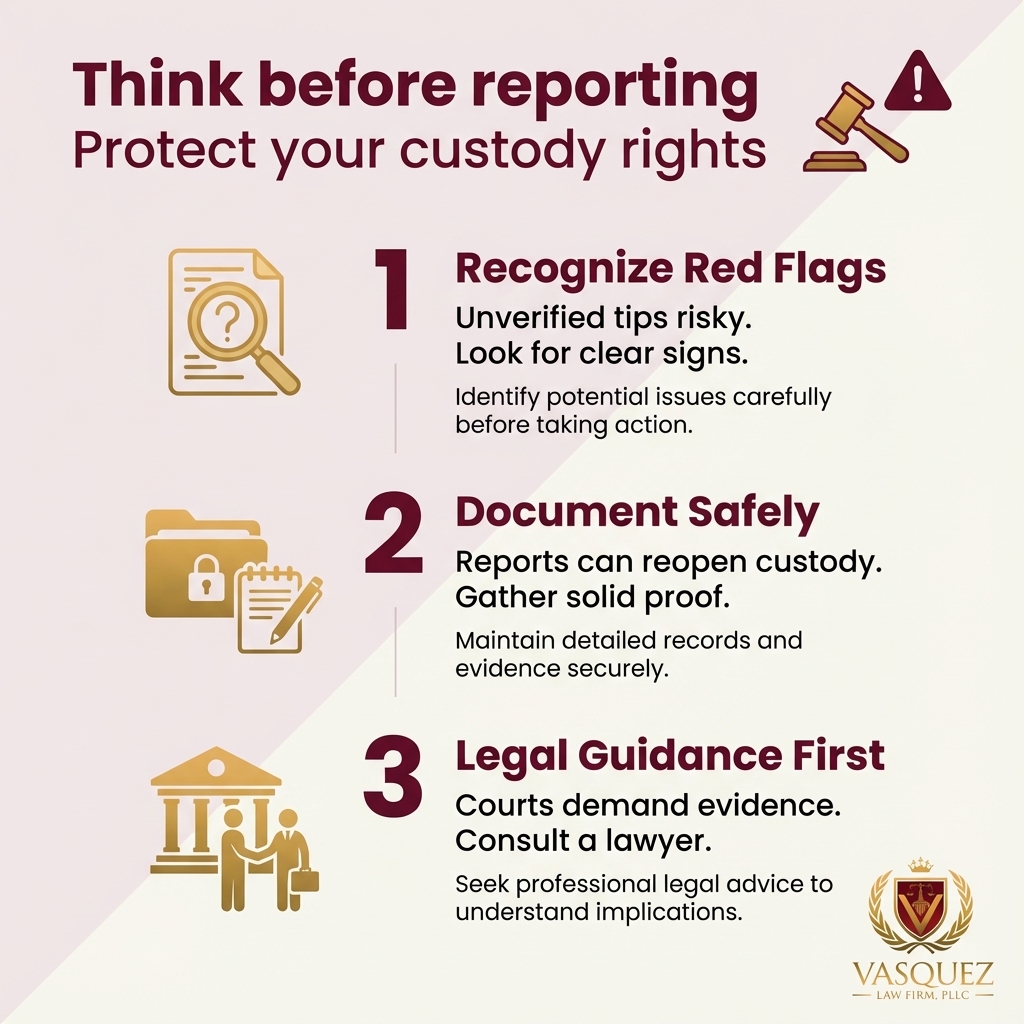
If this situation applies to you, take these steps NOW:
- Step 1: Protect the child immediately. Arrange safe supervision, avoid exchanging the child in private, and follow any existing custody order unless safety requires emergency action.
- Step 2: Preserve evidence. Save texts, emails, app messages, screenshots, call logs, and any prior DSS/police references. Write a timeline with dates, who said what, and who witnessed it.
- Step 3: Stop “investigating” on your own. Do not hack accounts, impersonate anyone online, or access someone else’s devices. It can create criminal exposure and harm your credibility.
- Step 4: Prepare for emergency court. Gather your child’s school/medical contact info, current custody orders, and any prior protective order paperwork so you can respond quickly if a motion is filed.
If you’re the parent raising the concern
Focus on safety and documentation. Avoid telling the child to “get you proof” or repeatedly questioning them. Courts can view that as coaching. If DSS or law enforcement is involved, keep communications factual and consistent.
If you’re the parent being accused
Take it seriously and keep calm. Don’t try to “explain” through long texts or social media posts. Do not delete accounts or wipe devices—those actions can look like destruction of evidence. In a custody case, your behavior in the first 48 hours often becomes a key exhibit.
Make the household safe right now
Regardless of who is accused, consider short-term safety steps that judges often expect to see:
- No unsupervised contact until the court can review the facts
- Separate sleeping arrangements if parents are still in the home
- Restricted device access for children; parent-controlled passwords
- Neutral public exchange locations for visitation transfers
Warning Signs & Red Flags to Watch For
These are signs your case may be in jeopardy:
- The other parent files an emergency custody motion and you are served with little notice.
- DSS or law enforcement asks to interview the child (or you) and you are unsure of your rights.
- Your co-parent demands you “agree” to permanent custody changes immediately or threatens to “go public.”
Seeing these signs? Vasquez Law Firm, PLLC has handled high-conflict family cases in North Carolina. Attorney Vasquez knows the court process and the evidence judges look for. Get a free case evaluation.
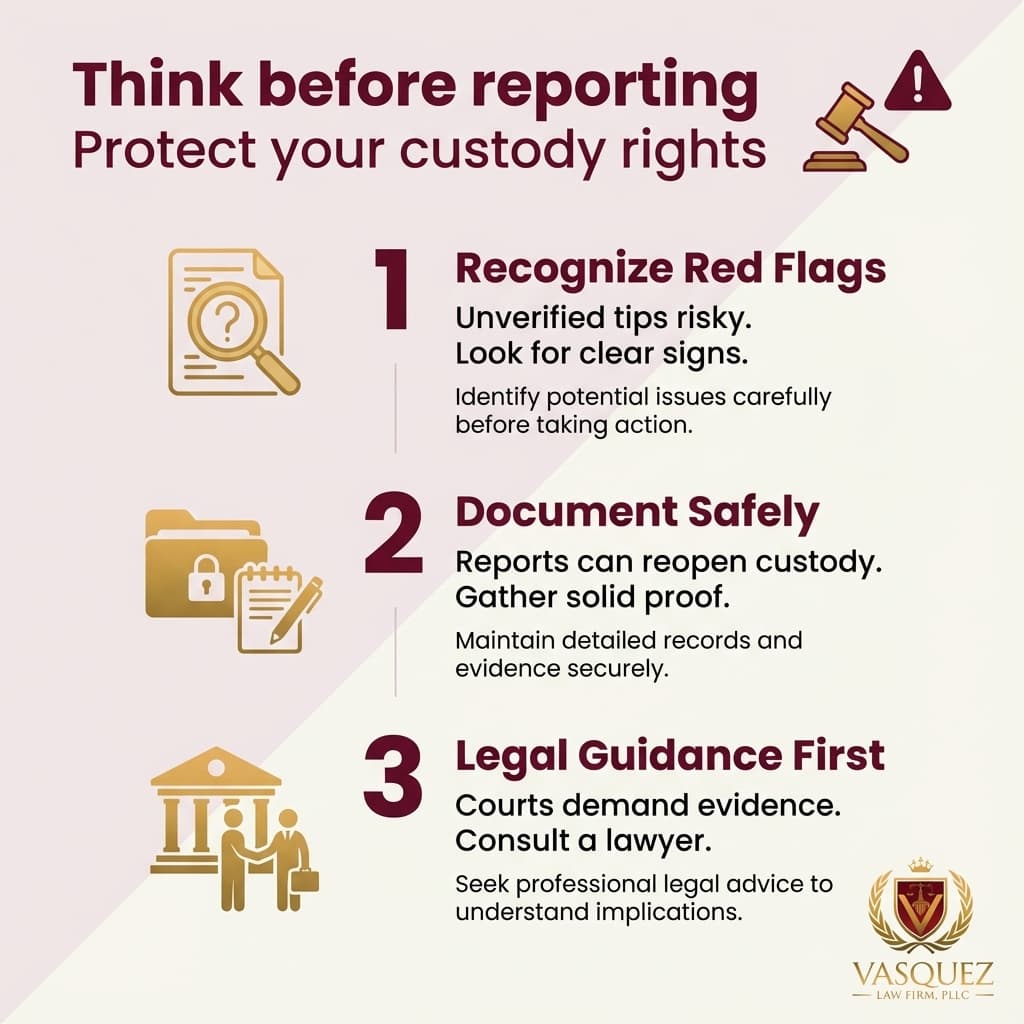
Your Rights: What You CAN and CANNOT Do
YOU HAVE THE RIGHT TO:
- Ask the court for emergency custody or restrictions when you believe a child is at risk (through a motion in the existing case or by filing a custody action).
- Request supervised visitation if safety is a concern while facts are investigated.
- Set reasonable safety boundaries (like public exchanges and third-party supervision) while you seek court guidance.
YOU CANNOT:
- Ignore a court order simply because you are scared or angry. If an order feels unsafe, seek emergency relief rather than “self-help.”
- Destroy or hide digital evidence (deleting messages, wiping devices, deleting cloud accounts). That can backfire in both family and criminal proceedings.
Vasquez Law Firm, PLLC helps North Carolina clients understand and protect their rights every day.
Digital evidence is different (and judges know it)
In cases involving alleged child sexual abuse material, evidence often includes device histories, cloud accounts, messaging apps, and IP/device identifiers. Family court may not litigate the criminal charge itself, but it can set strict custody conditions based on risk indicators.
Emergency custody is a high-stakes, fast-moving process
Emergency orders can be issued quickly and then revisited at a follow-up hearing. The judge often wants to see:
- Specific facts (dates, statements, screenshots) rather than conclusions
- Clear explanation of why waiting for a normal hearing creates danger
- Practical safety plan (supervision, exchanges, communication boundaries)
Protective orders may intersect with custody
In some situations, families also explore protective orders (including domestic violence protective orders under Chapter 50B) if there are threats, stalking, or harassment tied to the allegations. Custody terms may be addressed inside or alongside those proceedings.
Documents You'll Need (Save This Checklist)
Gather these documents NOW (before they disappear):
- Any existing custody order, separation agreement, or parenting plan
- Police report number, officer contact card, or case reference details (if provided)
- Screenshots/printouts of messages, emails, app chats, and call logs (with dates visible)
- School and daycare records (attendance, behavior notes, authorized pickup list)
- Medical/therapy records and provider contact information (if relevant and lawful to share)
Tip: Keep all documents organized in one folder - it makes the process much easier.
KEY TAKEAWAY:
In a high-risk custody dispute, speed + credibility matters. Courts act fastest when you bring specific facts, organized documents, and a child-focused safety plan—not accusations and chaos.
Legal Background and Context
To understand why an arrest like the Union County case can change a family case, it helps to know how North Carolina law frames custody and child safety.
1) “Best interests of the child” drives custody decisions
Custody in North Carolina is governed by the “best interests” standard. Under N.C. Gen. Stat. § 50-13.2, courts can enter custody orders that promote a child’s welfare. If a judge sees credible safety risks—especially involving sexual exploitation—temporary restrictions can happen quickly.
2) Emergency relief and modification can happen on short timelines
If there is already a custody order, a parent may seek a change based on a substantial change in circumstances and the child’s best interests. Modification authority appears in N.C. Gen. Stat. § 50-13.7. A new criminal investigation, DSS involvement, or safety allegation can be argued as a major change requiring immediate review.
3) Criminal allegations don’t “decide” custody—but they shape risk
Family court is not a criminal trial. But judges can consider conduct that affects the child’s safety and home environment. Allegations involving child sexual abuse material are treated as high-risk because they can suggest:
- Unsafe supervision and exposure risks
- Potential grooming behavior or boundary violations
- Risk to other children in the household
For court logistics, filing information, and county courthouse resources, the North Carolina Judicial Branch (NC Courts) website is a reliable starting point.
4) DSS/CPS may become involved alongside the divorce
When allegations involve child abuse or neglect, DSS may assess safety and may open an investigation. North Carolina’s child welfare framework is found in Chapter 7B. Many parents feel pressured during DSS contact. Staying factual, organized, and consistent is critical—especially when family court hearings are pending.
For general child welfare information and reporting resources, see the North Carolina Department of Health and Human Services (NCDHHS).
Where a divorce lawyer fits when the headline is criminal
When people search “divorce lawyer NC” after reading news like this, they’re usually facing one of these realities:
- A co-parent has been arrested or investigated and custody must change quickly
- They fear false accusations will be used to take away parenting time
- They need a court-enforceable safety plan (supervision, exchanges, restrictions)
What Are My Options in Family Court?
Answer 3 questions to understand your rights
Question 1 / 3
What family legal issue are you facing?
Keep Reading

A family lawyer’s job is to stabilize the custody case, present credible facts, and protect the child-focused record the judge will rely on long-term.
How Vasquez Law Firm, PLLC Helps North Carolina Clients Win These Cases
Cases like this require calm, organized action. Vasquez Law Firm, PLLC helps families manage urgent custody issues that erupt when serious allegations surface. Our team is led by Attorney Vasquez (JD), with 15 years of experience and bar admissions in the North Carolina State Bar and the Florida Bar. Se Habla Español.
What we actually do (so nothing gets missed)
Here’s exactly how a divorce lawyer NC clients rely on can build control in a crisis:
- Step 1: We identify the fastest path to court relief (emergency custody, temporary orders, or modification) based on your current case posture.
- Step 2: We help organize evidence into a judge-friendly timeline (messages, screenshots, witnesses, school notes), focusing on admissible and credible facts.
- Step 3: We propose practical, child-centered safety terms (supervised visitation, exchange locations, device boundaries) that courts commonly adopt.
- Step 4: We prepare you for hearings and communications so you don’t accidentally damage your credibility during the most sensitive phase of the case.
Real example (how strategy changes outcomes)
Real example: “A parent came to us after discovering disturbing online communications connected to the other parent during a separation. The client was terrified of being accused of ‘withholding’ the child. We moved quickly for temporary custody terms and structured supervised visitation while the investigation played out, with neutral exchange rules and clear communication limits. The court adopted safety-focused conditions that protected the child and reduced conflict.” — Attorney Vasquez
Why this approach matters in North Carolina courts
Family court judges in North Carolina see many emergency filings. The cases that get traction are the ones that are:
- Specific: who/what/when/where (not rumor)
- Child-focused: safety plan first, blame second
- Organized: clean exhibits, clear timeline, consistent statements
If you’re navigating this kind of crisis, working with a divorce lawyer NC families trust can help you present the right facts the right way—without unnecessary escalation.

Frequently Asked Questions (Specific to This Situation)
1) If my co-parent is arrested on child sex abuse material charges in Union County, can I get emergency custody immediately?
Possibly. If you can show facts suggesting the child faces a real safety risk, you may be able to request emergency custody or temporary restrictions quickly. The court will look for specific details (arrest information, pending charges, prior concerning conduct, and a clear safety plan). If there is already a custody order, you may be seeking temporary emergency relief and/or modification based on changed circumstances.
2) DSS wants to interview my child after a tip-based investigation—what should I do during an active divorce?
Keep the focus on the child’s well-being and avoid coaching. Provide DSS with basic, accurate information and ask about the process and next steps. In parallel, you should prepare for how DSS involvement may be raised in family court (for example, a request for supervised visitation). Also, keep a written log of contacts, dates, and what was discussed, because family court often moves on documentation.
3) What if I believe my spouse is using a “tip” to make a false allegation to win custody?
Family courts can sanction bad-faith behavior, but the priority is still child safety. The best response is not retaliation—it’s documentation and a credible record. Preserve communications, identify inconsistencies, and present verifiable facts. Avoid deleting digital data or confronting witnesses. If an emergency hearing is set, the court may implement temporary safety measures first and sort out credibility with more evidence later.
4) Are screenshots and texts enough for a judge to restrict visitation in North Carolina?
They can be enough to support temporary restrictions, depending on what they show and whether they can be authenticated. Judges often consider the context: dates, sender identity, and whether the information aligns with other evidence (police/DSS involvement, school concerns, or admissions). Save original messages when possible and keep metadata (time/date) visible.
5) If there’s a criminal no-contact order, does it automatically change our custody schedule?
Not automatically, but it often makes the current schedule impossible to follow. A no-contact condition may restrict communication between parents and, in some cases, contact with children depending on the case and terms. Usually, a family court order must be updated to reflect safe exchanges, third-party communication tools, or supervised visitation. Acting quickly helps prevent accusations that you “violated” the custody order.
6) Should I warn the other parent’s employer/school or post about the arrest online during the divorce?
Generally, no. Public posts can inflame the case, risk defamation claims, and harm your credibility in court. Judges expect parents to protect children without turning the situation into a public campaign. If a school or caregiver needs safety-related information (for example, pickup restrictions), share only what is necessary and document what you provided and why.
7) What does supervised visitation usually look like after allegations like this?
Supervision can be done by an agreed adult, a professional supervisor, or a supervised visitation center depending on the risk level and local options. Orders often address: who supervises, where visits occur, how long they last, device rules, and whether overnights are prohibited. The court’s goal is to reduce risk while preserving appropriate parent-child contact when safe.
Don't Navigate This Alone
If you're dealing with emergency custody issues tied to child exploitation allegations or a related investigation, Vasquez Law Firm, PLLC can help. With 15+ years serving North Carolina, we know what works.
Free consultation. Bilingual team. No fees unless we win.
Call Now: 1-844-967-3536
Se Habla Español - Hablamos Su Idioma

William Vasquez
Founder & CEO, Vasquez Law Firm, PLLC
William Vasquez is the founder and CEO of Vasquez Law Firm, PLLC, a results-driven firm specializing in immigration, criminal defense, family law, personal injury, and workers' compensation. A U.S. Air Force veteran and recipient of the Joint Service Achievement Medal, William is dedicated to fiercely fighting for his clients' rights.