Lo que los Inmigrantes Deben Saber Sobre el Uso de Fuerza del DHS en 2026
Understand DHS use of force policies and your rights as an immigrant in 2026. Get critical insights and contact Vasquez Law Firm for a free consultation today.
Publicado el 16 de febrero de 2026
Hable con un abogado de inmigración
Llamada gratis. Un plan claro para su caso.
Gratis y confidencial · Se habla español · 24/7
¿Tiene preguntas? Hable con un abogado - consulta gratuita.
Llame 1-844-967-3536¿Le preocupa cómo le afectan las últimas noticias de inmigración?
Agende una evaluación confidencial con un abogado de inmigración - sepa exactamente dónde está parado.
Lo que los Inmigrantes Deben Saber Sobre el Uso de Fuerza del DHS en 2026
Understanding the Department of Homeland Security's (DHS) use of force policies is critical for immigrants and their families in 2026. Whether you are a Dreamer, a visa holder, or simply residing in the U.S., knowing your rights and the legal framework governing how federal agents interact with the public is essential. This guide provides a comprehensive overview of DHS use of force guidelines, including those for ICE and CBP, helping you navigate complex situations with informed confidence. At Vasquez Law Firm, we believe in empowering our community with knowledge, ensuring you know what to expect and how to protect yourself.
Need help with your case? Our experienced attorneys are ready to fight for you. Se Habla Español.
Or call us now: 1-844-967-3536
Quick Answer
DHS use of force policies govern how federal agents, including ICE and CBP, employ physical force in their duties. These policies emphasize de-escalation, proportionality, and the protection of life, generally permitting force only when necessary and reasonable. Individuals have rights, including the right to remain silent and to counsel, which are crucial during any encounter.
- Force must be objectively reasonable given the circumstances.
- De-escalation is a primary directive before using force.
- Agents are accountable for their actions and adherence to policy.
- Individuals can file complaints regarding excessive force.
- Knowing your rights, such as remaining silent, is vital during encounters.
- The 2026 policies reflect ongoing efforts to ensure transparency and accountability.
Understanding DHS Use of Force Policies
The Department of Homeland Security (DHS) oversees a vast array of law enforcement agencies, including U.S. Immigration and Customs Enforcement (ICE) and U.S. Customs and Border Protection (CBP). Each agency operates under specific guidelines regarding the use of force, which are regularly updated to reflect best practices and legal standards. As of 2026, these policies emphasize a commitment to safeguarding life, promoting de-escalation, and ensuring accountability.
The core principle is that any force used must be objectively reasonable and necessary to achieve a legitimate law enforcement objective. This means agents must assess the situation, consider alternatives, and use only the minimum amount of force required. Understanding these policies is crucial for anyone interacting with DHS components, especially for immigrants who may face enforcement actions.
For instance, the DHS Use of Force Handbook outlines a continuum of force, from verbal commands to the use of less-lethal weapons and, in extreme cases, deadly force. This framework guides agents in their decision-making process, aiming to resolve situations peacefully whenever possible. Knowing these parameters can help individuals understand their rights and what constitutes an appropriate or excessive response from an agent.
What Are the Three Types of Use of Force?
Generally, law enforcement agencies categorize the use of force into three broad types, though specific terminology may vary slightly across DHS components. These include:
- Verbal Commands and Presence: This is the lowest level of force, where an agent's mere presence or clear verbal instructions are sufficient to gain compliance. It relies on authority and communication to control a situation without physical contact.
- Less-Lethal Force: This category involves physical tactics or tools designed to incapacitate or control an individual without causing death or serious bodily harm. Examples include physically restraining someone, using pepper spray, tasers, or batons. This level of force is typically employed when verbal commands fail and there is active resistance or a threat.
- Deadly Force: This is the highest level of force, used only when an agent reasonably believes there is an imminent threat of death or serious bodily injury to themselves or others. Deadly force is a measure of last resort, and its application is subject to strict legal and policy constraints, such as those outlined in Tennessee v. Garner, 471 U.S. 1 (1985).
These categories are part of a continuum, meaning agents are expected to escalate or de-escalate their response based on the evolving threat level and resistance encountered. The policies are designed to ensure that force is proportional to the threat and necessary for the situation.
DHS, ICE, and CBP Use of Force Policies
While DHS sets overarching use of force principles, specific components like ICE and CBP have their own detailed policies, often outlined in their respective handbooks. These policies are critical for agents operating in diverse environments, from border crossings to interior enforcement actions in places like Orlando, Florida, or across North Carolina.
ICE's use of force policy, for example, is detailed in internal directives that guide its Enforcement and Removal Operations (ERO) and Homeland Security Investigations (HSI) agents. These directives specify when and how agents can employ force during arrests, detentions, and other enforcement activities. The policies emphasize de-escalation techniques and the importance of documenting every use of force incident.
Similarly, CBP's use of force policies apply to Border Patrol agents and Customs Officers. Given their role at the border, these policies often address situations involving vehicle pursuits, resisting individuals, and individuals attempting to cross unlawfully. Both agencies require comprehensive training on these policies, with regular refreshers to ensure compliance with the latest standards as of 2026.
DHS Use of Deadly Force Policy
The DHS use of deadly force policy is the most stringent of all force guidelines. It permits the use of deadly force only when an officer has a reasonable belief that the subject poses an imminent threat of death or serious physical injury to the officer or to another person. This standard is rooted in the Fourth Amendment of the U.S. Constitution, which prohibits unreasonable searches and seizures, and has been refined by Supreme Court precedent.
Agents are trained to exhaust all other reasonable means before resorting to deadly force. This includes verbal warnings, if feasible, and attempts at less-lethal options. Post-incident reviews are mandatory and rigorous, ensuring accountability and adherence to policy. Any deviation from these strict guidelines can lead to severe consequences for the agent involved, including criminal charges or disciplinary action. The Department of Justice (DOJ) use of force policy also aligns with these principles, providing a consistent federal standard.
Immigrant Rights During Encounters with DHS
Knowing your rights is paramount when interacting with any law enforcement agency, especially DHS components like ICE or CBP. Immigrants, regardless of their status, possess certain constitutional rights that must be respected during encounters. These rights are fundamental to protecting individuals from potential abuses of power and ensuring due process.
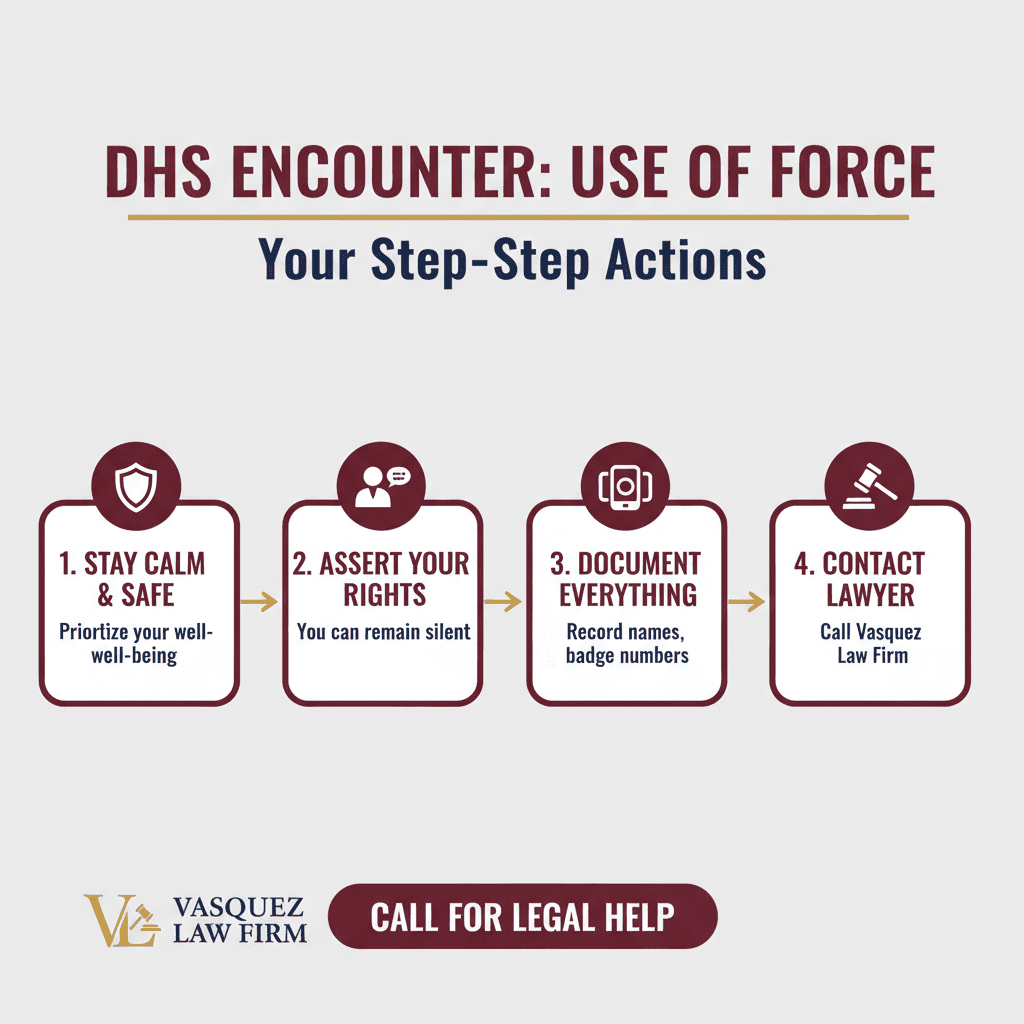
One of the most important rights is the right to remain silent. You are not obligated to answer questions about your immigration status, nationality, or how you entered the country. You can simply state, "I wish to remain silent and I want to speak with an attorney." This applies whether you are a U.S. citizen, a lawful permanent resident, or an undocumented immigrant. Exercising this right can prevent you from inadvertently providing information that could be used against you.
You also have the right to an attorney. If you are detained, you should immediately request to speak with a lawyer. Do not sign any documents or make any statements without first consulting with legal counsel. Immigration law is complex, and an attorney can help protect your interests and guide you through the process. Vasquez Law Firm specializes in immigration law and can provide the experienced representation you need.
What Laws Does DHS Enforce?
The Department of Homeland Security (DHS) enforces a broad range of federal laws related to border security, immigration, customs, and national security. Its primary mission is to secure the nation from the many threats we face, encompassing both domestic and international concerns. Specifically concerning immigration, DHS enforces titles of the U.S. Code related to immigration and nationality.
Key laws enforced by DHS components include the Immigration and Nationality Act (INA), which governs virtually all aspects of immigration law, from visas to deportation proceedings. Additionally, DHS agencies enforce laws related to drug trafficking, human smuggling, trade violations, and cybercrime. This wide scope means that interactions with DHS can arise in various contexts, from routine border inspections to complex criminal investigations, all under the umbrella of federal authority. For more details on these enforcement powers, refer to 8 U.S.C. § 1103 - Powers and duties of the Secretary of Homeland Security.
Filing a Complaint Against DHS Agents
If you believe a DHS agent, including ICE or CBP personnel, has engaged in misconduct, used excessive force, or violated your rights, you have the right to file a complaint. This is a crucial mechanism for accountability and can help prevent future abuses. The process typically involves submitting a formal complaint to the appropriate oversight body within DHS.
Common types of misconduct reported include excessive use of force, verbal abuse, unlawful detention, or discrimination. When filing a complaint, it is important to include as much detail as possible: the date, time, and location of the incident; the names or badge numbers of the agents involved; a description of what happened; and any witnesses or evidence, such as photos or videos. Documentation is key to a successful complaint.
There are several avenues for filing a complaint. You can submit a complaint directly to the DHS Office of Inspector General (OIG), the Office for Civil Rights and Civil Liberties (CRCL), or the specific agency's internal affairs division (e.g., ICE Office of Professional Responsibility, CBP Office of Professional Responsibility). Consulting an attorney before filing a complaint can ensure your rights are protected and the complaint is submitted effectively. Vasquez Law Firm can assist with this process, ensuring your voice is heard.
Documentation Checklist for Complaints
To ensure your complaint is as strong as possible, gather the following:
- Date, Time, and Location: Be precise about when and where the incident occurred.
- Agent Identification: Names, badge numbers, vehicle numbers, or physical descriptions of agents.
- Detailed Narrative: A clear, chronological account of the events.
- Witness Information: Names and contact details of anyone who saw the incident.
- Evidence: Photos, videos, audio recordings, or medical records if injuries occurred.
- Specific Allegations: Clearly state what policies or rights you believe were violated.
- Contact Information: Your name and contact details, though anonymous complaints are sometimes possible.
When to Call a Lawyer Now
Navigating encounters with DHS or understanding the complexities of their use of force policies can be overwhelming. Knowing when to seek legal counsel is crucial for protecting your rights and ensuring the best possible outcome. Do not hesitate to contact an experienced immigration attorney if any of the following situations apply to you or a loved one:
- You or someone you know has been detained by ICE or CBP.
- You believe excessive force was used during an encounter with a DHS agent.
- You have been asked to sign documents by immigration officials.
- You are facing deportation or removal proceedings.
- You are unsure about your rights during an immigration interview or encounter.
- You have received a Notice to Appear (NTA) in immigration court.
- You are a victim of immigration fraud or abuse.
- You need assistance filing a complaint against a federal agent.
- You are seeking to adjust your immigration status or apply for a visa.
- You want to understand the implications of the latest immigration policies in 2026.
In Orlando, North Carolina, or anywhere across the U.S., Vasquez Law Firm is ready to provide the aggressive and compassionate representation you deserve. We understand the urgency and sensitivity of immigration matters.
Don't face your legal challenges alone. Our team is here to help you every step of the way.
Call today: 1-844-967-3536 | Se Habla Español
About Vasquez Law Firm
At Vasquez Law Firm, we combine compassion with aggressive representation. Our motto "Yo Peleo" (I Fight) reflects our commitment to standing up for your rights. We understand the unique challenges faced by the immigrant community and are dedicated to providing clear, effective legal guidance.
- Bilingual Support: Se Habla Español - our team is fully bilingual and ready to assist you in your preferred language.
- Service Areas: We provide comprehensive immigration services across North Carolina, Florida, and nationwide, alongside personal injury, workers' compensation, criminal defense, family law, and traffic defense in North Carolina.
- Experience: With over 15 years of dedicated legal experience, Attorney Vasquez has a proven track record of fighting for justice and achieving favorable outcomes for his clients.
- Results: Our firm has successfully handled thousands of cases, helping individuals and families navigate complex legal landscapes with confidence and peace of mind.
Attorney Trust and Experience
Attorney Vasquez holds a Juris Doctor degree and is admitted to practice in both the North Carolina State Bar and Florida Bar. With over 15 years of dedicated legal experience, he has built a reputation for providing personalized attention and achieving favorable outcomes for his clients. His deep understanding of federal immigration law and commitment to the community make Vasquez Law Firm a trusted advocate for your legal needs.
Frequently Asked Questions
What does 'objectively reasonable' mean for DHS use of force?
"Objectively reasonable" means that the force used by a DHS agent must be judged from the perspective of a reasonable officer on the scene, rather than with the 20/20 vision of hindsight. It considers the severity of the crime, whether the suspect poses an immediate threat to the safety of the officers or others, and whether they are actively resisting arrest or attempting to evade arrest by flight. This standard is crucial in evaluating an agent's actions.
Can DHS agents use force to enter my home without a warrant?
Generally, DHS agents, like other law enforcement, need a warrant to enter a private residence unless there are exigent circumstances (e.g., hot pursuit of a fleeing suspect, immediate danger to life, or destruction of evidence). If agents attempt to enter without a warrant and no clear exigency exists, you have the right to refuse entry. Always ask to see a warrant and speak with an attorney if possible.
What is the DHS Use of Force Handbook?
The DHS Use of Force Handbook is an internal document that outlines the policies, procedures, and training requirements for all DHS components regarding the application of force. It details the continuum of force, reporting requirements, and accountability measures. While internal, its principles guide agent conduct and are often consistent with broader federal law enforcement standards. It's updated periodically to reflect current legal and operational best practices.
What should I do if I witness excessive DHS use of force?
If you witness excessive DHS use of force, prioritize your safety first. If safe to do so, document the incident with your phone (video, photos), noting details like time, location, and agent identification. Do not interfere with agents. Afterward, report the incident to the DHS Office of Inspector General (OIG) or the ACLU. An attorney can also help you file a formal complaint effectively.
Does the DHS use of force policy 2026 apply to all immigrants?
Yes, the DHS use of force policy for 2026 applies to all individuals, including U.S. citizens, lawful permanent residents, and undocumented immigrants, during encounters with DHS law enforcement components. These policies are designed to protect the rights and safety of everyone, ensuring that force is used only when necessary and in a lawful, proportional manner. Your immigration status does not diminish these protections.
Can I sue DHS for excessive force?
Yes, under certain circumstances, you may be able to sue DHS or individual agents for excessive force, usually under the Federal Tort Claims Act (FTCA) or a Bivens action for constitutional violations. These cases are complex and require expert legal guidance. You must demonstrate that the force used was objectively unreasonable and caused injury. Consulting an attorney immediately after such an incident is crucial to preserve your legal options.
What is the difference between DHS and DOJ use of force policies?
While both DHS and DOJ (Department of Justice) components (like the FBI or DEA) follow similar constitutional standards for use of force, their specific internal policies and handbooks may differ in detail and application. DOJ policies often serve as a benchmark for federal law enforcement. However, DHS agencies tailor their policies to their unique missions, such as immigration enforcement, while still adhering to overarching federal legal principles like those from Graham v. Connor, 490 U.S. 386 (1989).
Are there specific policies for DHS use of force in vehicle stops?
Yes, DHS agencies, including CBP and ICE, have specific policies governing the use of force during vehicle stops and pursuits. These policies address when and how agents can initiate a stop, use tactical vehicle intervention (TVI), or employ other force measures. The primary goal is to ensure public safety and minimize risks to all parties involved, emphasizing de-escalation and proportionality even in dynamic vehicle situations.
How can an attorney help if I've had an encounter with DHS?
An attorney can provide crucial assistance by explaining your rights, assessing the legality of an encounter or detention, filing complaints on your behalf, and representing you in immigration court or other proceedings. They can help gather evidence, navigate complex legal procedures, and advocate for your best interests, especially if you believe DHS use of force was improper. Vasquez Law Firm offers comprehensive support for these situations.
What is Title 1 DHS use of force?
The reference to "Title 1 DHS use of force" typically refers to the first section or part of an agency's internal use of force policy or handbook, which often outlines general principles, definitions, and the legal framework. It doesn't refer to a specific U.S. Code Title. These introductory sections establish the foundation for all subsequent detailed rules and procedures regarding agent conduct and force application.
Sources and References
- U.S. Citizenship and Immigration Services (USCIS)
- Executive Office for Immigration Review (EOIR)
- Tennessee v. Garner, 471 U.S. 1 (1985)
- 8 U.S.C. § 1103 - Powers and duties of the Secretary of Homeland Security
- Graham v. Connor, 490 U.S. 386 (1989)
¿Necesita ayuda con inmigración? Nuestros abogados de inmigración pueden revisar su caso.
Ready to take the next step? Contact Vasquez Law Firm today for a free, confidential consultation. We're committed to fighting for your rights and achieving the best possible outcome for your case.
Comience Su Consulta Gratis Now
Call us: 1-844-967-3536
Se Habla Español - Estamos aquí para ayudarle.

Hable Hoy con un Abogado de Inmigración
Un plan claro para su caso en una llamada, sin compromiso.

William Vásquez
Fundador y CEO, Vasquez Law Firm, PLLC
William Vasquez es el fundador y CEO de Vasquez Law Firm, PLLC, una firma orientada a resultados que se especializa en inmigración, defensa criminal, derecho de familia, lesiones personales y compensación laboral. Veterano de la Fuerza Aérea de los Estados Unidos y receptor de la Medalla por Logro Conjunto en el Servicio, William está dedicado a luchar ferozmente por los derechos de sus clientes.